E-Invoicing in Estonia: What’s Required and Who Needs It in 2026?
Estonia’s leadership in digital business services is well-known, and e-invoicing is now a key requirement for companies operating within its borders.
For e-residents and foreign entrepreneurs, staying on top of the latest e-invoicing rules is essential to remain compliant and avoid costly mistakes.
This guide explains what you need to know about E-Invoicing in Estonia for 2026 – who it applies to, what’s required, and how to get started with the right tools.
The New E-Invoicing Law in Estonia: Timeline and Overview
Digital invoicing is starting to become the standard in Estonia, but recent changes make it even more crucial for international founders and e-residents.
Estonia first required e-invoicing for all government suppliers in 2019. As of July 2025, the “buyer’s choice” rule – driven by updates to the Accounting Act and aligned with EU digitalization goals – applies to all accounting entities. From 2026, any business or public-sector organization in Estonia can require their partners to send e-invoices in the proper machine-readable format.
The push for a universal e-invoice regime aims to improve financial processes, automate bookkeeping, and strengthen data security while reducing paperwork and errors. All companies operating in Estonia, including those run by e-residents and foreign entrepreneurs, should be ready.
Who Must Use E-Invoicing in 2026?
If you invoice an Estonian company or government body, you must be able to provide an e-invoice in the following cases:
- B2B (business-to-business): If the company you’re invoicing is registered as an e-invoice receiver, and asks for one, you must comply.
- B2G (business-to-government): E-invoicing remains largely mandatory for invoices sent to the public sector. While some agencies may accept PDFs, the default and preferred method remains machine-readable e-invoices.
Special Cases and Payment Types
- Foreign entrepreneurs and e-residents: If you operate an Estonian OÜ or similar entity, you are an accounting entity under local law, so the rules apply even if you manage your company remotely.
- Routine payments (partial payments, intra-bank, standing orders): E-invoicing works for split payments and payments handled directly between banks, making reconciliation and compliance simpler.
Accepted E-Invoice Standards and Formats
E-invoice is not a PDF or scanned document – it’s a structured, machine-readable file (typically XML) that can be read and processed automatically by accounting software.
- All entitled recipients can demand invoices in the European standard EN 16931 format.
- Required data includes payment amount, payment date, your bank account, and all fields necessary under the Estonian Accounting Act.
- The standard applies to both domestic payment and cross-border EU transactions.
Flexibility Through Contractual Agreement
By mutual agreement, you and your business partner can use alternative formats. Clarifying invoicing expectations in contracts or agreements from the start helps prevent delays and disputes.
Choosing E-Invoicing Software and Service Providers
To meet the requirements, you’ll need an invoicing software or an e-invoice operator. Look for software that offer full support for machine-readable formats and current European standards (EN 16931)
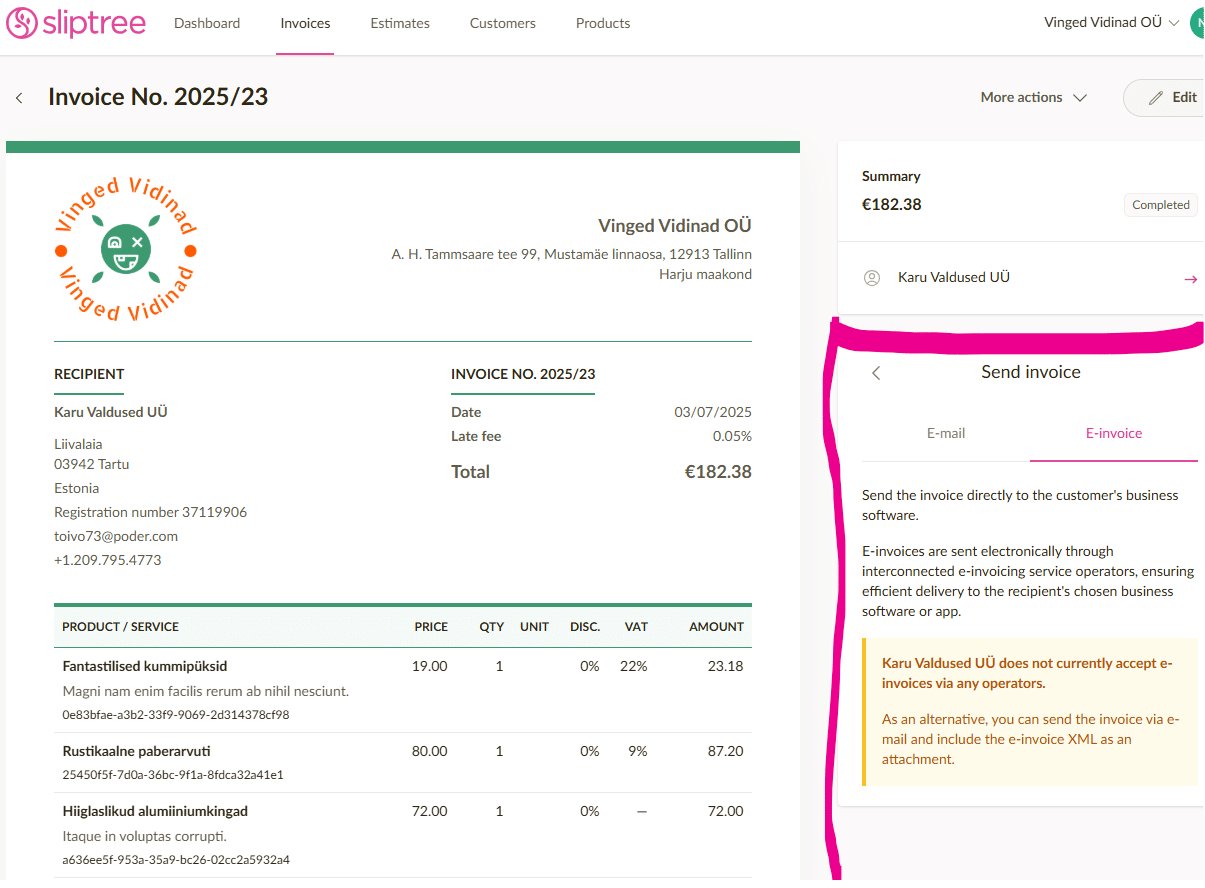
Special invoicing platforms like Sliptree help entrepreneurs (including e-residents and foreign founders) generate and send compliant e-invoices with minimal technical effort.
Practical Steps to Creating Your First E-Invoice
- Select a compliant software or digital invoicing service provider.
- Choose a tool that integrates with your accounting system and supports Estonian/european formats.
- Register your company as an e-invoice recipient or sender in the Commercial Register.
- When using Sliptree, this step is done automatically for you.
- Create and send your first e-invoice.
- Create the invoice through your selected platform, and choose to send it as an e-invoice.
- Make sure to include all required details: payment amount, payment date, bank account information, reference to agreements or contracts.
- Monitor all sent and received e-invoices.
- Track payment status, manage corrections, and keep digital archives for tax purposes.
With platforms like Sliptree, e-residents and international entrepreneurs can simplify the creation and dispatch of fully compliant e-invoices, reducing admin and risk of errors.
Challenges, Costs, and Best Practices
Common Pitfalls
- Sending a PDF-invoice by email when an e-invoice is required.
- Using non-compliant formats or missing key details like VAT or bank information.
- Failing to set clear contract terms for invoicing.
- Late or missed payments due to outdated invoice workflows.
How to Minimize Errors and Reduce Costs
- Automate invoice creation and dispatch whenever possible.
- Use your software to track all invoices and payment statuses.
- Keep contracts up to date regarding invoicing preferences and VAT application.
Cross-Border and EU Considerations
If you invoice clients in other EU countries, check whether e-invoicing is required and ensure the correct data is included for VAT/reverse charges, insurance, and payment scenarios involving multiple installments.
With Sliptree, sending e-invoices abroad is just as easy as sending them within Estonia. After creating an account and enabling e-invoicing, you can send invoices to any company in the Peppol network, no matter where they are located.
Conclusion
By staying current on Estonian e-invoicing requirements and using the right digital tools, you can save time, reduce errors, and keep your business running smoothly – wherever you’re based.
For e-residents, foreign founders, and local entrepreneurs, the main task is to adopt the right tools, clarify contract terms, and ensure all partners are on the same page. Taking action now is the best way to stay competitive, compliant, and efficient.
If you prefer a streamlined, Estonia-compliant solution that integrates with your daily business tasks, consider Sliptree or a similar digital invoicing service provider.
Frequently asked questions
Is e-invoicing mandatory for all businesses in Estonia in 2026?
Not quite, although e-invoicing is mandatory for most B2G invoices and for B2B transactions where the buyer is registered as an e-invoice receiver and requests them.
Which e-invoice software or formats do I need for compliance?
You’ll need e-invoicing software that supports machine-readable formats in line with the European standard EN 16931, or as required by the recipient and agreed in your contract.
What if my customer or supplier isn’t ready for e-invoices?
For B2B transactions, you must send a compliant e-invoice if requested by your customer, provided that they’re registered as an e-invoice receiver. If not, you can use other formats, but it’s best to clarify expectations in your contracts.
Can I still send PDF or paper invoices?
PDF or paper invoices may be used if the recipient accepts them. However, public sector entities and many businesses now prefer, or require, e-invoices.
Need help with your next business step?
Book a focused 3-hour consultation with Eesti Consulting for €100.
Book a 3-hour consultation — €100