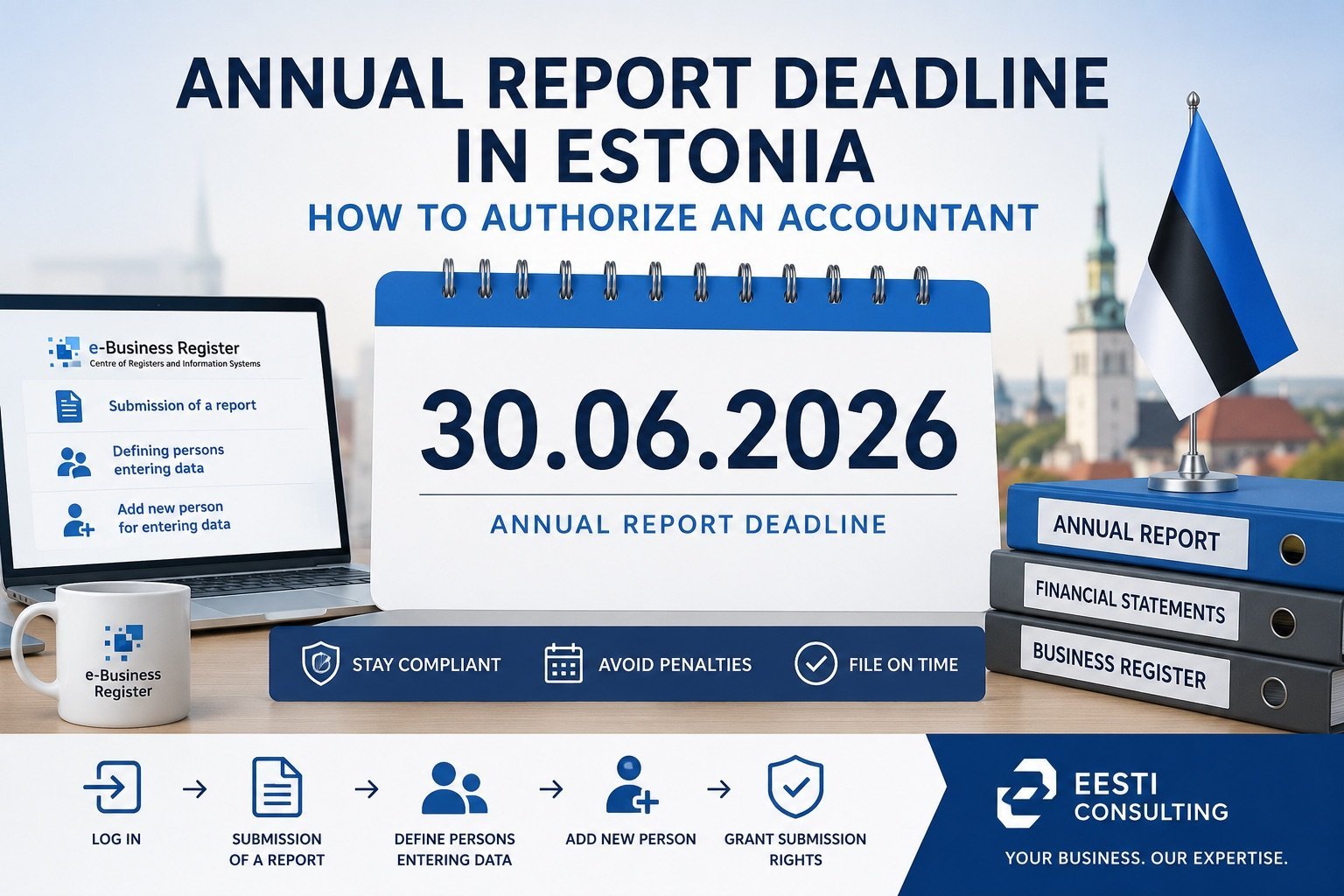
Deadline 30.06.2026

Annual Report Deadline in Estonia: How to Authorize an Accountant to Submit Your Annual Report

Every Estonian company, including businesses owned by e-residents, must submit an annual report to the Estonian Business Register. The deadline is generally six months after the end of the financial year. For companies whose financial year ends on 31 December, the annual report must be filed by 30 June 2026!

Many entrepreneurs prefer to delegate this process to their accountant. Fortunately, the Estonian e-Business Register allows company board members to authorize accountants to prepare and submit annual reports on behalf of the company.

In this guide, we explain how to grant annual report submission rights to your accountant.

Why Authorize an Accountant?

Preparing and filing an annual report requires accuracy and compliance with Estonian accounting and corporate regulations. By authorizing an accountant, you can:

  • Save time on administrative tasks.
  • Ensure financial statements are prepared correctly.
  • Avoid delays in filing.
  • Reduce the risk of penalties for non-compliance.
  • Allow a professional to manage the submission process.

Even when an accountant handles the filing, company board members remain responsible for ensuring the report is accurate and submitted on time.

Step 1: Log in to the e-Business Register

Access the Estonian e-Business Register using your preferred authentication method:

  • e-Residency card
  • ID card
  • Mobile-ID
  • Smart-ID

Once logged in, select the company for which you want to grant access rights.

Caption: Log in to the Estonian e-Business Register and select your company.

Step 2: Open the Annual Report Environment

Navigate to the annual reporting section and select:

“Submission of a Report”

This section contains all tools required for preparing, signing, and submitting annual reports.

Caption: Access the annual report submission environment.

Step 3: Define Persons Entering Data

Within the reporting environment, select:

“Defining Persons Entering Data”

This option allows board members to grant access rights to accountants and other authorized individuals.

Caption: Open the section for managing annual report access rights.

Step 4: Add a New Authorized Person

Click:

“Add New Person for Entering Data”

A new authorization form will appear.

Caption: Add a new person who will assist with preparing or submitting the annual report.

Step 5: Enter the Accountant’s Details

Enter the accountant’s personal identification code and review the authorization settings.

You will see an important option:

“The person entering data is authorised to submit the report”

If this checkbox is selected, the accountant will be able not only to prepare the report but also to submit it to the Business Register after all required signatures have been collected.

If the checkbox remains unchecked, the accountant can prepare the report, but a company representative must complete the final submission.

Caption: Grant submission rights by selecting the authorization checkbox.

Step 6: Save the Authorization

After reviewing the details, click Save.

The accountant will immediately receive the assigned rights and can begin working on the annual report.

Depending on the permissions granted, the accountant may:

  • Enter financial information.
  • Prepare the report.
  • Monitor the signing process.
  • Submit the report to the Business Register.
corporation tax

Alternative Solution: Authorizing an Accounting Firm

Estonia has also expanded authorization options through the state portal eesti.ee and the Pääsuke authorization system.

This allows companies to authorize an accounting firm rather than an individual accountant. The accounting firm can then assign the task to the appropriate employee without requiring a new authorization every time staffing changes.

This solution is particularly useful for companies working with professional accounting service providers.

What Happens If You Miss the Annual Report Deadline?

Failure to submit an annual report may lead to:

  • Warning notices from the Business Register.
  • Financial penalties.
  • Restrictions on company activities.
  • Potential compulsory deletion from the register in severe cases.

Timely filing helps maintain your company’s good standing and demonstrates transparency to banks, partners, investors, and government authorities.

How EESTI Consulting Can Help

At EESTI Consulting, we help Estonian companies and e-residents with:

  • Annual report preparation and filing
  • Accounting and bookkeeping services
  • Tax compliance
  • Payroll administration
  • Business Register filings
  • E-Residency business support

Whether your company has active operations or no business activity during the financial year, our team can prepare and submit your annual report efficiently and in compliance with Estonian regulations.

corporation tax

Need Assistance?

Contact EESTI Consulting today to ensure your annual report is prepared accurately and submitted before the deadline.

Our specialists work with entrepreneurs and e-residents from around the world and can manage the entire annual reporting process on your behalf.

Read more
Access to EU market

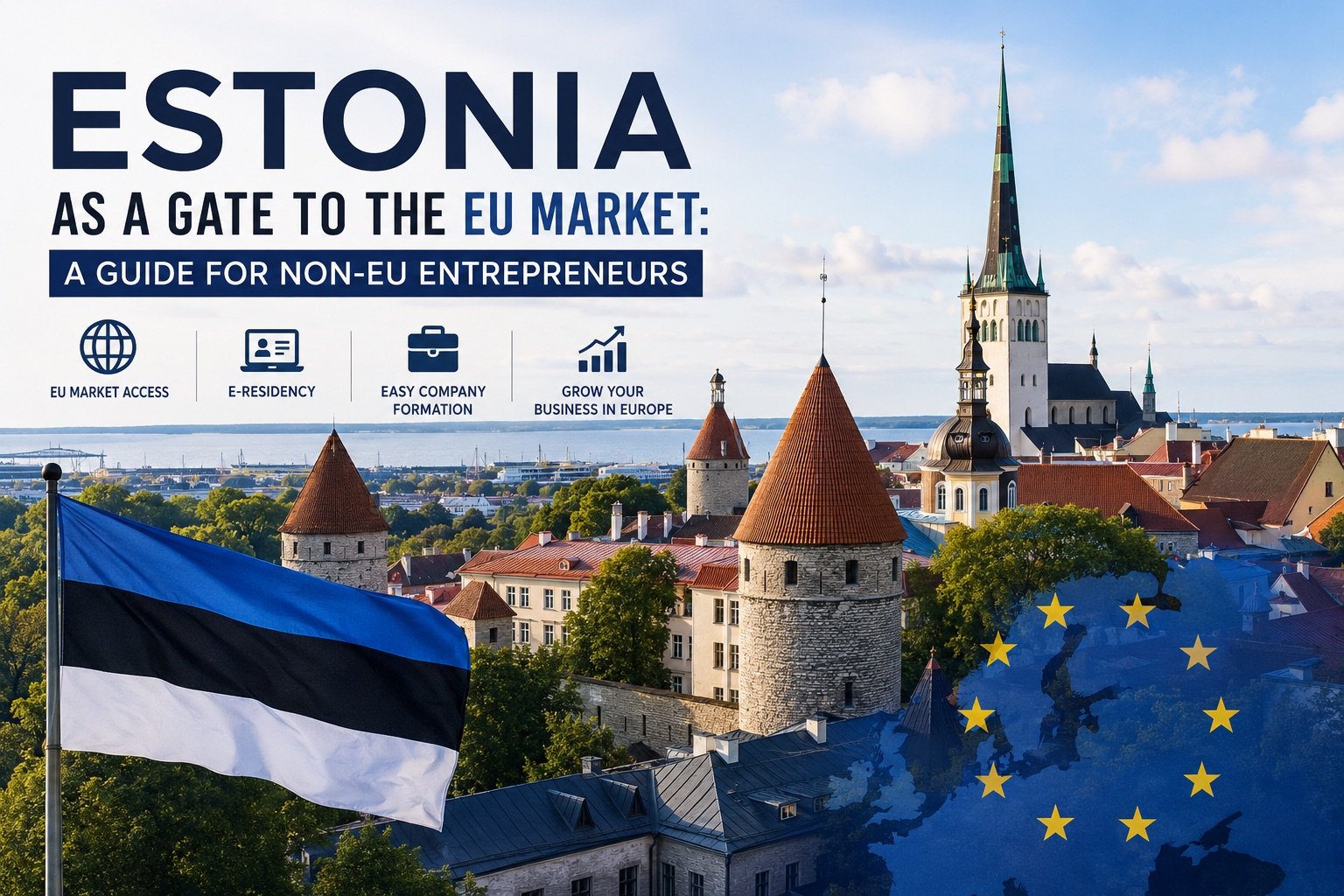
Estonia as a Gateway to the EU Market: The Complete Guide for Non-EU Entrepreneurs

Introduction

For entrepreneurs outside the European Union, expanding into Europe can be challenging. Different legal systems, tax regulations, banking requirements, and administrative procedures often create barriers that slow down international growth.

Fortunately, Estonia has emerged as one of the most attractive destinations for non-EU founders looking to establish a presence in Europe. Thanks to its innovative digital infrastructure, business-friendly regulations, and globally recognized e-Residency program, Estonia offers a simple and efficient way to gain access to the European market.

Whether you run an e-commerce business, a SaaS company, a consulting agency, or an online service business, Estonia can serve as your gateway to the European Union.

In this guide, we’ll explain why Estonia is considered one of the best countries for non-EU entrepreneurs and how it can help you expand your business across Europe.

Why Do You Need Access to the EU Market?

One of the biggest reasons entrepreneurs establish an EU company is to unlock opportunities that are often difficult to access from outside Europe.

Sell on Amazon Europe and Other Marketplaces

For e-commerce businesses, EU market access is a major competitive advantage.

Many international sellers use an EU company to expand on platforms such as:

  • Amazon Europe
  • eBay
  • Etsy
  • Allegro
  • Kaufland Marketplace
  • Bol.com

Having an EU-based company can help simplify operations when selling products across European countries and working with local logistics providers. Read more about Amazon business.

Popular Amazon marketplaces include:

  • Germany
  • France
  • Italy
  • Spain
  • Poland
  • Netherlands
  • Sweden

For many entrepreneurs, Estonia company formation is the first step toward building a successful European e-commerce business.

change a company name

Reach More Than 450 Million Consumers

The European Union is one of the world’s largest economic regions.

By operating through an EU company, businesses can access a market of more than 450 million consumers with strong purchasing power and a growing demand for online services and products.

This creates significant opportunities for:

  • E-commerce brands
  • Software companies
  • Digital agencies
  • Consultants
  • Coaches
  • Educational platforms
  • Subscription-based businesses

Work with European Clients

Many European companies prefer to work with businesses that operate within the EU regulatory framework.

An Estonian company can help:

  • Increase trust and credibility
  • Simplify invoicing
  • Improve business relationships
  • Facilitate cross-border cooperation

This is especially valuable for:

  • IT companies
  • SaaS businesses
  • Marketing agencies
  • Freelancers
  • Software developers
  • B2B service providers

Access European Banking and Payment Solutions

One of the challenges faced by many non-EU entrepreneurs is access to reliable financial services.

An EU company may provide access to:

  • European fintech platforms
  • Business payment solutions
  • Euro-denominated accounts
  • International payment providers

This can improve cash flow management and make it easier to serve European customers.

change a company name

Build an International Brand

Having a European company often enhances your professional image.

Customers, suppliers, and business partners frequently view EU companies as:

  • More trustworthy
  • Better regulated
  • More stable
  • Easier to work with

For startups and growing businesses, this additional credibility can support long-term growth. Read more about trademark registration with SME FUND 2026 donation.

Why Estonia Is the Best Gateway to the EU Market

When entrepreneurs research how to start a company in Europe as a non-EU resident, Estonia is often at the top of the list.

Here’s why.

1. Estonia Offers a Fully Digital Business Environment

Estonia is known as one of the world’s most advanced digital societies.

Business owners can:

  • Register a company online
  • Sign documents digitally
  • Submit annual reports electronically
  • Access government services remotely
  • Manage company administration online

This significantly reduces bureaucracy compared to many other countries.

2. Estonia e-Residency Makes Company Management Easy

The Estonian e-Residency program allows entrepreneurs from almost anywhere in the world to obtain a secure government-issued digital identity.

It is important to note that e-Residency is not:

  • Citizenship
  • Tax residency
  • A residence permit
  • A visa

Instead, it provides access to Estonia’s digital business ecosystem.

With e-Residency, entrepreneurs can:

This makes Estonia particularly attractive for location-independent founders.

3. Business-Friendly Tax System

One of Estonia’s most famous advantages is its corporate taxation model.

Unlike many jurisdictions where profits are taxed immediately, Estonia generally taxes corporate profits when they are distributed.

This means that businesses can often reinvest earnings into growth before taxation on distributed profits applies.

For startups and growing companies, this can be a significant advantage.

4. Low Administrative Burden

Running a company in Estonia is generally straightforward.

The country has:

  • Transparent regulations
  • Efficient public administration
  • Digital reporting systems
  • Modern compliance processes

This helps entrepreneurs focus on growing their business rather than dealing with excessive bureaucracy.

Who Should Consider an Estonian Company?

E-Commerce Entrepreneurs

If you sell products online through Amazon, Shopify, Etsy, or other marketplaces, Estonia can provide an efficient European business structure.

SaaS Companies

Software businesses often operate internationally from day one.

An Estonian company can support:

  • International invoicing
  • European customer acquisition
  • Business scalability

Consultants and Agencies

Marketing agencies, IT consultants, designers, and freelancers frequently choose Estonia because of its simplicity and flexibility.

Startups

Estonia has developed a strong reputation as a startup-friendly country and offers an ecosystem that supports international founders.

How to Start a Company in Estonia

The process is relatively simple compared to many traditional jurisdictions.

Step 1: Apply for e-Residency

Submit an online application and complete the identity verification process.

Step 2: Receive Your e-Residency Kit

After approval, collect your digital identity card from a designated pickup location.

Step 3: Register Your Company

Use the Estonian online business registry to establish your company.

Step 4: Set Up Banking and Payments

Choose a suitable banking or fintech solution that supports your business needs.

Step 5: Organize Accounting and Compliance

Ensure your company complies with Estonian accounting and reporting requirements.

Step 6: Start Selling Across Europe

Begin serving customers throughout the European Union and beyond.

Important Considerations Before Expanding to Europe

While Estonia offers many advantages, entrepreneurs should always consider:

Personal Tax Residency

Your personal tax obligations depend on where you live, not simply where your company is registered.

Local Regulations

Certain industries may require licenses or additional regulatory approvals.

International Compliance

Businesses should always operate with genuine commercial activity and comply with applicable tax and legal requirements.

Professional legal and tax advice is strongly recommended before making international business decisions.

Conclusion

If you are looking for a simple and efficient way to gain access to the EU market, Estonia remains one of the best options available for non-EU entrepreneurs.

Its combination of:

  • Digital company management
  • e-Residency
  • Business-friendly regulations
  • Access to the European Union
  • Support for international entrepreneurs

makes it an ideal gateway for global business expansion.

Whether you want to sell on Amazon Europe, launch a SaaS startup, work with European clients, or build an international brand, Estonia company formation can be a powerful first step toward establishing your presence in Europe.

For many founders around the world, Estonia is not just a place to register a company—it’s a strategic gateway to the entire European market.

Read more
Why you need contact person

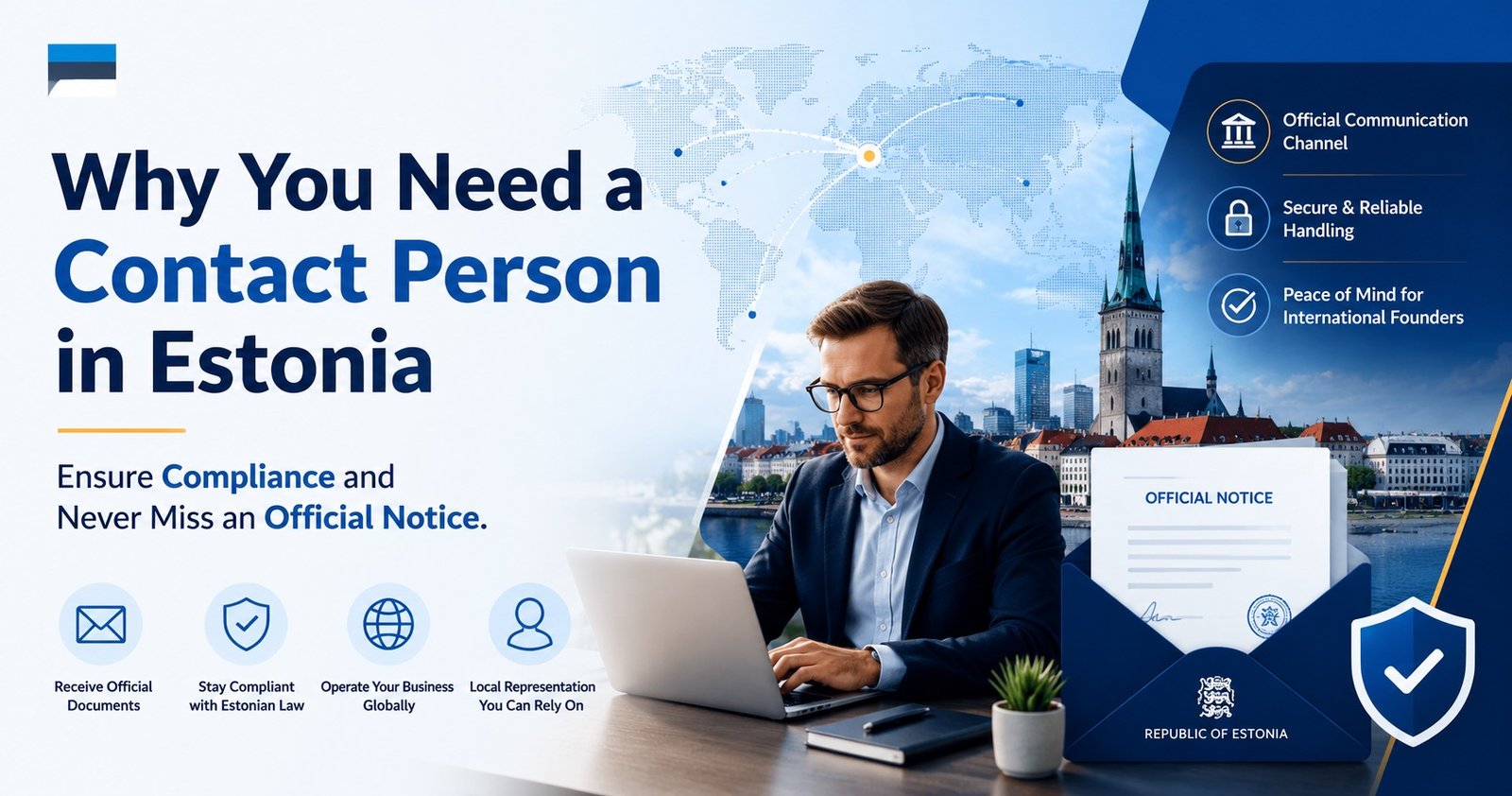
Why Do Non-Residents Need a Contact Person in Estonia?

Estonia’s e-Residency programme has transformed the way entrepreneurs do business internationally. Today, more than 140,000 e-residents from over 180 countries have joined the programme, establishing more than 41,800 Estonian companies. In 2025 alone, e-residents founded a record 5,556 new businesses, highlighting Estonia’s position as one of Europe’s most attractive destinations for digital entrepreneurs and location-independent business owners.

However, operating an Estonian company as a non-resident also comes with certain legal obligations. One of the most important is the requirement to appoint a contact person in Estonia in specific circumstances. While this requirement is often overlooked by foreign entrepreneurs, it plays a crucial role in ensuring effective communication between the company and Estonian authorities.

In this article, we explain when a contact person is required, what responsibilities they have, and why appointing a professional service provider can help your company remain compliant with Estonian corporate regulations.

What Is a Contact Person?

A contact person is an individual or licensed service provider based in Estonia who acts as an official communication channel between a company and Estonian authorities.

The contact person receives official correspondence, legal notices, and court documents on behalf of the company and ensures that these communications are promptly forwarded to the company’s management.

It is important to understand that a contact person does not participate in the management of the company, make business decisions, or assume liability for the company’s obligations.

When Is a Contact Person Required?

Under the Estonian Commercial Code, a contact person is generally required when:

  • The members of the management board reside outside Estonia; and
  • The company’s registered address is not located at the address of a licensed service provider.

This requirement applies to many companies established by e-residents and other foreign entrepreneurs who manage their businesses remotely.

If your company uses the address of a licensed corporate service provider, that provider typically acts as both the registered office service provider and the contact person.

Why Did Estonia Introduce This Requirement?

The purpose of the contact person requirement is straightforward: to ensure that Estonian authorities can reliably communicate with companies whose management is located abroad.

Without a local point of contact, official correspondence may not be delivered efficiently, creating compliance risks for both the company and public authorities.

The contact person helps ensure that important notifications, requests, court documents, and administrative communications reach the company without delay.

Who Can Act as a Contact Person?

Not everyone can act as a contact person.

Under Estonian law, the role may generally be performed by:

  • Licensed corporate service providers;
  • Law firms and attorneys-at-law;
  • Notaries;
  • Sworn auditors; and
  • Other professional service providers authorised under applicable regulations.

The contact person’s details are registered in the Estonian Business Register and are publicly visible.

What Does a Contact Person Do?

The responsibilities of a contact person typically include:

  • Receiving official correspondence from Estonian authorities;
  • Accepting court documents and legal notices;
  • Forwarding communications to the company’s management;
  • Helping ensure that important deadlines and notifications are not missed.

A contact person does not:

  • Manage the company;
  • Represent the company in business transactions;
  • Sign contracts on behalf of the company;
  • Become liable for company debts or tax obligations.

Their role is purely administrative and communication-focused.

What Happens If a Company Does Not Have a Required Contact Person?

If a company is legally required to appoint a contact person but fails to do so, the Estonian Business Register may request that the company correct the deficiency.

Continued non-compliance can lead to administrative measures and, in serious cases, proceedings that may result in the deletion of the company from the register.

For this reason, companies should ensure that their contact person details remain accurate and up to date at all times.

Benefits of Using a Professional Contact Person Service

Many entrepreneurs choose a professional service provider because it offers more than simple legal compliance.

Benefits often include:

  • A reliable Estonian business address;
  • Professional handling of official correspondence;
  • Timely forwarding of important documents;
  • Reduced risk of missed legal notices;
  • Support with ongoing corporate compliance.

For international entrepreneurs managing their businesses remotely, these services provide additional peace of mind and administrative convenience.

How to Change or Appoint a Contact Person

A company can appoint or replace a contact person by filing an application with the Estonian Business Register.

The appointment generally requires:

  • Consent from the contact person;
  • Updated company information;
  • Registration of the changes in the Business Register.

The process can usually be completed electronically if the company representatives have access to Estonian digital signatures.

Conclusion

A contact person serves as an essential communication link between an Estonian company and local authorities. For many non-resident entrepreneurs, appointing a contact person is not only a legal requirement but also a practical solution that helps ensure smooth business operations.

Whether you are establishing a new Estonian company or managing an existing one remotely, maintaining a compliant contact person arrangement helps protect your business and ensures that important communications are never missed.

Read more
change a business name

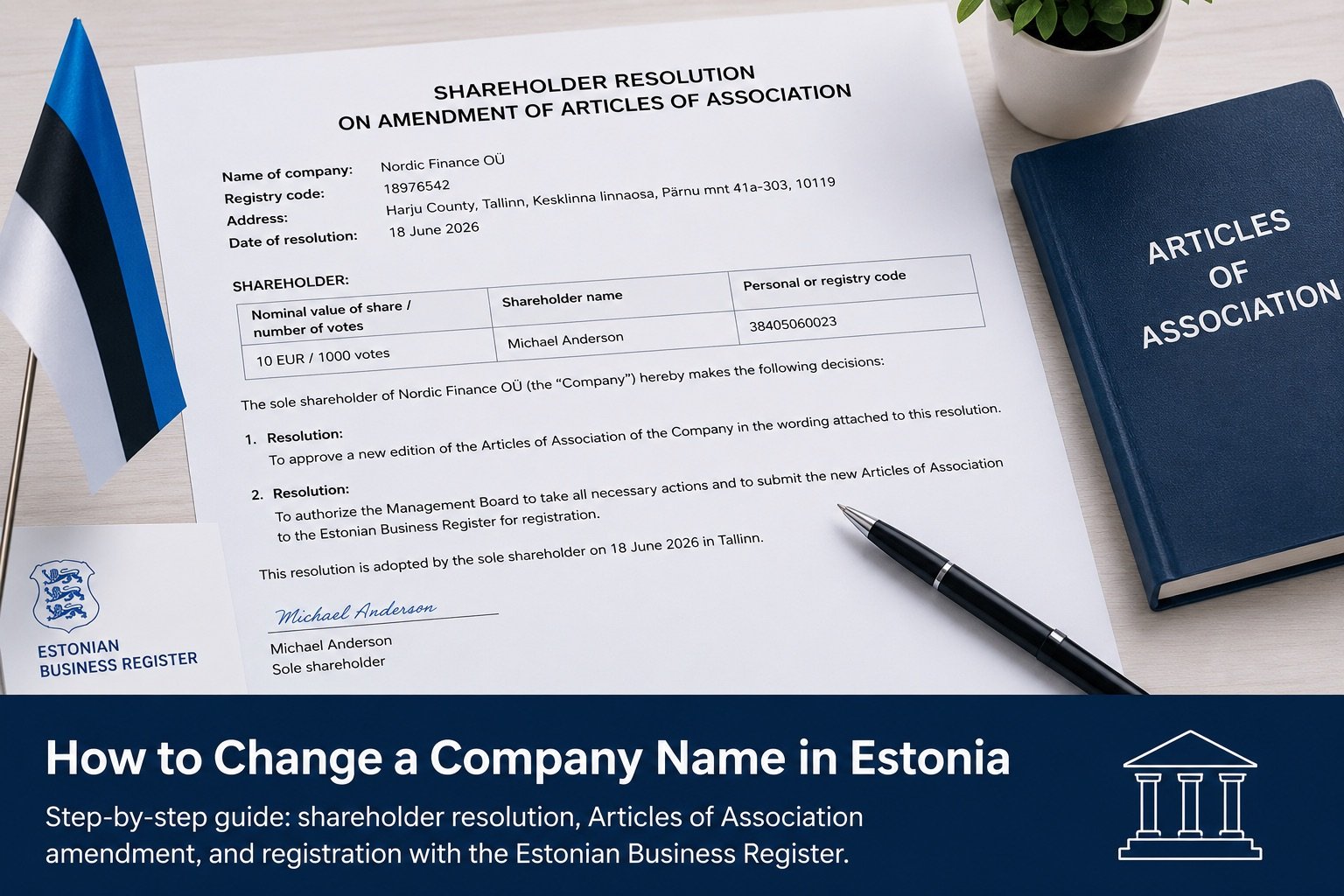
How to Change a Company Name in Estonia

Changing a company name in Estonia is a straightforward process, but it requires amending the company’s Articles of Association and registering the change with the Estonian Commercial Register. The procedure differs depending on whether the shareholders can sign documents digitally using an Estonian e-Residency card or whether the change must be completed through a notary public.

Before You Start

Before initiating the name change, it is advisable to:

  • Verify that the new company name is available and complies with Estonian naming requirements.
  • Ensure that the proposed name is distinguishable from existing registered business names.
  • Update the company’s Articles of Association to reflect the new name.

Option 1: Change the Company Name Using an e-Residency Card

If all shareholders and management board members have valid Estonian digital IDs (including e-Residency cards), the company name change can usually be completed online.

Procedure

  1. Prepare a Shareholders’ Resolution The shareholders must adopt a resolution approving:
    • The change of the company name.
    • The amendment of the Articles of Association.
  2. Update the Articles of Association The new company name must be inserted into the Articles of Association.
  3. Sign Documents Digitally with PIN-2 All required parties sign the resolution and amended Articles of Association using their Estonian digital signatures.
  4. Submit the ApplicationThe application for amendment is submitted electronically through the Estonian Company Registration Portal.
  5. Registration of the ChangeOnce approved by the Commercial Register, the new company name becomes officially registered.

Advantages

  • Fast and efficient process.
  • No need for a physical visit to a notary.
  • Lower administrative costs.

EORI number

Option 2: Change the Company Name Through a Notary Public

If the shareholders or board members cannot use Estonian digital signatures, the company name change can be completed through a notary public. (Choose a notary public from a list, contact and do this procedure with a notary).

Procedure

  1. Prepare a Shareholders’ ResolutionA shareholders’ resolution is required approving:
    • The change of the company name.
    • The amendment of the Articles of Association.
  2. Amend the Articles of AssociationThe new company name must be included in the revised Articles of Association.
  3. Attend a Notarial MeetingThe shareholders or their authorised representatives sign the necessary documents before an Estonian notary public.
  4. Submission to the Commercial Register The notary submits the required documentation to the Commercial Register.
  5. Registration of the New Company Name After registration, the company may officially operate under its new name.

Documents Typically Required

  • Shareholders’ resolution approving the name change.
  • Amended Articles of Association containing the new company name.
  • Identification documents of shareholders or representatives.
  • Power of attorney (if applicable).
EORI number

What Happens After Registration?

Once the company name change has been registered, the company should update:

  • Business contracts and agreements.
  • Bank account information.
  • Invoices and accounting records.
  • Company website and email signatures.
  • Employment documents.
  • Licences, permits, and regulatory registrations where applicable.

Template of Article of Association in english

ARTICLES OF ASSOCIATION

  1. The business name of the private limited company (hereinafter referred to as the “Company”) is Cherrydrive OÜ.
  2. The registered office of the Company is located in Tallinn, Harju County, Estonia.
  3. The minimum share capital of the Company is EUR 10 and the maximum share capital is EUR 40.
  4. Shares may be paid for by monetary or non-monetary contributions. The procedure for making contributions shall be determined by the shareholders.
  5. The value of non-monetary contributions shall be determined by the Management Board of the Company. The valuation of non-monetary contributions shall be audited if required by law.
  6. Shares may be issued at a premium, meaning for an amount exceeding their nominal value.
  7. The Company shall not have a reserve capital.
  8. Each share with a nominal value of EUR 1 shall grant one vote.
  9. A shareholder may freely transfer a share to another shareholder. In the event of a transfer of a share to a third party, the other shareholders shall have a right of first refusal within one (1) month from the submission of the transfer agreement.
  10. The financial year of the Company begins on 1 January and ends on 31 December.
  11. The Management Board is the management body of the Company and shall represent and manage the Company. The Management Board shall consist of one (1) to five (5) members. Members of the Management Board shall be elected and removed by the shareholders. Members of the Management Board shall be appointed for an indefinite term.
  12. The Company shall be dissolved:
    (a) by a resolution of the shareholders;
    (b) by a court decision; or
    (c) on other grounds provided by law.
  13. The members of the Management Board shall act as liquidators of the Company unless otherwise provided by a resolution of the shareholders or a court decision.
  14. Any matters not regulated by these Articles of Association shall be governed by the Estonian Commercial Code and other applicable legislation of the Republic of Estonia.

Conclusion

Changing a company name in Estonia is a relatively simple corporate procedure. Companies with access to Estonian digital signatures can complete the process online through the e-Residency and Company Registration Portal. If digital signing is not possible, the change can be executed through a notary public by adopting a shareholders’ resolution and amending the Articles of Association to reflect the new company name.

Proper preparation of the resolution and updated Articles of Association will help ensure a smooth and efficient registration process.

Read more

How to Get an EORI Number in Estonia: Complete Step-by-Step Guide (2026)

If you plan to import or export goods in Estonia, having an Estonian VAT number may not be enough. Many entrepreneurs are surprised to discover that, even after completing VAT registration, they are still unable to clear goods through customs because they do not have an EORI number.

Without a valid EORI (Economic Operators Registration and Identification) number, you cannot carry out customs procedures within the European Union, meaning your imports and exports may be delayed or even blocked.

The good news is that obtaining an Estonian EORI number is a straightforward process. In most cases, the application can be completed electronically through the Estonian Tax and Customs Board’s e-MTA system.

If you have not yet established an Estonian company, you may also consider purchasing a ready-made company with an active VAT and EORI registration. Such companies are fully operational and can often start trading immediately after the ownership transfer.

This guide explains:

  • What an EORI number is;
  • Who needs one in Estonia;
  • How to apply through the e-MTA portal;
  • What documents may be required;
  • Common mistakes to avoid;
  • Alternative solutions for entrepreneurs who need to start trading quickly.

What Is an EORI Number?

EORI stands for Economic Operators Registration and Identification.

It is a unique customs identification number used throughout the European Union.

An EORI number allows businesses and individuals to:

  • Import goods into the EU;
  • Export products outside the EU;
  • Submit customs declarations;
  • Use customs transit procedures;
  • Communicate with customs authorities across the European Union.

An economic operator may only have one valid EORI number within the EU.

Who Needs an EORI Number in Estonia?

You may need an EORI number if you:

✅ Import goods from non-EU countries;

✅ Export goods outside the EU;

✅ Operate an international eCommerce business;

✅ Run a logistics or freight forwarding company;

✅ Are an Estonian e-Resident trading physical goods;

✅ Are a foreign business carrying out customs operations through Estonia.

If your business only provides digital services without importing or exporting goods, an EORI number is generally not required.

corporation tax

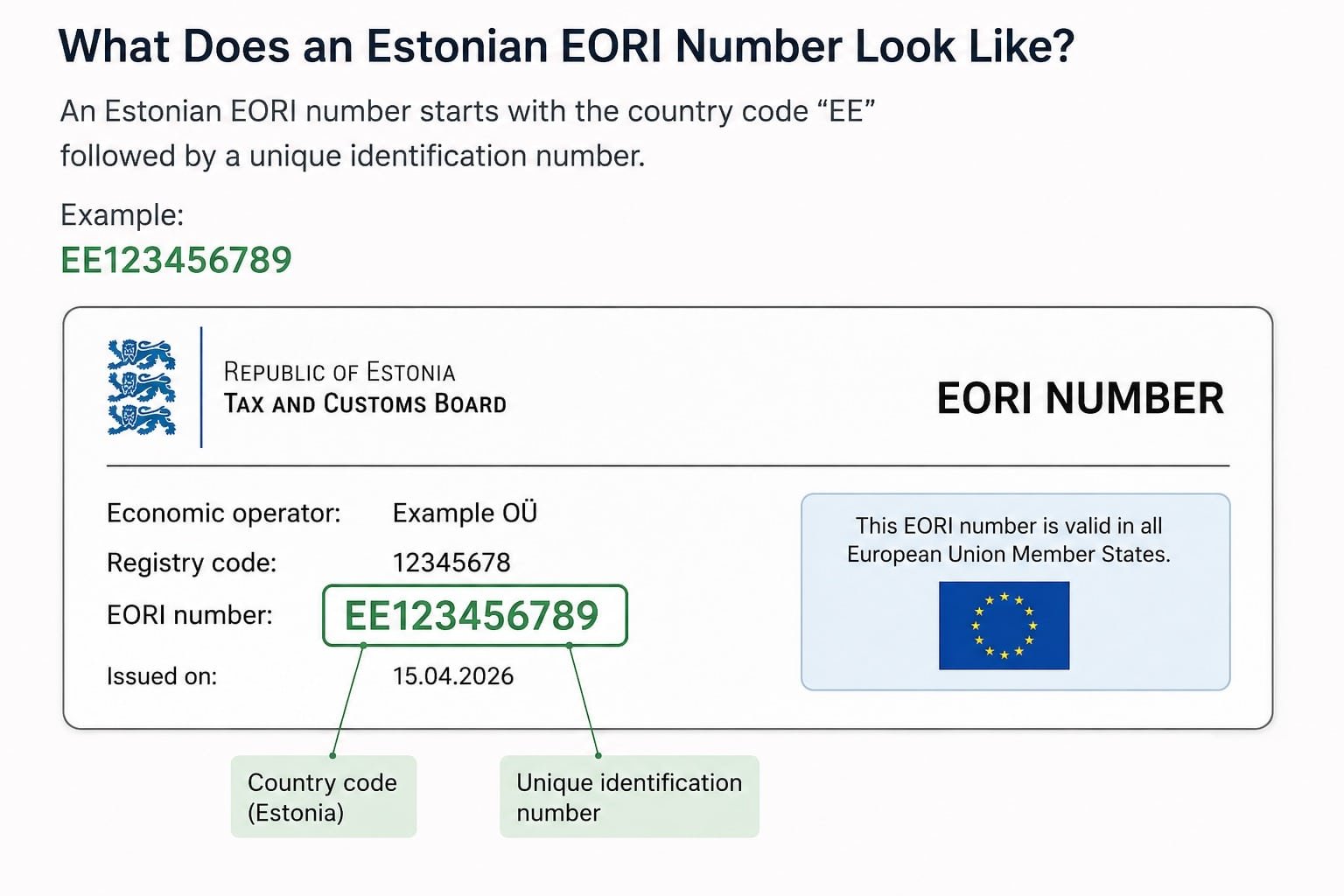
What Does an Estonian EORI Number Look Like?

An Estonian EORI number begins with the country code EE, followed by a unique identification number.

Example:

EE123456789

The exact structure depends on the applicant’s legal status, but every Estonian EORI number starts with the prefix EE and is recognised throughout the European Union.


Example of an Estonian EORI Number

EORI - format number

The illustration below shows a sample Estonian EORI number and explains its structure.


Who Issues the EORI Number in Estonia?

The Estonian EORI number is issued by the Estonian Tax and Customs Board (MTA).

Estonian companies generally apply through the electronic e-MTA portal.

Foreign businesses may also apply if Estonia is the appropriate Member State for their customs activities.


How to Get an EORI Number in Estonia

▣ Step 1: Log in to e-MTA

Visit the Estonian Tax and Customs Board electronic portal.

You can sign in using:

  • Estonian ID Card;
  • Mobile-ID;
  • Smart-ID;
  • e-Residency Digital ID.

▣ Step 2: Open the Customs Section

Navigate to the customs services section.

Select the EORI registration application.


▣ Step 3: Complete the Application

Prepare the required information:

  • Company name;
  • Registry code;
  • Contact details;
  • Existing VAT registrations;
  • Other identification details.

Double-check the information before submitting the application.


▣ Step 4: Submit the Application

Submit the application electronically.

The Estonian Tax and Customs Board will process your request.


▣ Step 5: Receive Your EORI Number

Once approved, your EORI number becomes valid throughout the European Union.

You can use it for:

  • Imports;
  • Exports;
  • Customs declarations;
  • Transit procedures;
  • International logistics.

Do You Need VAT Registration Before Getting an EORI Number?

Not necessarily.

An EORI number and a VAT number have different purposes.

VAT NumberEORI Number
TaxationCustoms
VAT reportingImport and export
Tax complianceCustoms identification

Many companies have both registrations.

However, having an Estonian VAT number does not automatically mean you have an EORI number.

This is one of the most common mistakes made by new entrepreneurs.

corporation tax

Want to Start Trading Faster?

If you have not yet established an Estonian company, there is another practical solution.

You may consider purchasing a ready-made Estonian company with an active VAT and EORI number already issued.

These companies are:

✔ Fully incorporated;

✔ Ready for business operations;

✔ Suitable for import and export activities;

✔ Able to start trading immediately after ownership transfer.

For entrepreneurs who need to enter the European market quickly, purchasing a ready-made company can save valuable time and reduce administrative procedures.

Eesti Consulting can assist with both company acquisitions and regulatory registrations.

corporation tax

Can Foreign Companies Get an Estonian EORI Number?

Yes.

Foreign businesses outside the European Union may apply for an Estonian EORI number if Estonia is their first point of customs interaction within the EU.

How Long Does It Take?

Processing times depend on the completeness of the application.

Electronic applications submitted through e-MTA with complete information are generally processed quickly.

How Much Does an EORI Number Cost?

Applying for an EORI number in Estonia is free of charge.

There are no government fees for obtaining an EORI number from the Estonian Tax and Customs Board.

Can an e-Resident Apply?

Yes.

If you operate an Estonian company through the e-Residency programme and intend to trade physical goods internationally, your company can obtain an EORI number through the standard procedure.

Common Mistakes

Avoid these common issues:

❌ Assuming VAT and EORI are identical;

❌ Applying in the wrong EU country;

❌ Waiting until your first shipment arrives;

❌ Providing incomplete information;

❌ Forgetting existing VAT registrations;

❌ Assuming an Estonian VAT number automatically includes EORI registration.

Frequently Asked Questions

Is an EORI number mandatory?

Yes.

Businesses and individuals involved in customs operations generally require an EORI number.

Does an EORI number expire?

Normally, no.

It remains valid unless cancelled according to customs regulations.

Can one company have multiple EORI numbers?

No.

An economic operator may only have one valid EORI number within the European Union.

Is an Estonian EORI valid across Europe?

Yes.

Once issued, it can be used throughout the EU customs territory.

Why Choose Eesti Consulting?

Whether you are an entrepreneur, e-Resident or international investor, Eesti Consulting can help you with:

✔ Estonian company formation;

✔ Ready-made companies with VAT and EORI numbers;

✔ VAT registration;

✔ EORI registration;

✔ e-Residency support;

✔ Customs compliance;

✔ International trade consulting.

If you need to start importing or exporting goods quickly, we can help you choose the most efficient solution for your business—whether that means registering a new EORI number or acquiring a ready-made Estonian company that already has active VAT and EORI registrations.

Need Help with EORI Registration in Estonia?

Contact Eesti Consulting today and let our specialists help you get your business ready for international trade.

Read more
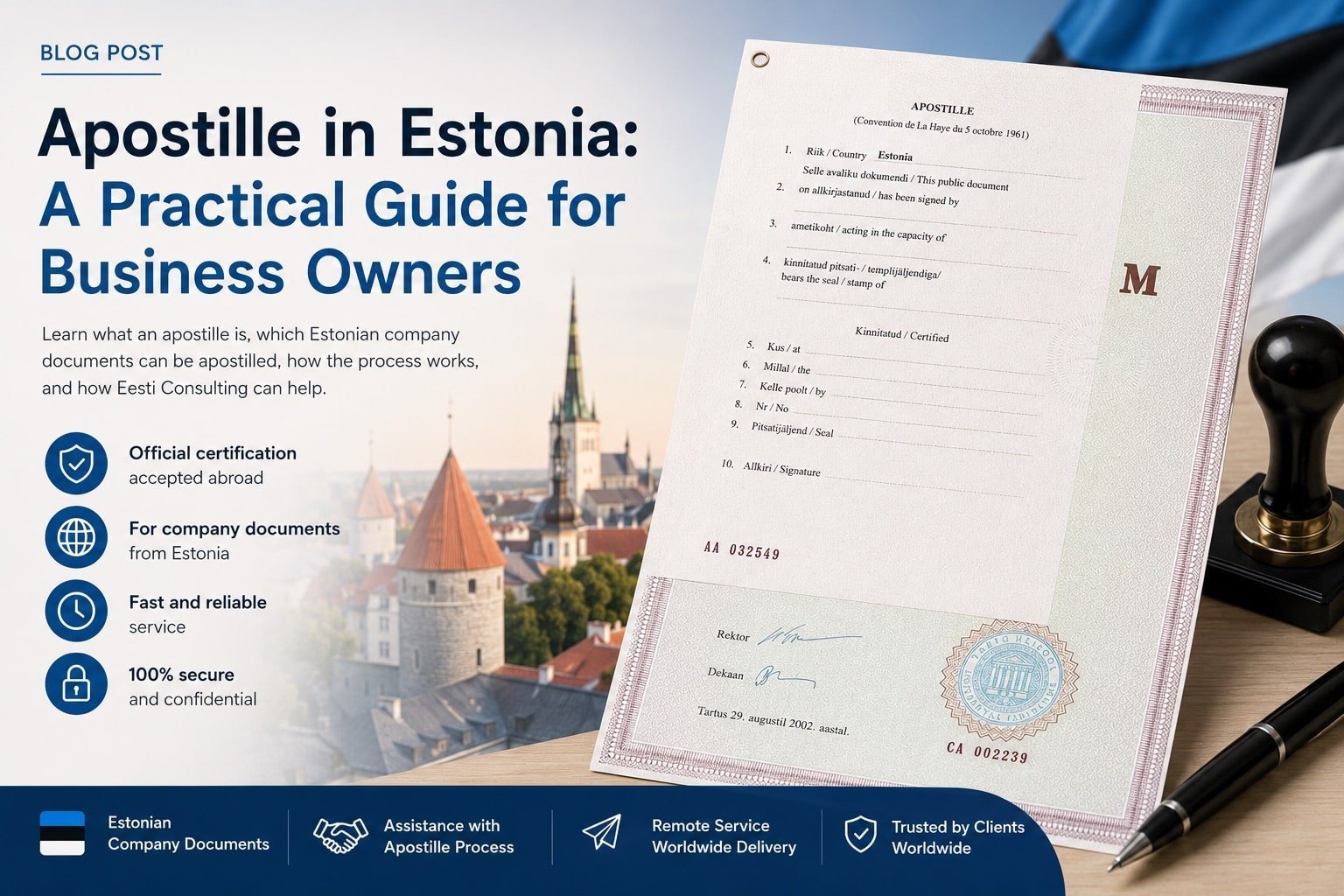
How to Get Apostille in Estonia?

Apostille in Estonia: A Practical Guide for Business Owners

If you own an Estonian company, there may come a time when you need to prove its legal status abroad. In many cases, this requires an apostille.

For international entrepreneurs, apostilled company documents are often required when opening a bank account, dealing with foreign authorities, completing KYC procedures, or working with international business partners.

This guide explains what an apostille is, which Estonian company documents can be apostilled, and how the process works.

What Is an Apostille?

Apostille is an official certificate that confirms a public document is authentic. It verifies the signature, seal, or stamp on the document, allowing it to be recognised in countries that are members of the Hague Apostille Convention.

Instead of a lengthy legalisation process, an apostille provides a simple and internationally accepted method of document authentication.

Which Estonian Company Documents Can Be Apostilled?

For most of our clients, apostilles are required for corporate documents issued by the Estonian Commercial Register (RIK).

The most commonly apostilled documents include:

🔹 Certificate of registration;

🔹 Official Commercial Register extracts;

🔹 List of board members;

🔹 List of shareholders;

🔹 Information about Ultimate Beneficial Owners (UBOs);

🔹 Articles of Association;

🔹 Other official company documents.

Official extracts from the Commercial Register can be apostilled and used abroad for various business purposes.

Depending on the receiving authority, other public or notarised documents may also qualify for an apostille.

When Do You Need an Apostille?

One of the most common situations is opening a corporate bank account abroad.

Many foreign banks require original company documents together with an apostille to verify:

🔹 The legal existence of the company;

🔹 The identity of directors;

🔹 The ownership structure;

🔹 The company’s beneficial owners.

Banks often require official original extracts rather than simple electronic printouts.

An apostille may also be required for:

🔹 Opening foreign bank accounts;

🔹 Establishing a subsidiary or branch;

🔹 Investor due diligence;

🔹 KYC and compliance procedures;

🔹 Signing international contracts;

🔹 Participating in international tenders;

🔹 Dealing with foreign authorities.

Requirements vary depending on the country and institution.

Who Issues Apostilles in Estonia?

In Estonia, apostilles are issued exclusively by notaries.

Since 2010, Estonian notaries have been the competent authorities responsible for issuing apostilles for public documents, including many corporate and Commercial Register documents.

One advantage of the Estonian system is that you can use any Estonian notary regardless of where your company is registered.

The official list of Estonian notaries is available here:

https://www.notar.ee/en/notaries/list

How to Obtain an Apostille in Estonia

The process is straightforward.

🔹 Step 1: Obtain the Required Documents

First, identify which documents are required by the foreign authority, bank, or business partner.

Official Commercial Register extracts can usually be obtained quickly.

🔹 Step 2: Apostille Certification

The documents are submitted to an Estonian notary for apostille certification.

The notary verifies the authenticity of the document and issues the apostille certificate.

🔹 Step 3: International Use

Once apostilled, the documents can be presented to banks, government authorities, and business partners in countries that recognise apostilles.

How Eesti Consulting Can Help

Many entrepreneurs only discover they need apostilled company documents when requested by a foreign bank or authority.

Eesti Consulting can assist by obtaining the necessary Commercial Register documents and coordinating the apostille process with an Estonian notary.

Whether your company has just been established or has been operating for years, we can help you obtain the required corporate documents for international use.

Our clients commonly request apostilled documents for:

🔹 Opening bank accounts abroad;

🔹 Compliance and KYC procedures;

🔹 Investor due diligence;

🔹 International business transactions;

🔹 Corporate administration.

The entire process can be arranged remotely, making it easy for international business owners.

Frequently Asked Questions

❓ Can Eesti Consulting arrange apostilled documents remotely?

Yes.

The entire process can be completed remotely. Eesti Consulting can obtain the required documents, coordinate the apostille process, and deliver the completed documents according to your preferences.

Documents can be provided:

🔹 As scanned copies by email;

🔹 By regular international post;

🔹 By courier services such as DPD, UPS, or DHL.

This allows entrepreneurs worldwide to obtain apostilled Estonian company documents without visiting Estonia.

❓ How long does it take to obtain an apostille?

In most cases, the process takes approximately 1–2 business days.

For urgent matters, Eesti Consulting also offers expedited services whenever possible to minimise waiting times.

Processing times may vary depending on the type of document and notary availability.

❓ Can Eesti Consulting translate Articles of Association from Estonian into English?

Yes.

We can arrange professional translations of the Estonian Articles of Association into English.

This service is often requested by foreign banks, investors, business partners, and legal advisers who require English-language corporate documents.

❓ Can Commercial Register extracts be apostilled?

Yes.

Official extracts from the Estonian Commercial Register can generally be apostilled and are among the most frequently requested documents by our clients.

Common examples include:

🔹 Company registration extracts;

🔹 Lists of board members;

🔹 Shareholder information;

🔹 Ultimate Beneficial Owner (UBO) information;

🔹 Other official corporate records.

❓ Why do foreign banks request apostilled documents?

Foreign banks often need additional verification of foreign companies before opening a corporate account.

An apostille confirms that the official Estonian company documents are authentic, helping banks complete their KYC and compliance procedures.

Final Thoughts

For owners of Estonian companies, apostilles are most commonly used for official Commercial Register documents rather than personal certificates.

They play an important role in international banking, compliance procedures, and cross-border business activities.

Because many foreign institutions require original official documents with an apostille, planning ahead can save valuable time and prevent delays.

If you need apostilled documents for your Estonian company, Eesti Consulting can:

🔹 Obtain the required Commercial Register extracts;

🔹 Coordinate the apostille process with an Estonian notary;

🔹 Arrange certified English translations of corporate documents;

🔹 Deliver documents electronically or by post, DPD, UPS, or DHL worldwide.

Whether you have just established your company or have been operating for many years, we can help make the entire apostille process simple, fast, and fully remote.

Read more

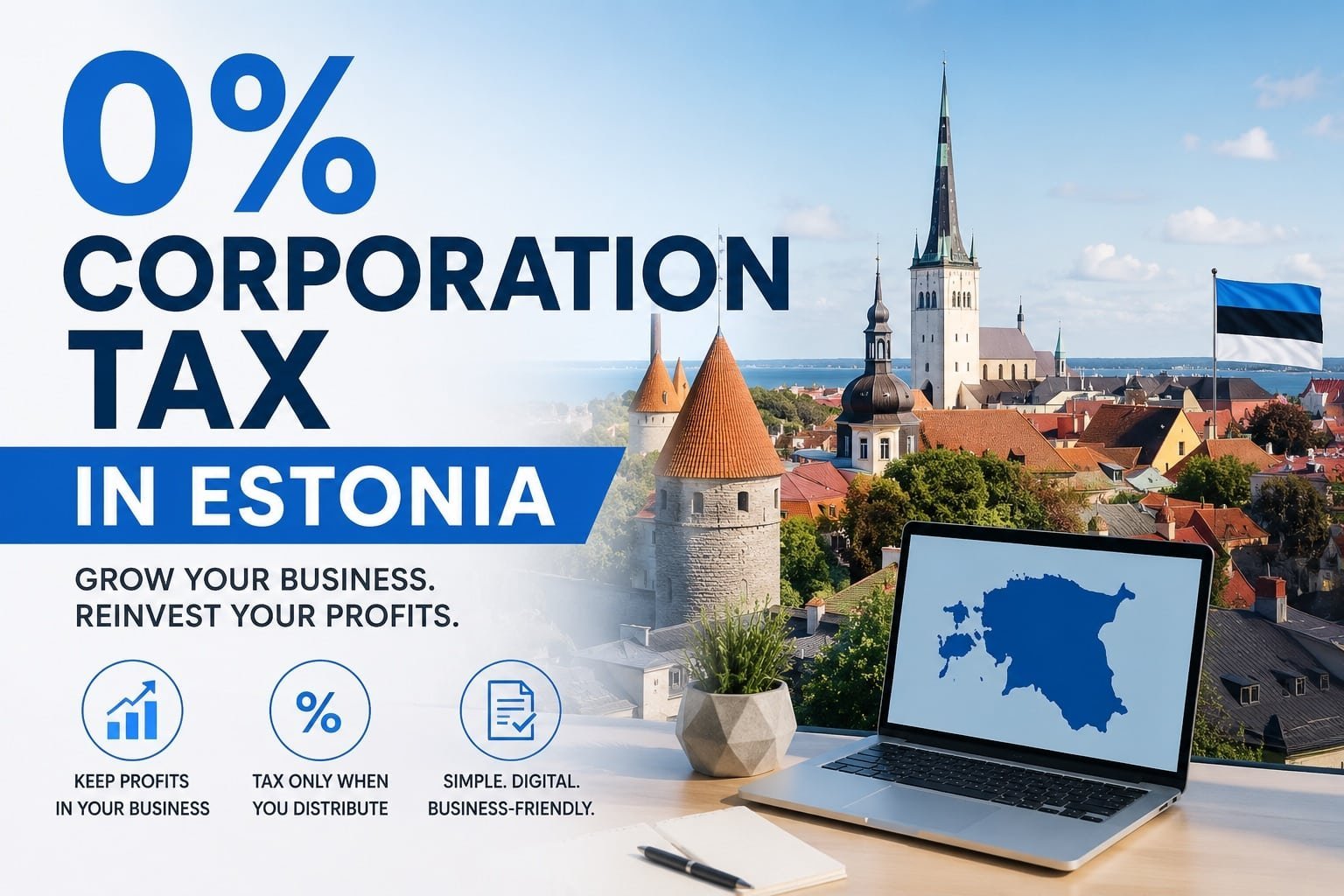
How Does Corporation Tax Work in Estonia? A Simple Guide for Foreign Entrepreneurs

If you’re thinking about starting a business in Estonia, you’ve probably heard that the country has a 0% corporate tax rate. While that’s not completely true, Estonia does have one of the most business-friendly tax systems in Europe.

The biggest difference compared to many other countries is that Estonian companies usually don’t pay corporate income tax when they earn profits. Instead, tax is generally due when profits are distributed to shareholders or used for certain non-business purposes.

This system has made Estonia a popular choice for startups, e-commerce businesses, IT companies, freelancers, and international entrepreneurs who want to grow their businesses before taking money out.

In this guide, we’ll explain how corporation tax works in Estonia, the current tax rates, and what foreign business owners should know about tax residency. Explore also zero tax countries list.

How Does the Estonian Corporate Tax System Work?

Most countries charge corporation tax on a company’s annual profits. Estonia takes a different approach.

In Estonia, a company can earn profits and keep them in the business without paying corporate income tax straight away. The money can be used to invest in new equipment, hire employees, develop products, or simply build up the company’s savings.

Corporate income tax is usually paid when profits leave the company.

The most common example is paying dividends to shareholders, but dividends are not the only situation where tax may apply.

Certain transactions can also be treated as profit distributions, including:

  • dividends,
  • non-business expenses,
  • certain gifts and donations,
  • fringe benefits,
  • hidden profit distributions to shareholders.

This means it’s important to keep proper accounting records and make sure company expenses are genuinely related to the business.

🤔 Is Estonia a 0% corporate tax country?

This is one of the biggest myths about Estonia. The answer is no.

Estonia does not have a 0% corporate tax rate. Instead, it has a system where profits are generally taxed when they are distributed rather than when they are earned.

If you keep the profits in your company and use them to grow the business, you generally won’t pay corporate income tax on those retained earnings.

Once you decide to distribute profits, corporate income tax usually becomes payable.

Many entrepreneurs like this system because it improves cash flow and gives businesses more flexibility during their growth stage.

Example

Imagine your Estonian company earns a profit of €100,000.

If you decide to keep the money in the business and reinvest it, there is generally no corporate income tax on those retained profits.

You could use the money to:

  • expand your business,
  • buy equipment,
  • hire employees,
  • invest in marketing,
  • develop new products.

If you decide to distribute the profits to shareholders, corporate income tax will generally apply to that distribution.

Lei Code

What Is the Corporation Tax Rate in Estonia?

As of 2026, the standard Estonian corporate income tax rate is 22%.

The tax is calculated using the 22/78 formula on distributed profits.

In simple terms, if a company wants to distribute profits to shareholders, it must also pay corporate income tax to the Estonian Tax and Customs Board.

Many older articles on the internet mention a reduced corporate tax rate of 14% for regularly distributed dividends.

This information is outdated.

The reduced dividend taxation system was abolished, and the standard corporate income tax rules now apply to profit distributions.

When reading about Estonian taxation online, it’s always worth checking whether the information has been updated, as many older guides still refer to rules that are no longer in force.

Simple example

Let’s say your company has made €100,000 in profit.

If you keep the money in the company:

  • Corporate income tax: generally €0.
  • Money available for future business activities: €100,000.

If you decide to distribute the profits:

  • Corporate income tax generally becomes payable.
  • The remaining amount can be distributed to shareholders.

This is one of the reasons Estonia’s tax system is popular with growing businesses that prefer to reinvest their earnings.

Lei Code

Tax Residency of an Estonian Company

Another important topic for foreign entrepreneurs is tax residency.

Under Estonian law, a company incorporated in Estonia is generally considered an Estonian tax resident.

If you register an OÜ, your company will normally become an Estonian tax resident and must comply with Estonian tax rules.

However, this is not always the end of the story.

Many countries use additional rules to determine where a company is tax resident.

One common test is called the “place of effective management.”

In simple terms, some countries ask questions like:

  • Where are important business decisions made?
  • Where do the directors work from?
  • Where is the company actually managed?

If another country believes that your company is effectively managed there, it could also claim that the company is tax resident in that country.

This may lead to a dual tax residency situation.

Fortunately, many countries have double tax treaties that help determine which country has the primary right to tax a business.

If you run an Estonian company while living abroad, it’s a good idea to understand both the Estonian rules and the tax rules of your home country.

Why Do So Many Entrepreneurs Choose Estonia?

Estonia’s tax system offers several advantages for business owners.

☑️Profits can be reinvested

Instead of paying corporation tax every year, businesses can often keep profits in the company and use them for future growth.

☑️Better cash flow

Money that would otherwise be paid as annual corporation tax can be invested back into the business.

☑️Simple administration

Estonia is well known for its digital government services, making it easier to manage a company online.

☑️Attractive for international businesses

Many freelancers, consultants, e-commerce stores, software companies, and startups choose Estonia because of its modern business environment.

However, it’s important to remember that an Estonian company does not automatically eliminate tax obligations in other countries.

Your personal tax residency and the place where your business is managed can also affect your overall tax situation.

Lei Code

Common Questions About Estonian Corporation Tax

❓ Does an Estonian company pay annual corporation tax?

Generally, retained profits are not subject to annual corporate income tax. Tax is usually due when profits are distributed or deemed to be distributed.

❓ Are dividends taxed in Estonia?

Yes. Dividend distributions generally trigger corporate income tax at the company level.

❓ Is Estonia a tax haven?

No. Estonia is a fully regulated EU and OECD member state with a transparent tax system. Its corporate tax model simply works differently from many other countries.

❓ Can a foreigner own an Estonian company?

Yes. Foreign individuals and businesses can own Estonian companies, although they should also consider the tax rules in their country of residence.

Final Thoughts

Estonia has one of the most unique corporate tax systems in Europe. Instead of taxing profits every year, the system generally taxes profits when they are distributed.

This gives businesses more flexibility and allows them to reinvest earnings before paying corporate income tax. For many entrepreneurs, especially startups and growing companies, this can provide a significant advantage.

At the same time, it’s important to understand that Estonia is not a 0% tax country. Corporate income tax generally applies when profits are distributed, and international entrepreneurs should also consider tax residency rules and any applicable double tax treaties.

If you’re planning to start or run an Estonian company, understanding how corporation tax works is an important first step towards staying compliant and making informed business decisions.

Disclaimer: This article is for general informational purposes only and should not be considered tax or legal advice. Tax rules may change, and individual circumstances vary. Professional advice should always be sought for specific situations.

Read more
the list of notaries in estonia

The List of Notaries in Estonia: A Practical Guide for Foreigners and Businesses

If you are planning to do business in Estonia, purchase property, establish a company, or prepare official legal documents, there is a good chance you will need the services of an Estonian notary public.

Unlike in many countries, Estonian notaries play an important role in both business and private legal matters. They are independent public officials appointed by the state who ensure that transactions comply with Estonian law while protecting the interests of all parties involved.

Thanks to Estonia’s digital infrastructure, many notarial services can now be completed efficiently, making the country particularly attractive for international entrepreneurs and investors.

In this guide, we’ll explain what Estonian notaries do, introduce several licensed notaries, and show how Eesti Consulting can help foreign clients navigate the entire process.

What Is an Estonian Notary?

An Estonian notary is an independent legal professional authorised by the state to certify legal transactions and official documents.

The role of a notary goes beyond simply witnessing signatures. They verify identities, explain legal consequences, prepare official documents, and ensure that transactions comply with Estonian legislation.

Many important legal acts require notarisation before they become legally effective.

Who Can Use an Estonian Notary?

Estonian notarial services are available to both residents and foreigners.

You do not need to be an Estonian citizen to use a notary. International entrepreneurs, investors, companies, and private individuals regularly use Estonian notarial services for business and personal matters.

Many notaries provide assistance in English, and certain procedures can be completed remotely depending on the nature of the transaction.

What Can You Do with an Estonian Notary?

An Estonian notary can assist with a surprisingly wide range of legal and commercial matters.

One of the most popular services is the incorporation of an Estonian OÜ (private limited company). Foreign investors often establish companies with the assistance of a notary, particularly when the incorporation process involves multiple shareholders or specific corporate structures.

Notaries are also involved in the establishment of MTÜs (non-profit associations), which are widely used for charities, professional organisations, educational initiatives, sports clubs, and international NGOs.

A notary can prepare and certify a Power of Attorney, allowing another person to act on your behalf. This is especially useful for foreign clients who cannot travel to Estonia but wish to establish a company, transfer shares, or complete other legal procedures.

Many business owners also use notarial services for corporate changes, including share transfers, changes to management board members, amendments to the Articles of Association, and capital increases.

Estonian notaries also play an important role in real estate transactions, inheritance matters, wills, family law issues, and the certification of signatures and official documents.

Register an Estonian Company with Eesti Consulting

Starting a business in Estonia often involves notarial procedures, especially for more complex corporate structures.

At Eesti Consulting, we help international entrepreneurs establish Estonian companies by coordinating the entire process.

Our services include preparing incorporation documents, arranging appointments with suitable notaries, assisting with Powers of Attorney, and supporting communication throughout the registration process.

If you are unable to visit Estonia personally, we can often help organise the transaction through alternative legal solutions where permitted by law.

Rather than searching for a suitable notary yourself, our team can recommend the most appropriate professional based on your particular circumstances.

Need an Apostille?

Many official Estonian documents are intended for use outside Estonia.

In such cases, an apostille may be required to confirm the authenticity of the document for foreign authorities.

Common examples include:

  • company registration documents;
  • Commercial Register extracts;
  • Powers of Attorney;
  • notarial certificates;
  • educational documents;
  • court decisions.

Eesti Consulting can assist clients with obtaining apostilles and organising international delivery of official documents.

Lei Code

Order Official Estonian Company Documents

Foreign banks, investors, business partners, and public authorities often require official corporate documentation.

Typical requests include:

  • Certificate of Incorporation;
  • Articles of Association;
  • Commercial Register extracts;
  • shareholder information;
  • board member certificates;
  • beneficial ownership information.

Many of these documents can be notarised and apostilled depending on the requirements of the receiving country.

Our team can assist with ordering, certification, and international shipping.

Can You Choose Any Notary?

One of the advantages of the Estonian system is flexibility.

In most cases, you are free to choose any licensed Estonian notary regardless of where you live or where your company is registered.

International clients often prefer notaries in Tallinn due to their extensive experience with foreign investors and English-speaking transactions.

The List of Notaries in Estonia

Estonia has many experienced notaries serving both local and international clients. Here are ten examples from the official register.

Ants Ainson

A Tallinn-based notary serving both private and business clients.

Siret Paavel-Margna

Located in Tallinn and experienced in various corporate and private legal matters.

Erki Põdra

A well-known Tallinn notary regularly assisting business transactions.

Tarvo Puri

Provides a broad range of notarial services for domestic and international clients.

Merle Saar-Johanson

Offers notarial assistance for both private individuals and businesses.

Alla Ševtšuk

An experienced Tallinn notary handling numerous commercial transactions.

Mall Vendel

Provides comprehensive notarial services in the Estonian capital.

Egle Uri

Assists with various legal and corporate procedures.

Paavo Uibopuu

A Tartu notary serving both local and international clients.

Toomas Saaver

You can find more contacts here. Based in Rakvere and providing traditional notarial services across a broad range of legal matters.

The complete and up-to-date register of Estonian notaries can always be found on the official website of the Estonian Chamber of Notaries.

Do You Need Estonian e-Residency?

Many people assume that Estonian e-Residency is required for notarial procedures.

In reality, this is not always the case.

Depending on the transaction, it may be possible to proceed through a properly prepared Power of Attorney or other legally recognised identification methods.

The appropriate solution depends on your individual circumstances and the type of legal act involved.

Why Work with Eesti Consulting?

Foreign clients often find it difficult to understand Estonian legal procedures or identify which documents are required.

Eesti Consulting helps simplify the process by acting as a single point of contact for international entrepreneurs and investors.

We can assist with:

company registration;

MTÜ formation;

preparation of Powers of Attorney;

coordination with Estonian notaries;

obtaining apostilles;

ordering official company documents;

Commercial Register extracts;

corporate changes;

general business support.

Instead of contacting multiple service providers, our clients benefit from a coordinated approach tailored to their specific needs.

Lei Code

Final Thoughts

Estonia has built one of Europe’s most efficient and business-friendly legal systems, and notaries play an important role in ensuring that important transactions are completed securely and in accordance with the law.

Whether you are planning to establish an Estonian company, create a non-profit association, prepare a Power of Attorney, order official corporate documents, obtain an apostille, or complete another legal procedure, working with an experienced notary can make the process significantly easier.

For international clients, professional assistance can save both time and unnecessary administrative complexity. At Eesti Consulting, we regularly assist entrepreneurs, investors, and private individuals with notarial matters and can help connect you with the right Estonian notary for your particular project.

Read more
VAT Oss in Estonia

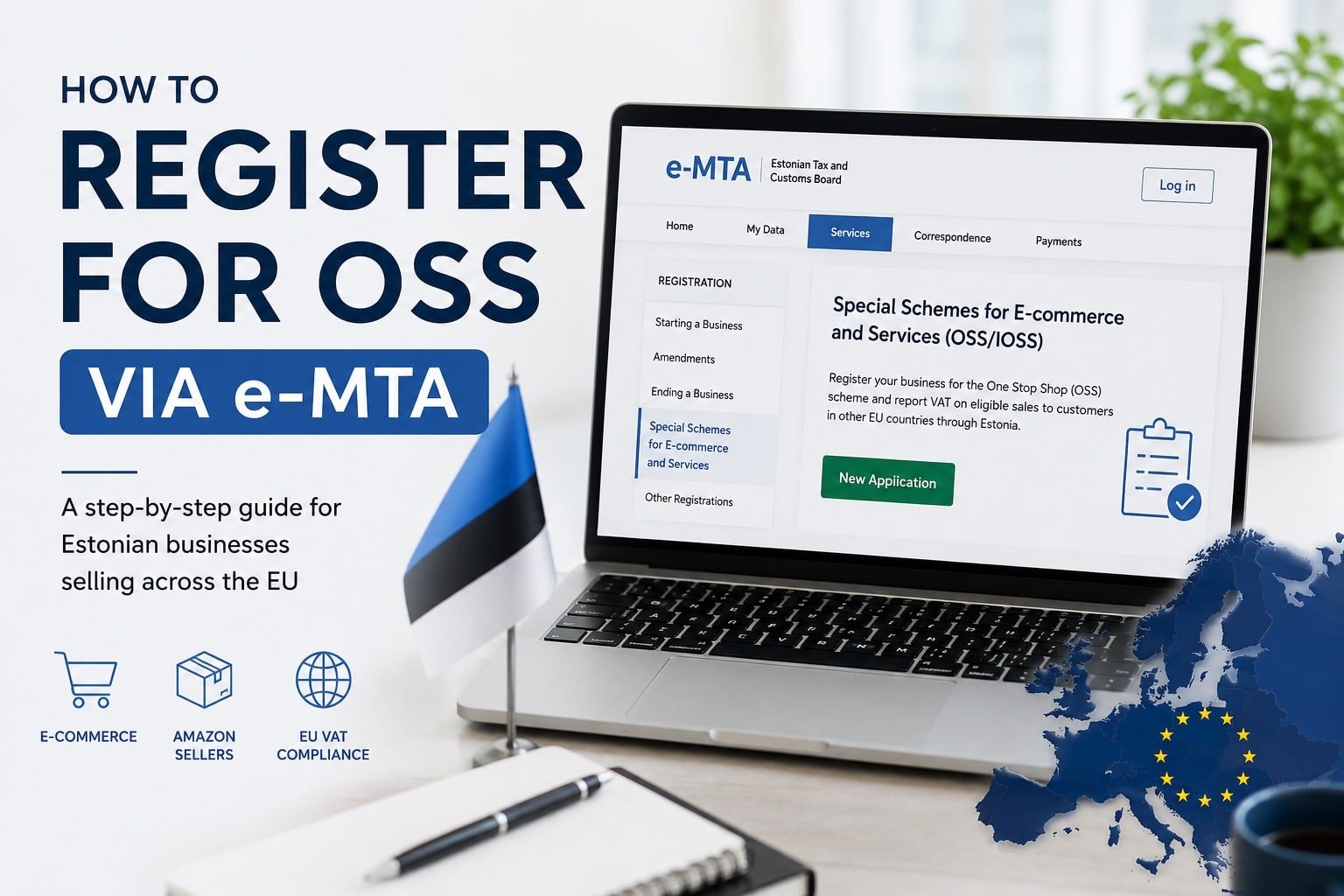
How to Register for OSS in Estonia via e-MTA: A Step-by-Step Guide

Cross-border e-commerce has transformed the way businesses operate. Today, an Estonian company can easily sell products through Amazon FBA, run a Shopify or WooCommerce store, manage an Etsy shop, or provide digital services to customers across the European Union.

While expanding into new markets creates exciting opportunities, it also brings additional VAT obligations. Different VAT rates and reporting requirements can become challenging for online sellers operating in several EU countries.

To simplify these rules, the European Union introduced the One Stop Shop (OSS) scheme. Instead of registering for VAT in multiple Member States, eligible businesses can declare and pay VAT through a single quarterly return.

For Estonian businesses, OSS registration is completed through the Estonian Tax and Customs Board’s e-MTA portal. The process is relatively simple, but understanding the rules before registering is essential.

In this guide, we’ll explain what the OSS scheme is, who should register, how to apply through e-MTA, and what Estonian businesses should know before getting started.

What Is OSS?

The One Stop Shop (OSS) is a special EU VAT scheme designed to simplify VAT reporting for businesses making eligible B2C sales across the European Union.

Before OSS was introduced, businesses selling goods or certain services to consumers in several EU countries often had to register for VAT separately in each country.

Today, many businesses can report these transactions through a single quarterly VAT return submitted in their home Member State.

The OSS scheme is particularly popular among online retailers and digital businesses because it reduces administrative work and simplifies VAT compliance.

Who Should Register for OSS?

The OSS scheme is mainly intended for businesses making cross-border B2C sales within the European Union.

It is particularly useful for:

Amazon FBA sellers expanding across Europe.

Shopify and WooCommerce stores shipping products to customers in multiple EU countries.

Etsy sellers offering handmade or unique products internationally.

Online marketplaces connecting buyers and sellers across borders.

Digital businesses selling software, subscriptions, online courses, or electronic services.

Lei Code

For example, an Estonian OÜ selling products through Amazon to customers in Germany, France, Italy, and Spain may benefit from OSS registration instead of dealing with several foreign VAT registrations.

Similarly, a Shopify store based in Estonia shipping products throughout Europe can often simplify its VAT reporting through OSS.

Do You Need an Estonian VAT Number?

Before joining the OSS scheme, a business should generally have an Estonian VAT registration.

A valid VAT number is usually required before submitting an OSS application through e-MTA.

Businesses should also confirm that their sales qualify for the OSS scheme and understand which transactions can be reported through the system.

What Should You Prepare Before Registration?

Preparing the necessary information before starting the application can save time and avoid mistakes.

Your company should have its VAT registration details, contact information, bank account details, and information regarding cross-border B2C sales readily available.

It is also important to determine the intended starting date for the OSS scheme, as this affects future reporting obligations.

Understanding your sales channels and customer locations before registering can make the process much smoother.

How to Register for OSS via e-MTA

The registration process is completed through the Estonian Tax and Customs Board’s online environment.

Step 1. Log in to e-MTA.

Access the e-MTA portal using your preferred authentication method and select the company you wish to register.

Step 2. Navigate to the registration section.

Open the registration services and locate the special schemes for e-commerce and services.

Step 3. Start a new application.

Choose the OSS registration option and begin the application process.

Step 4. Complete the required information.

Provide your company details, contact information, and the intended start date for the OSS scheme.

Step 5. Review and submit the application.

Check that all information is correct before submitting the application electronically.

Once approved, your company can begin reporting eligible transactions through the OSS system.

Lei Code

What Happens After Registration?

Joining the OSS scheme is only the beginning of your VAT obligations.

Businesses must maintain accurate records of cross-border sales and submit quarterly OSS returns through e-MTA.

Good bookkeeping is essential, especially for businesses selling through multiple platforms or to customers in different EU countries.

Keeping proper documentation helps ensure compliance and simplifies future reporting.

Common OSS Registration Mistakes

Many businesses assume that registration itself is the difficult part, but ongoing compliance is equally important.

Common mistakes include choosing the wrong registration date, misunderstanding which transactions qualify for OSS, applying incorrect VAT rates, and maintaining incomplete sales records.

Businesses selling through several online platforms should also ensure that their accounting systems properly separate domestic and OSS transactions.

Do I Need Estonian e-Residency?

A common misconception is that Estonian e-Residency is required for OSS registration.

In reality, e-Residency is not mandatory.

As long as the company has the appropriate access to e-MTA or appoints an authorised representative, it can generally manage the registration process without becoming an Estonian e-Resident.

Can an Accountant Register for Me?

Many businesses choose to work with an accountant or tax adviser for OSS registration and ongoing compliance.

This can be particularly helpful for companies operating multiple online stores, selling through marketplaces, or managing large numbers of cross-border transactions.

Professional support can reduce administrative burdens and help businesses avoid costly VAT mistakes.

Which Businesses Benefit Most from OSS?

The OSS scheme can benefit many types of businesses.

An Estonian company operating an Amazon FBA business may use OSS to simplify VAT reporting for sales across the EU.

A Shopify or WooCommerce store shipping products to several Member States can often avoid multiple VAT registrations.

An Etsy seller reaching customers across Europe may also benefit from the scheme.

Digital businesses providing online services, software, subscriptions, or educational products to consumers throughout the EU can often use OSS to simplify VAT compliance.

As e-commerce continues to grow, the OSS scheme has become an important tool for businesses looking to expand internationally.

Practical Example

Imagine an Estonian OÜ operating a successful Shopify store selling home accessories.

The business is based in Estonia but receives orders from customers in Germany, France, Italy, Spain, and the Netherlands. It also sells selected products through Amazon’s European marketplaces.

Without OSS, the company could potentially face multiple VAT registration requirements across different EU countries.

By registering for the OSS scheme through e-MTA, the business can report eligible B2C sales through a single quarterly VAT return in Estonia while charging the appropriate VAT rates for customers in each destination country.

This approach saves time and significantly reduces administrative complexity.

Final Thoughts

The One Stop Shop (OSS) scheme has become an essential VAT tool for modern businesses engaged in cross-border e-commerce. Whether you sell through Amazon FBA, operate a Shopify or WooCommerce store, manage an Etsy business, or provide digital services to customers across the European Union, OSS can significantly simplify your VAT obligations.

For Estonian companies, the registration process through e-MTA is relatively straightforward. However, understanding the rules before applying is just as important as completing the registration itself. Choosing the correct registration date, identifying eligible transactions, and maintaining accurate records can help avoid unnecessary compliance issues in the future.

As online sales continue to grow, more Estonian businesses are expanding into European markets. The OSS scheme allows entrepreneurs to focus on growing their businesses instead of dealing with multiple VAT registrations across different countries.

If your Estonian company is planning to sell products or services to private customers throughout the EU, it may be worth reviewing whether the OSS scheme is the right solution for your business model. Professional tax and accounting advice can also help ensure that your VAT obligations are managed correctly from the very beginning.

Whether you’re launching your first Shopify store, scaling an Amazon FBA business, or growing an established e-commerce brand, understanding the OSS scheme is an important step towards successful and compliant international expansion.

Read more
LEI Code in Estonia

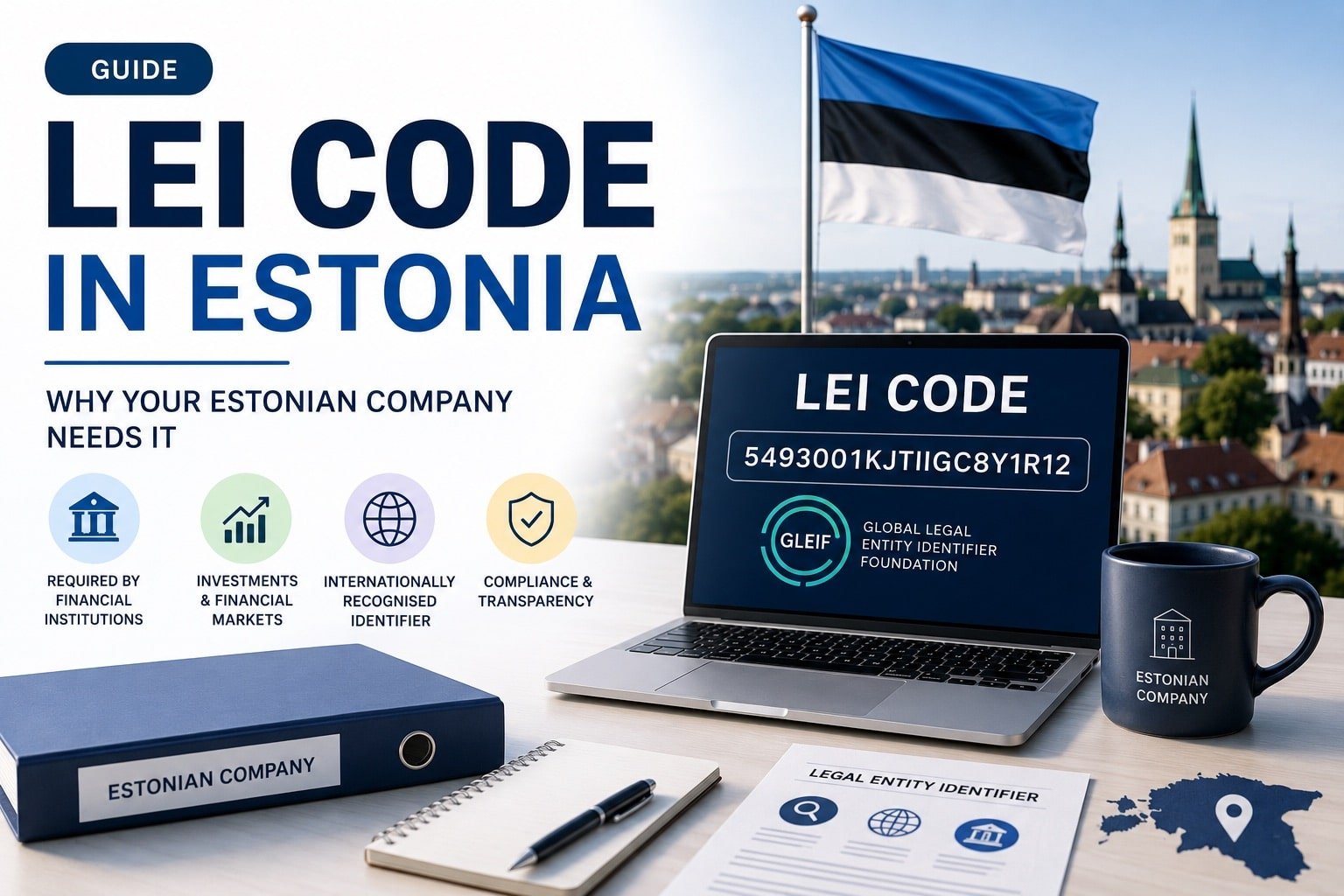
LEI Code in Estonia: Why Your Estonian Company May Need One

Estonia is one of Europe’s most business-friendly jurisdictions, attracting entrepreneurs, startups, holding companies, investment vehicles, and international businesses from around the world. While establishing an Estonian company is relatively simple, many business owners eventually encounter a requirement they may not have heard about before: the LEI Code.

If your Estonian company plans to work with banks, investment firms, financial institutions, or participate in financial markets, obtaining an LEI may become essential.

In this guide, we’ll explain what an LEI Code is, who needs one, how much it costs, and how to obtain one for your Estonian company.

What Is an LEI Code?

A Legal Entity Identifier (LEI) is a unique 20-character identification code assigned to legal entities participating in financial transactions.

Think of it as a global identification number for companies, foundations, associations, investment funds, and other legal entities.

The LEI system was introduced following the global financial crisis to improve transparency and make it easier for regulators and financial institutions to identify the parties involved in financial transactions.

An LEI is recognised in more than 200 jurisdictions worldwide and is governed by the Global Legal Entity Identifier Foundation (GLEIF).

What Does an LEI Code Look Like?

An LEI consists of 20 letters and numbers.

For example:

5493001KJTIIGC8Y1R12

Each LEI is unique and linked to publicly available information about the legal entity.

Why Does an Estonian Company Need an LEI Code?

Not every Estonian company requires an LEI. However, many businesses eventually need one when interacting with financial institutions.

Common situations include:

✔ Opening certain investment accounts

✔ Buying or selling stocks

✔ Trading bonds

✔ Investing in ETFs

✔ Trading derivatives

✔ Participating in financial markets

✔ Working with investment brokers

✔ Issuing securities

✔ Conducting certain regulated financial transactions

Many banks and financial institutions will not process specific transactions unless the company has an active LEI.

Which Estonian Entities Can Obtain an LEI?

An LEI can be issued to most registered legal entities in Estonia, including:

✔ OÜ (Private Limited Company)

✔ AS (Public Limited Company)

✔ MTÜ (Non-Profit Association)

✔ Foundation (SA)

✔ Investment funds

✔ Holding companies

✔ Government entities

✔ Other registered legal persons

As long as the entity is officially registered and has legal status, it can generally apply for an LEI.

Do Small Companies Need an LEI?

Most ordinary small businesses do not need an LEI immediately.

For example, a consulting company providing services to clients will usually operate without one.

However, if the company wishes to:

✔ Open a corporate investment account

✔ Invest company funds in securities

✔ Work with financial institutions

✔ Trade on financial markets

an LEI will often become mandatory.

remote work

LEI Code and Corporate Investment Accounts

This is one of the most common reasons Estonian companies apply for an LEI.

Many brokers and financial institutions require companies to have a valid LEI before they can:

✔ Purchase shares

✔ Trade ETFs

✔ Buy bonds

✔ Access investment platforms

✔ Hold financial instruments

Without an active LEI, the institution may refuse to execute transactions.

LEI Code for Holding Companies

Holding companies frequently require LEIs.

For example, if an Estonian OÜ holds investments in:

✔ Stocks

✔ ETFs

✔ Bonds

✔ Investment funds

✔ Foreign companies

obtaining an LEI is often necessary to satisfy broker and compliance requirements.

LEI Code for Startups

Startups may also need an LEI in certain situations.

This can happen when:

✔ Raising investment capital

✔ Issuing financial instruments

✔ Participating in regulated transactions

✔ Working with institutional investors

Many investors prefer dealing with entities that can be clearly identified through internationally recognised systems such as LEI.

remote work

How Much Does an LEI Code Cost?

The cost depends on the registration agent and the registration period selected.

In most cases, companies pay:

✔ An initial registration fee

✔ An annual renewal fee

Unlike a company registration number, an LEI must be renewed periodically to remain active.

Pricing varies between providers, but annual costs are generally modest compared to the compliance benefits.

How Long Does It Take to Obtain an LEI?

The process is usually very fast.

In many cases, an LEI can be issued within a few hours or within one business day after verification of the company details.

The exact timing depends on the registration agent and the complexity of the application.

What Information Is Required?

Applicants typically need:

✔ Company name

✔ Registration number

✔ Registered address

✔ Legal form

✔ Authorised representative details

The issuing organisation will verify the information against official company registers.

Is an LEI Public?

Yes.

One of the goals of the LEI system is transparency.

Basic information associated with an LEI is publicly available through the global LEI database, including:

✔ Company name

✔ Registration details

✔ Jurisdiction

✔ LEI status

This helps financial institutions verify counterparties and reduce risks.

What Happens If an LEI Expires?

An expired LEI may cause problems when dealing with banks, brokers, and financial institutions.

Some transactions may be rejected until the LEI is renewed.

For this reason, companies using financial services should ensure their LEI remains active at all times.

Advantages of Having an LEI Code

✔ Internationally recognised company identification

✔ Improved credibility with banks and financial institutions

✔ Easier access to investment platforms

✔ Compliance with financial regulations

✔ Faster verification procedures

✔ Greater transparency in cross-border transactions

✔ Required for many corporate investment activities

Final Thoughts

While many Estonian companies can operate successfully without an LEI Code, businesses involved in investments, financial markets, securities trading, or institutional finance will often need one.

For holding companies, investment vehicles, startups raising capital, and companies opening corporate brokerage accounts, obtaining an LEI is often a simple but essential compliance step.

The process is fast, relatively inexpensive, and recognised globally. If your Estonian company plans to invest, trade financial instruments, or work with regulated financial institutions, obtaining an LEI Code early can help avoid delays and ensure smooth operations.

Read more

How to Set Up an MTÜ (NGO) in Estonia: A Simple Guide for Foreigners

Estonia is one of the most digital countries in the world and a popular destination for entrepreneurs, startups, and international organisations.

The country is home to more than 120,000 e-Residents from over 180 countries and has created globally known companies such as Skype, Wise, Bolt, Pipedrive, and Veriff. Estonia is known for its simple administration, digital services, and transparent legal system.

While many people know Estonia as a great place to start a company, fewer know that foreigners can also establish an MTÜ (Mittetulundusühing), which is the Estonian version of a non-profit organisation or NGO.

Whether you want to launch a charity, sports club, educational project, cultural organisation, professional association, or community initiative, an Estonian MTÜ can be an excellent solution.

In this guide, you’ll learn how to register an MTÜ in Estonia, what documents are required, how much it costs, how long it takes, and what options are available if you do not have Estonian e-Residency.

What Is an MTÜ?

An MTÜ is a non-profit organisation. There are approximately 23,000 non-profit organisations registered in Estonia, compared to 288,265 private limited companies (OÜs).

Source: https://ariregister.rik.ee/eng/statistics

Unlike a company, it is not created to generate profits for owners or shareholders. Any income earned by the organisation must be used to support its activities and goals.

An MTÜ – non profit organization – is often used for:

✔ Charities, Sports clubs, Educational projects, Cultural organisations, Professional associations, Community groups, Religious organisations, International NGOs

Imagine three friends who want to make a positive impact across Europe. 🇩🇪 Anna is a teacher from Germany, 🇵🇱 Marek is an IT specialist from Poland, and 🇪🇸 Sofia is a social worker from Spain. Together, they decide to create a non-profit organisation that provides free digital skills training to disadvantaged young people.

Their project includes organising workshops, partnering with schools and local communities, applying for European grants, and accepting donations from private sponsors. They also plan to hire trainers and cooperate with volunteers in several countries.

Instead of setting up a commercial company, they choose to establish an Estonian MTÜ. The legal structure perfectly matches their non-profit goals and provides a recognised European legal entity for their activities.

None of the founders live in Estonia, and they do not have Estonian e-Residency. Fortunately, this is not a problem. They authorise a representative through a Power of Attorney, who completes the registration process on their behalf.

Within a short period, their MTÜ is officially registered in Estonia. The organisation can now sign contracts, receive grants and donations, employ staff, cooperate with international partners, and manage projects across Europe.

An MTÜ can receive donations, apply for grants, hire employees, sign contracts, and own assets.

MTÜ vs OÜ: What’s the Difference?

FeatureOÜ (Private Limited Company)MTÜ (Non-Profit Association)
PurposeConducting business and generating profitNon-profit activities and pursuing a common interest
Profit DistributionAllowed (dividends can be paid to shareholders)Not allowed; profits must be reinvested into the organisation’s objectives
Owners / MembersShareholdersMembers
Minimum Founders12
Management BodyManagement BoardManagement Board
Main GoalCommercial activitiesSocial, cultural, educational, charitable, sports, or other non-commercial activities
TaxationSubject to corporate taxation rulesTax benefits may apply depending on activities and status
Popularity in EstoniaApproximately 288,265 registered entitiesApproximately 23,000 registered entities
Suitable ForBusinesses, startups, consulting, e-commerce, investmentsClubs, associations, charities, community projects, NGOs

Who Can Register an MTÜ?

Estonia allows both locals and foreigners to establish an MTÜ.

You need:

✔ At least two founders

✔ At least one board member

✔ A unique organisation name

✔ Articles of Association

There are no nationality restrictions.

Foreign individuals and foreign organisations can be founders or board members.

How Much Does It Cost?

The official Estonian state fee for MTÜ registration is currently EUR 30.

Additional costs may apply if you need:

✔ Notarial services

✔ Apostille or legalisation

✔ Certified translations

✔ Professional registration assistance

remote work

How Long Does Registration Take?

Estonia is known for fast registration procedures.

In most cases, an MTÜ is registered within approximately five business days after the application has been submitted.

The process may take longer if documents need to be notarised or sent internationally.

How to Register an MTÜ in Estonia

The registration process is relatively simple.

✔ Choose a Name

Your organisation must have a unique name that is not already registered in Estonia.

✔ Prepare the Articles of Association

This document explains the purpose of the organisation, membership rules, management structure, and decision-making procedures.

✔ Appoint the Board

Every MTÜ needs at least one board member who will represent the organisation.

✔ Submit the Application

The registration documents are submitted to the Estonian Business Register.

✔ Pay the State Fee

The registration fee must be paid before the application can be processed.

✔ Receive Registration Confirmation

Once approved, your MTÜ receives its registration number and becomes an official legal entity.

What If I Don’t Have e-Residency?

Many people think they need Estonian e-Residency to establish an MTÜ.

This is not true.

You can register an MTÜ even if you:

✔ Do not have e-Residency

✔ Do not have an Estonian ID card

✔ Have never visited Estonia

✔ Live outside the European Union

While e-Residency can make some procedures easier, it is not required.

Can I Register an MTÜ Remotely?

Yes.

If you cannot travel to Estonia, you can usually establish an MTÜ through a Power of Attorney (PoA).

This means you authorise a representative to complete the registration process on your behalf.

The process usually includes:

✔ Preparing the incorporation documents

✔ Signing a Power of Attorney before a local notary

✔ Obtaining an apostille if required

✔ Sending the documents to Estonia

✔ Registration by an authorised representative

This option is very popular among international founders.

Advantages of an Estonian MTÜ

There are many reasons why foreign founders choose Estonia.

European Union Legal Entity

Your organisation operates within an EU member state.

Remote Registration

You can often register an MTÜ without travelling to Estonia.

Open to Foreigners

There are no nationality restrictions for founders.

Low Registration Costs

The state fee is only EUR 30.

Fast Registration

Most registrations are completed within a few business days.

Modern Digital Environment

Estonia is one of the world’s most advanced digital societies.

Good International Reputation

Estonian legal entities are respected throughout Europe and internationally.

Flexible Structure

An MTÜ can receive donations, hire staff, own property, and apply for grants.

Does an MTÜ Pay Taxes?

An MTÜ is not automatically exempt from taxes.

Depending on its activities, it may need to pay:

✔ Employment taxes

✔ VAT

✔ Taxes on certain benefits

✔ Taxes related to commercial activities

Many organisations use professional accounting services to ensure compliance with Estonian regulations.

remote work

Is an Estonian MTÜ Right for You?

An MTÜ may be the right choice if you want to establish:

✔ A charity

✔ An NGO

✔ A sports club

✔ A cultural association

✔ An educational organisation

✔ A community project

✔ A professional network

✔ An international non-profit initiative

If your goal is to run a commercial business and earn profits, an OÜ is usually a better option.

Final Thoughts

Estonia offers one of the simplest and most efficient systems in Europe for establishing a non-profit organisation.

With a state registration fee of only EUR 30, a registration time of around five business days, and the possibility of remote incorporation through a Power of Attorney, foreign founders can establish an Estonian MTÜ quickly and efficiently.

Most importantly, you do not need Estonian e-Residency to get started. Even if you have never visited Estonia, it is possible to create and manage an Estonian NGO while benefiting from the country’s modern digital infrastructure and strong international reputation.

Read more

How to Budget for a Retail Store Fit-Out Without Overspending

Starting an online store is exciting, but many entrepreneurs focus on products, marketing and website design while overlooking the business foundations that support long-term success.

Before launching, it is important to establish the right company structure, understand your tax obligations and consider where your business should be registered. Factors such as VAT requirements, accounting responsibilities, payment processing and cross-border sales regulations can have a significant impact on both costs and future growth.

A successful eCommerce business is built on more than just sales. Taking the time to address legal, financial and operational considerations from the beginning can help avoid costly mistakes and create a stronger foundation for sustainable growth. Start Amazon business in the EU.

Start With Your Store Objectives Before Setting a Budget

Before allocating a single dollar, define what the store needs to achieve.

A convenience store, supermarket, pet store and pharmacy all have very different fit-out requirements. Product size, inventory volume, customer traffic and merchandising strategies will influence how much needs to be invested.

Questions worth answering early include:

  • How many products will be displayed?
  • What types of shelving will be required?
  • Will the store need checkout counters?
  • How much stock will be stored on the shop floor?
  • Is future expansion likely?

Retailers who start with clear operational goals often make better purchasing decisions because every expense can be measured against a specific business need.

Break the Budget Into Major Fit-Out Categories

One of the easiest ways to lose control of spending is treating the fit-out as a single expense.

Breaking costs into categories creates visibility and helps identify areas where adjustments can be made if necessary.

Cost CategoryTypical Inclusions
Shelving & DisplaysGondola shelving, wall shelving, display units
Shop FixturesCounters, display cabinets, service areas
FlooringVinyl, tiles, timber flooring
LightingGeneral lighting and feature lighting
Electrical WorksWiring, power points, compliance work
Signage & BrandingExternal and internal signage
InstallationLabour and assembly costs
ContingencyUnexpected project expenses

Creating separate budgets for each category reduces the likelihood of unexpected overspending later in the project.

Calculate Shelving Costs Early to Avoid Budget Blowouts

Shelving is often one of the largest investments in a retail fit-out.

Unfortunately, it is also one of the most commonly underestimated costs. Retailers frequently focus on floor space while overlooking factors such as shelving depth, shelf quantities, accessories, end bays and installation requirements.

The earlier shelving costs are calculated, the easier it becomes to create an accurate fit-out budget.

Retailers can use tools that help them calculate gondola shelving costs before finalising store layouts. This provides a clearer understanding of expected investment levels and allows budget adjustments before purchasing decisions are made.

Early planning also helps avoid costly redesigns once installation begins.

Common Retail Fit-Out Expenses That Are Often Forgotten

Many budget overruns come from costs that were never included in the original estimate.

Consider the following examples:

Freight and Delivery

Large shelving systems and fixtures often require specialised transport. Delivery expenses can vary significantly depending on location and order size.

📌 Installation Labour

Some retailers budget for products but forget to account for installation time and labour costs.

📌 Compliance Requirements

Electrical upgrades, accessibility requirements and safety compliance work can create unexpected expenses during the fit-out process.

📌 Technology Systems

Point of sale equipment, security systems, networking infrastructure and payment terminals are frequently overlooked.

📌 Future Expansion

Stores often grow faster than anticipated. Choosing systems that can expand later may reduce future costs.

Small overlooked expenses can collectively become one of the largest causes of budget overruns.

Where Retailers Can Reduce Costs Without Sacrificing Store Quality

Reducing costs does not automatically mean reducing quality. In many cases, spending can be lowered through better planning rather than cheaper products.

Some practical approaches include:

  1. Simplify aisle layouts to reduce unnecessary shelving.
  2. Standardise shelving systems throughout the store.
  3. Choose modular fixtures that can be reconfigured later.
  4. Avoid excessive custom-built displays.
  5. Phase non-essential upgrades into future stages.
  6. Purchase systems designed for long-term use.

Retailers often achieve better financial outcomes when they focus on functionality first and aesthetics second.

Why Good Shelving Planning Saves Money Long Term

A retail fit-out should be viewed as a long-term investment rather than a one-time expense.

Poor shelving decisions often create ongoing costs through replacements, store reconfigurations and inefficient use of floor space.

Well-planned shelving systems can deliver benefits such as:

  • Improved stock capacity
  • Faster replenishment
  • Better customer navigation
  • Easier merchandising updates
  • Reduced future refurbishment costs

Choosing flexible systems from the beginning often proves more economical than replacing unsuitable fixtures later.

How Mills Shelving Helps Retailers Control Fit-Out Costs

Many retail fit-out budgets become difficult to manage because retailers are forced to make decisions without accurate shelving information.

Mills Shelving helps simplify that process by providing shelving solutions designed specifically for retail environments.

Their systems support:

  • Supermarkets
  • Convenience stores
  • Pet stores
  • Liquor stores
  • Pharmacies
  • Specialty retail stores

Beyond supplying shelving, Mills Shelving assists retailers with layout planning, shelving configuration and installation support.

Because the shelving systems are modular, retailers can expand or reconfigure stores without replacing entire shelving runs. That flexibility helps reduce long-term costs and supports future growth.

Fast delivery, available stock and practical retail experience also help retailers avoid many of the delays and budget surprises that commonly affect fit-out projects.

Final Budgeting Checklist Before Starting Your Fit-Out

Before committing to suppliers and purchases, review the following checklist:

📋 Final Budgeting Checklist Before Starting Your Fit-Out

💰 Confirm total project budget

📂 Separate costs into categories

🛒 Calculate shelving requirements

🚚 Include delivery and freight expenses

🔧 Include installation costs

💻 Budget for technology systems

🛡️ Allocate contingency funds

📈 Review future expansion requirements

⏳ Confirm supplier lead times

📐 Finalise store layout plans

Completing these steps can significantly reduce the risk of unexpected spending during the fit-out process.

Do you want to sell in Europe? Choose Estonia as your company location.

For entrepreneurs looking to enter the European market, Estonia offers one of the most modern and business-friendly environments in the EU. Through the e-Residency programme, founders from almost anywhere in the world can establish and manage an Estonian company entirely online without relocating to Estonia.

One of the biggest advantages of an Estonian company is its unique corporate tax system. Profits retained within the business and reinvested into growth are generally not subject to corporate income tax. Taxation is deferred until profits are distributed as dividends, allowing companies to scale more efficiently and preserve cash flow during the growth phase.

Estonia is also an attractive option for eCommerce businesses that plan to sell across the European Union. As an EU-based company, you can access European payment providers, build trust with customers and simplify many aspects of cross-border trade.

For online sellers, VAT compliance is a crucial consideration. An Estonian company can register for VAT when required and participate in the EU VAT framework, including the One Stop Shop (OSS) scheme, which allows eligible businesses to report and pay VAT for sales to consumers across multiple EU countries through a single system rather than registering separately in every member state.

remote work

Combined with digital company management, online administration and a transparent legal framework, Estonia remains one of the most attractive jurisdictions for entrepreneurs building international online businesses.

Before launching your online store, it is worth considering not only your products and marketing strategy but also where your company will be registered. The right business structure can make expansion into European markets significantly easier.

Conclusion

Retail store fit-outs rarely go over budget because of one major expense. More often, costs increase through a series of small oversights and unplanned decisions.

Retailers who define their objectives early, calculate shelving requirements accurately and account for hidden expenses generally achieve far better financial outcomes.

A well-planned fit-out creates a store that functions efficiently from day one, while also providing the flexibility to grow without unnecessary future costs.

Read more

10 Countries That Make Remote Work and Online Business Easier in 2026

Remote work is no longer a niche lifestyle. Millions of people now earn a living while travelling or living abroad, choosing destinations based on lifestyle, cost of living, internet quality, and business opportunities.

The number of digital nomads continues to grow every year. Recent digital nomad statistics estimate that there are now around 43 million digital nomads worldwide.

Governments have also started competing for remote workers. Today, around 66 countries offer some form of visa or residency option for location-independent professionals, according to this list of digital nomad visa countries. Europe has been particularly active, with more than 40 countries introducing remote work visa programmes in recent years, including tax free countries.

This shift has been supported by growing internet access around the world. According to the latest global internet access data, 70.3% of the world’s population is now online, making remote work possible in more places than ever before.

As a result, some countries have become clear favourites among remote workers and online business owners. While some attract people with low living costs, others stand out for their tax systems, visa options, infrastructure, or quality of life.

If you’re planning to work remotely or run an online business in 2026, here are ten countries worth considering.

Portugal

Portugal remains one of Europe’s most attractive destinations for remote workers and online entrepreneurs. The country offers a Digital Nomad Visa, access to the EU market, and a well-developed startup ecosystem centred around Lisbon and Porto.

In Portugal, overseas residents can apply for a permanent visa, similar to the indefinite leave to remain in the UK, after 5 years of living and working there. Its affordable living options and leading digital infrastructure have made it a go-to destination for remote workers.

For entrepreneurs planning a long-term move, Portugal provides a relatively straightforward path to residency. To register as a resident, open bank accounts, sign rental agreements, or carry out many administrative activities, foreign nationals typically need a NIF (Número de Identificação Fiscal).

Lisbon is also home to Web Summit, one of the world’s largest technology conferences, and has attracted major international employers including Google, Microsoft, Cloudflare, and Mercedes-Benz Tech.

Key Facts

🌍 Capital: Lisbon

💶 Currency: Euro (EUR)

📄 Digital Nomad Visa: Available

🆔 Required Tax Number: NIF (Número de Identificação Fiscal)

🏢 Major Companies: Google, Microsoft, Cloudflare, Mercedes-Benz Tech

📍 Popular Locations: Lisbon, Porto, Madeira

Thailand

Thailand remains one of the world’s most established destinations for digital nomads. Bangkok offers a modern business environment with excellent connectivity, while Chiang Mai continues to attract freelancers and entrepreneurs thanks to its affordability and strong remote work community.

Thailand’s Destination Thailand Visa (DTV) has made longer stays easier for location-independent professionals.

Key Facts

🌍 Capital: Bangkok

💶 Currency: Thai Baht (THB)

📄 Remote Work Visa: Destination Thailand Visa (DTV)

🆔 Required Tax Number: Thai Tax Identification Number

🏢 Major Companies: Agoda, Grab, Lazada, CP Group

📍 Popular Locations: Bangkok, Chiang Mai, Phuket

no income tax country

United Arab Emirates

The UAE has become one of the world’s leading destinations for entrepreneurs, consultants, and online business owners. Dubai attracts founders looking for modern infrastructure, international connectivity, low taxes, and a business-friendly environment. The country also offers options for remote workers and remains a popular choice for international entrepreneurs thanks to its stable economy, simple company registration process, and strategic location between Europe, Asia, and Africa.

Key Facts

🌍 Capital: Abu Dhabi

💶 Currency: UAE Dirham (AED)

📄 Remote Work Visa: Available

🆔 Required ID: Emirates ID

🏢 Major Companies: Amazon, Meta, Salesforce, Emirates

📍 Popular Locations: Dubai, Abu Dhabi

Mexico

Mexico has become one of the most popular destinations for remote workers in the Americas. Its proximity to the United States, favourable time zones, lower living costs, and large international community make it especially attractive for entrepreneurs, freelancers, and online business owners. The country also offers a Temporary Resident Visa, which allows eligible remote workers and self-employed professionals to stay in Mexico for longer periods.

Many remote workers choose Mexico City, Playa del Carmen, or Puerto Vallarta as their base thanks to their reliable internet, coworking spaces, international communities, and relatively affordable cost of living.

Key Facts

🌍 Capital: Mexico City

💶 Currency: Mexican Peso (MXN)

📄 Remote Work Option: Temporary Resident Visa

🆔 Required Tax Number: RFC (Registro Federal de Contribuyentes)

🏢 Major Companies: Amazon, Uber, Mercado Libre, IBM

📍 Popular Locations: Mexico City, Playa del Carmen, Puerto Vallarta

Colombia

Colombia has become one of Latin America’s fastest-growing destinations for remote professionals. Medellín is especially popular among entrepreneurs thanks to its spring-like climate, affordable cost of living, growing startup ecosystem, and strong community of international founders and freelancers. The city is often referred to as the “City of Eternal Spring” because of its mild temperatures throughout the year.

The country’s Digital Nomad Visa allows eligible remote workers, freelancers, and online business owners to live and work remotely from Colombia for up to two years, making it an increasingly attractive option for location-independent professionals.

Key Facts

🌍 Capital: Bogotá

💶 Currency: Colombian Peso (COP)

📄 Digital Nomad Visa: Available

🆔 Required ID: Cédula de Extranjería

🏢 Major Companies: Rappi, Accenture, Amazon Web Services

📍 Popular Locations: Medellín, Bogotá, Cartagena

Indonesia

Indonesia, especially Bali, remains one of the most recognised destinations for digital nomads worldwide. The island combines a relatively low cost of living, established coworking hubs, reliable infrastructure in key areas, and a large international community of entrepreneurs, freelancers, and remote workers. Popular locations such as Ubud, Canggu, and Uluwatu have developed thriving ecosystems built around remote work and online businesses.

Many founders, freelancers, and remote workers initially move to Bali for a short stay but end up staying much longer thanks to the island’s lifestyle, networking opportunities, and year-round tropical climate. Indonesia also offers visa options for longer stays, with details available through the official Indonesian eVisa Portal

Key Facts

🌍 Capital: Jakarta

💶 Currency: Indonesian Rupiah (IDR)

📄 Remote Work Options: Multiple long-stay visa programmes

🆔 Required Tax Number: NPWP (for tax residents)

🏢 Major Companies: GoTo, Tokopedia, Google, Traveloka

📍 Popular Locations: Bali, Jakarta, Canggu, Ubud

Spain

La se grada familia

Spain continues to attract remote professionals thanks to its warm climate, modern infrastructure, excellent healthcare system, and high quality of life. The introduction of the Digital Nomad Visa has further strengthened its position as one of Europe’s leading destinations for location-independent workers. Many entrepreneurs are also drawn to Spain’s vibrant startup scene, particularly in Barcelona and Madrid.

Barcelona, Madrid, Valencia, and Málaga remain among the most popular choices. Spain is also familiar to many Poles thanks to Robert Lewandowski, who has spent several years living and playing in Barcelona for FC Barcelona, further highlighting the country’s appeal as a place to live and work.

Key Facts

🌍 Capital: Madrid

💶 Currency: Euro (EUR)

📄 Digital Nomad Visa: Available

🆔 Required Identification Number: NIE (Número de Identidad de Extranjero)

🏢 Major Companies: Amazon, IBM, Oracle, Telefónica

📍 Popular Locations: Barcelona, Madrid, Valencia, Málaga

no income tax country

Vietnam

Vietnam offers one of the best value-for-money lifestyles available to remote workers. Cities such as Ho Chi Minh City and Da Nang provide reliable internet, growing startup communities, and significantly lower living costs than many Western countries.

The country continues to attract freelancers, consultants, and startup founders looking to maximise their budgets.

Key Facts

🌍 Capital: Hanoi

💶 Currency: Vietnamese Dong (VND)

📄 Remote Work Option: Long-term business and investor visa routes

🆔 Required Tax Number: Vietnamese Tax Identification Number

🏢 Major Companies: Samsung, Intel, LG, FPT Software

📍 Popular Locations: Ho Chi Minh City, Hanoi, Da Nang

Montenegro

Montenegro has quietly become a popular destination for remote workers seeking a slower pace of life while remaining close to European markets. The country’s Adriatic coastline and mountain scenery continue to attract entrepreneurs and freelancers.

Although smaller than many destinations on this list, Montenegro’s popularity among remote professionals continues to grow.

Key Facts

🌍 Capital: Podgorica

💶 Currency: Euro (EUR)

📄 Remote Work Programme: Available

🆔 Required Tax Number: PIB

🏢 Major Companies: Porto Montenegro, Adriatic Marinas, Erste Bank

📍 Popular Locations: Budva, Kotor, Tivat, Podgorica

Costa Rica

Costa Rica has built a strong reputation among remote professionals looking for a balance between work and lifestyle. Its Digital Nomad Visa allows eligible applicants to stay for extended periods while working remotely.

The country’s political stability and natural beauty continue to attract professionals from North America and Europe.

Key Facts

🌍 Capital: San José

💶 Currency: Costa Rican Colón (CRC)

📄 Digital Nomad Visa: Available

🆔 Required Identification Number: DIMEX (for residents)

🏢 Major Companies: Intel, IBM, Amazon, HP

📍 Popular Locations: San José, Tamarindo, Santa Teresa, Jacó

Which Countries Offer e-Residency?

For many remote professionals, choosing where to live is only one part of the equation. The second question is where to register and manage an online business.

While dozens of countries now offer digital nomad visas, very few provide a true e-Residency programme that allows entrepreneurs to run a company remotely through government-backed digital services.

Estonia remains the global leader in this area. Its e-Residency programme allows entrepreneurs to establish and manage an EU company entirely online, regardless of where they live. Business owners can sign documents digitally, access company services remotely, and operate location-independent businesses from virtually anywhere in the world.

This has made Estonia particularly attractive to freelancers, consultants, agency owners, SaaS founders, and online entrepreneurs serving international clients.

no income tax country

Countries Offering e-Residency or Similar Programmes

🇪🇪 Estonia

🇱🇹 Lithuania

🇦🇿 Azerbaijan

🇺🇦 Ukraine

🇵🇼 Palau

Among these countries, Estonia remains the most developed and internationally recognised e-Residency ecosystem available today.

Which Country Is Right for You?

There is no single best country for every remote worker or online entrepreneur.

Some people focus on low living costs, while others prioritise taxation, business opportunities, infrastructure, lifestyle, or access to international markets.

The most successful remote professionals usually think beyond where they want to live. They also consider where they want to build, manage, and grow their business.

Whether you’re attracted by Portugal’s startup ecosystem, Thailand’s affordability, Dubai’s business environment, Bali’s entrepreneurial community, or Estonia’s digital business infrastructure, the opportunities for location-independent professionals have never been greater.


Read more

Taxi Booking App Providers and Their Role in Legal Compliance for Startups

Legal Compliance Starts With Your Taxi App Provider

Launching a ride-hailing business sounds straightforward until you realize how many legal obligations sit between you and your first paid trip. The platform you choose will shape your ability to meet every one of them.

There’s a moment in every taxi startup founder’s journey when the initial excitement gives way to something more sobering. The app concept makes sense, the market looks promising but then you start looking at what operating a transport platform actually requires. Driver verification. GDPR-compliant data handling. Payment processing that satisfies financial regulators. Tax records that hold up at audit time. Terms and privacy policies that are actually yours to edit.

None of this is impossible to navigate, but here’s what most founders don’t realize early enough: your choice of taxi app provider directly affects how easily you can satisfy these requirements. This is especially true if you’ve registered your company in a jurisdiction like Estonia, where digital-friendly formation and EU legal obligations come as a package deal.

What follows is a look at what four established providers actually offer in these areas based entirely on what they publicly document about their own products.

e-residency refusal

Why the Platform Choice Matters Legally

When your app goes live, it immediately touches a range of regulatory pressure points. Riders share their names, locations, trip history, and payment details all of which fall under GDPR data obligations if you’re operating within the EU or registered under an EU jurisdiction such as an Estonian OÜ. That means documented consent flows, secure storage, and the ability to fulfill user data requests or deletions on demand.

Payments must pass through PCI-DSS compliant gateways, and which gateways are available to you depends on what your app provider supports. Driver records are another area where regulators frequently intervene: many transport authorities require operators to verify driver identity, license validity, and vehicle insurance before a driver is allowed to take fares. Your platform either supports this natively, or you’re managing it manually which introduces both operational overhead and compliance risk.

Then there’s the financial reporting layer. Every trip is a transaction, and your admin panel needs to produce clear records for VAT filing and annual reporting. In Estonia, for example, companies must file annual reports and maintain proper accounting documentation. If your platform’s export tools can’t produce clean transaction records, that becomes your problem at tax time.

The platform you select isn’t just infrastructure it determines what compliance tools you have access to from day one, and what you’ll need to build or manage manually.

e-residency refusal

4 TOP Taxi Booking App Providers + Their Compliance-Relevant Features

Uberclone.co

Feautures: AI-powered white-label platform 🏆 400+ projects 🏆 97+ countries

Uberclone.co positions itself as a full-stack solution for founders who want to run an actual business rather than simply deploy an app. Their offering includes a rider app, driver app, admin panel, and dispatcher panel and their compliance-relevant features are worth examining closely.

The most significant from a regulatory standpoint is source code ownership. When your jurisdiction requires data to be stored within specific geographic boundaries, controlling your own source code means controlling where that data lives. This is a meaningful distinction from providers who host everything on their own servers.

Their platform supports 249 languages and multiple currencies out of the box, which matters for cross-border startups dealing with varying tax display requirements. Multiple payment gateway integrations allow operators to work with locally compliant processors rather than being locked into a single option. The admin panel includes driver onboarding with document upload and performance tracking the kind of record-keeping that transport regulators typically want to see.

Other practical features include editable terms and conditions, an analytics dashboard suitable for financial reporting, and masked phone numbers for protecting personal data during driver-rider communication a GDPR-relevant detail. All packages reportedly come with a Non-Disclosure Agreement covering your business data when working with the provider.

Elluminati

Feautures: 🏆 14+ years in operation 🏆 450+ clients 🏆Rydex platform

One of the more established taxi app development company is Elluminati Inc. It has been around long enough that their platform has been deployed in actual compliance scenarios by real operators across multiple regulatory environments. That operational track record is worth something when you’re evaluating whether a feature actually works in practice.

Their taxi app offering, built on a platform called Rydex, specifically highlights AI-driven driver verification automating document checks, identity validation, and periodic re-verification. They present this as both a passenger safety measure and a compliance mechanism, which is exactly the framing that matters to transport regulators. Multi-region tax compliance is documented as a platform capability, useful for startups planning to expand across jurisdictions.

On the data and payments side, Elluminati offers multiple currency, language, and gateway support, along with what they describe as industry-standard secure coding and pre-delivery security testing. Their commission management system, which handles varying rates across cities and countries alongside wallet payment settlement, gives operators the financial granularity needed for accurate record-keeping and reporting.

It’s worth noting, as with any provider, that correct configuration for your specific jurisdiction is still the operator’s responsibility.

AppDupe

Feautures: 🏆 One-time purchase 🏆 Lifetime source code

AppDupe’s model differs from subscription-based alternatives: operators purchase the complete source code outright, including PHP, JS, CSS, and AJAX. This is documented in their End User License Agreement and has direct implications for data compliance if you own the code, you control the hosting environment, which means you control where user data is stored and processed.

The platform is fully white-labeled, allowing operators to run everything under their own brand with their own terms. Their admin dashboard covers booking management, real-time tracking, dispatch, and analytics reporting. For cloud-based operators, this removes the need to manage server infrastructure while still maintaining control over data operations at the application level.

One thing to be aware of: AppDupe’s EULA is explicit that they reserve the right to restrict use if their terms are violated, and they do not offer refunds for buyers who fail to assess the software adequately before purchase. Reading the license terms carefully before committing is especially important here.

SpotnRides

Feautures: 🏆 By Uplogic Technologies 🏆 Operating since 2017 🏆 Rider, driver & dispatch apps

SpotnRides stands out for one specific feature that’s particularly relevant to operators in regulated markets: driver document verification is built directly into the app rather than managed externally. Drivers can upload identity proof, license documentation, and vehicle registration certificates from within the platform. For founders who need to demonstrate driver compliance to transport authorities, having this process native to the app rather than handled through separate systems simplifies both operations and documentation.

The platform also stores complete transaction history with timestamps, the kind of audit trail that VAT filing and annual reporting depend on. In-app wallets and multiple payment methods are supported, with stated security provisions covering trips, personal data, and payment processing. The platform is white-labeled and customizable for local market needs.

SpotnRides is marketed toward both startups and established operators. The explicit driver document management capability is the feature most likely to matter in markets where regulators actively audit operator compliance records.

e-residency refusal

Questions to Ask Before You Commit

Based on what these providers actually document, here are the questions that matter most before signing anything:

  • Source code ownership
    Who holds copyright, and under what conditions? Some providers include full ownership in their base packages; others restrict it to higher tiers or subscription models. Understand what you’re buying and what happens if you stop paying.
  • Data storage location
    Under GDPR, user data must be stored in a compliant location. If the provider controls your hosting, you need to know where their servers are situated and whether that meets your jurisdiction’s requirements.
  • Terms and privacy policy control
    This should be a baseline feature but verify before purchasing. You need to be able to publish and update your own legal documents without depending on the provider’s templates.
  • Payment gateway availability
    Not every gateway operates in every country. Confirm that the processors supported by the platform are available in your market and satisfy local financial regulations.
  • Driver document management
    If your transport authority expects verification records, the platform needs to support this natively. Manual workarounds create both compliance risk and administrative burden.
  • Financial record exports
    Test the export functionality before committing. You need clean, complete transaction records for VAT filing and annual reporting and discovering export limitations after launch is a painful problem to solve.

A Note on Estonian Registration and What It Means for Your App

Estonia’s OÜ structure has become a popular choice for founders because of its digital-first formation process, zero corporation tax on retained profits, and access to the EU market with meaningful startup support infrastructure. But registration is just the beginning of your compliance obligations.

A key advantage of an Estonian OÜ is the 0% corporate income tax on retained and reinvested profits. In practice, this means that as long as the company does not distribute dividends, it can reinvest earnings into growth, hiring, or product development without immediate corporate tax burden. Taxation only occurs when profits are distributed , which gives founders significantly more flexibility in managing cash flow and scaling operations – it does men that Estonia is a tax free country.

Estonia is also one of the most digitally advanced jurisdictions in the world thanks to its e-Residency program and fully online company formation system. A company can be registered remotely in a matter of hours, with banking, accounting, and administration largely handled through digital platforms. This reduces operational friction for international founders who want to operate within the EU without relocating.

This structure has been widely adopted by global startup founders, particularly in the tech and mobility sectors. One of Estonia’s most famous success stories is Estonia-based ride-hailing company Bolt (formerly Taxify), which expanded rapidly across Europe and Africa using this regulatory and digital infrastructure advantage. Similarly, companies like Wise (formerly TransferWise) and early-stage startups such as Skype (originally developed in Estonia) helped establish Estonia’s reputation as a serious global tech hub.

From a regulatory standpoint, an Estonian OÜ operating across EU markets must comply fully with EU-wide frameworks such as GDPR. This applies regardless of where users, drivers, or servers are physically located. For example, a taxi booking or mobility platform must ensure that consent flows at onboarding, data processing agreements, and mechanisms for data deletion requests are properly implemented from day one. In practice, this makes compliance architecture a core part of product design rather than an afterthought.

Retrofitting compliance systems after launch is typically significantly more expensive and technically complex than building on infrastructure that already supports GDPR principles natively.

For this reason, providers that allow source code ownership, modular architecture, and full control over data hosting are often better positioned for long-term regulatory compliance. They enable founders to adapt their systems to evolving EU legal requirements without being locked into closed ecosystems or limited backend configurations.

e-residency refusal

The Bottom Line

Every provider covered here offers white-label taxi booking software with admin dashboards, payment gateway integrations, and driver management tools. These aren’t differentiators, they’re table stakes. The differentiation lives in the details: where your data goes, who owns the code, how driver verification is handled, and what financial records you can actually extract.

No provider eliminates your legal obligations. You still need to configure the platform correctly, engage legal counsel familiar with your target market, and ensure your company registration and operational practices stay aligned. But starting with a platform that already has the right structural features puts you in a far better position than trying to build compliance capabilities after your first passengers are already riding.

The technical choice and the compliance choice are the same decision. It’s worth treating them that way from the beginning.

Read more
Company in Latvia - full guide 2026

Guide to Company Formation in Latvia in 2026

Latvia is a strategically located Northern European country situated between Estonia and Lithuania, with direct access to the Baltic Sea and strong trade connections to both Western and Eastern Europe. Over the last decade, Latvia has become an increasingly attractive destination for startups, international entrepreneurs, e-commerce businesses, consultants, and holding companies looking to establish a presence within the European Union.

Latvia joined the European Union in 2004, became part of the Schengen Area in 2007, and adopted the euro (EUR) as its official currency in 2014. As a member of the Eurozone, Latvian companies benefit from access to the EU single market of more than 440 million consumers and simplified cross-border business operations.

One of the main reasons entrepreneurs choose Latvia is its corporate tax system, which is similar to the Estonian model. Corporate income tax is generally applied only when profits are distributed, while retained and reinvested profits can remain untaxed. This allows businesses to reinvest capital into growth and expansion more efficiently.

Latvia is also known for its relatively low operating costs, modern digital infrastructure, skilled multilingual workforce, and transparent legal environment. Riga, the capital of Latvia, has developed into an important regional business hub for technology companies, consulting firms, fintech startups, logistics businesses, and international trading companies.

For entrepreneurs looking to expand into Europe, Latvia offers a combination of EU market access, efficient taxation, relatively low business costs, and straightforward company registration procedures.

This guide explains the company formation process in Latvia, including legal requirements, taxes, banking, registration costs, and practical considerations for foreign founders in 2026.

Why Entrepreneurs Choose Latvia

Latvia has become one of the most attractive jurisdictions in the Baltic region for international entrepreneurs and investors.

One of the key advantages is Latvia’s corporate tax system, which follows a model similar to Estonia. Corporate income tax is generally paid only when company profits are distributed. Retained or reinvested profits are not taxed immediately, allowing companies to use capital more efficiently for business growth.

Key advantages of Latvia include:

  • 0% corporate tax on retained and reinvested profits
  • Corporate tax generally applied only to distributed profits
  • Access to the EU single market
  • Euro (EUR) as the official currency
  • Relatively low operational and administrative costs
  • Fast company registration procedures
  • Modern fintech and digital banking infrastructure
  • Strategic geographic location between Western and Eastern Europe
  • Transparent and EU-regulated legal framework

Latvia is particularly attractive for:

  • IT and software companies
  • E-commerce businesses
  • Consulting firms
  • Marketing agencies
  • Logistics and transport companies
  • International trading businesses
  • Holding and investment structures

Another important advantage is the flexibility for foreign entrepreneurs. Non-residents can fully own and manage Latvian companies, and many registration procedures can be completed remotely.

Compared to many Western European jurisdictions, Latvia offers significantly lower office rental costs, salaries, and administrative expenses while maintaining access to the European market and banking system.

Most Common Business Structure in Latvia

The most popular legal entity for foreign entrepreneurs is the Limited Liability Company (SIA)Sabiedrība ar Ierobežotu Atbildību.

An SIA is similar to an LLC in many other countries and is suitable for both small businesses and international companies.

Benefits of an SIA include:

  • Limited liability protection
  • Flexible ownership structure
  • Simple management requirements
  • Professional business image
  • Eligibility for local and international operations

For most foreign founders, the SIA is considered the most practical and efficient company structure in Latvia.

PRO TIP for holding companies:

You can register a company as a foreigner from USA. Incorporate a business in the USA , then prepare Apostille , extract from Commercial Register and your USA company will be 100% shareholder a a legal person in Latvian commpany

Requirements to Start a Company in Latvia

Before registering a company in Latvia, several key requirements must be prepared.

Company Name

The company name must be unique and approved by the Latvian Register of Enterprises.

Registered Office Address

Every Latvian company must have a registered legal address located in Latvia.

Share Capital

A standard SIA typically requires share capital. Reduced-capital companies may also be available under certain conditions.

Shareholders and Directors

A Latvian company may have:

  • One or multiple shareholders
  • One or multiple board members

There are generally no nationality restrictions for foreign shareholders or directors.

Step-by-Step Company Formation Process in Latvia

Step 1: Choose a Business Structure

Most foreign entrepreneurs choose an SIA because of its flexibility and liability protection.

Step 2: Reserve a Company Name

The proposed company name must be checked and approved before registration.

Step 3: Prepare Incorporation Documents

Typical registration documents include:

  • Articles of Association
  • Shareholder details
  • Director information
  • Registered office address
  • Share capital confirmation

Foreign founders may also need identification documents and additional compliance verification depending on the company structure.

Step 4: Register the Company

The application is submitted to the Latvian Register of Enterprises.

Depending on the structure and documentation, registration can usually be completed within several business days.

Step 5: Open a Business Bank Account

After incorporation, entrepreneurs may open a corporate bank account or use licensed fintech payment institutions for international transactions and multi-currency operations.

Step 6: Register for Taxes

VAT registration may be required depending on business activity and annual turnover.

Companies hiring employees in Latvia must also comply with payroll tax and social contribution regulations.

Can Foreigners Open a Company in Latvia?

Yes. Foreign entrepreneurs and international companies can fully own and manage a Latvian company.

Latvia remains attractive for non-resident founders because:

  • Company ownership is open to foreigners
  • Remote registration may be possible
  • EU market access is available
  • Business regulations are transparent
  • International banking and fintech solutions are accessible

Many entrepreneurs work with professional company formation providers to simplify registration, compliance, and accounting procedures.

Corporate Taxes in Latvia

Latvia is known for having one of the more business-friendly corporate tax systems in Europe. The country operates a taxation model similar to Estonia, where corporate income tax is generally paid only when profits are distributed.

This structure is particularly attractive for startups, e-commerce businesses, consulting firms, and growing international companies that prefer to reinvest earnings instead of distributing dividends.

Corporate Income Tax (CIT)

Under the standard Latvian corporate tax regime:

  • 0% corporate tax applies to retained and reinvested profits
  • 20% corporate income tax applies to distributed profits

This means that as long as profits remain inside the company and are used for business development, expansion, marketing, hiring, or operational growth, corporate income tax is generally deferred.

In practice, Latvian companies pay corporate tax mainly when:

  • Dividends are distributed to shareholders
  • Profits are treated as deemed distributions
  • Certain non-business expenses are incurred

How Undistributed Profits Work

One of the key advantages of the Latvian tax system is the treatment of undistributed profits.

For example:

  • A company earns EUR 100,000 profit
  • The company reinvests the entire amount into operations
  • No corporate income tax is generally payable at that stage

However, if the company later distributes profits as dividends, corporate tax becomes payable.

Under the standard regime, Latvia applies the so-called 20/80 formula:

  • If shareholders receive EUR 80,000 in dividends
  • The company pays EUR 20,000 corporate tax
  • The total gross distributed amount becomes EUR 100,000

This model is one of the main reasons why Latvia is often compared to Estonia for tax-efficient business structuring.

Value Added Tax (VAT)

The standard VAT rate in Latvia is:

  • 21% standard VAT rate
  • Reduced VAT rates may apply to certain goods and services

Businesses are generally required to register for VAT once their annual taxable turnover exceeds the local VAT threshold.

VAT registration may also become mandatory earlier for:

  • Cross-border EU transactions
  • E-commerce businesses
  • Digital services
  • Import/export activities

Companies trading internationally often register for VAT from the beginning of operations to simplify cooperation with EU clients and suppliers.

Payroll Taxes and Minimum Salary

Companies employing staff in Latvia must comply with payroll tax and social contribution regulations.

Employers are generally responsible for:

  • Personal income tax withholding
  • Social security contributions
  • Salary reporting obligations
  • Employee registration requirements

Latvia also applies statutory minimum salary requirements, which employers must respect when hiring local employees.

For foreign-owned companies, it is important to maintain proper payroll accounting and employment compliance, especially when directors or founders receive salaries from the company.

Professional accounting support is strongly recommended to ensure compliance with Latvian tax and labour regulations.

Business Banking in Latvia

Opening a business bank account is one of the most important steps after company registration.

Latvia offers access to both traditional corporate banking institutions and modern European fintech solutions.

Latvian Corporate Banks

Entrepreneurs commonly use traditional Latvian banks such as:

  • Swedbank
  • SEB Bank
  • Citadele Bank
  • Luminor

Traditional banks may request:

  • Detailed business activity descriptions
  • Source of funds documentation
  • Customer contracts
  • Information about business partners
  • Proof of operational activities
  • Information regarding beneficial owners

International companies may undergo enhanced compliance and KYC verification procedures.

European Fintech Solutions

Many entrepreneurs also use licensed European fintech platforms for international transactions and multi-currency operations, including:

  • Revolut
  • Wise
  • Paysera
  • Payoneer
  • SwissFx

Fintech solutions are particularly popular among:

  • E-commerce businesses
  • Consulting companies
  • Freelancers
  • Digital service providers
  • International trading businesses

Compared to traditional banks, fintech onboarding procedures are often faster and more flexible for international entrepreneurs.

However, approval rates usually depend on:

  • Transparent company structure
  • Clear business model
  • Proper documentation
  • Low-risk business activity
  • Compliance readiness

Businesses operating in regulated or high-risk industries may face additional banking verification procedures.

Accounting and Compliance Requirements

All Latvian companies are required to maintain proper accounting records and comply with local reporting obligations.

Key compliance requirements include:

  • Annual financial statements
  • Corporate tax reporting
  • VAT declarations
  • Payroll reporting
  • Bookkeeping and accounting records

Working with local accountants can help businesses avoid penalties and maintain smooth operations.

Cost of Company Formation in Latvia

The total cost of company registration in Latvia depends on several factors, including:

  • Government registration fees
  • Legal and consulting support
  • Share capital structure
  • Accounting setup
  • Virtual office or legal address services
  • Banking assistance

Additional costs may include:

  • Notary fees
  • Translation services
  • Compliance documentation
  • Ongoing accounting services

Entrepreneurs should also consider ongoing annual compliance and accounting costs after incorporation.

How Long Does Company Registration Take?

In many cases, company registration in Latvia can be completed within a few business days.

The timeline depends on:

  • Document preparation
  • Shareholder structure
  • Registration method
  • Banking compliance procedures
  • Remote verification requirements

International founders may require additional verification checks depending on the jurisdiction involved.

Industries Growing in Latvia

Several industries continue to attract foreign entrepreneurs and investors in Latvia.

Popular sectors include:

  • IT and software development
  • E-commerce
  • Logistics and transportation
  • Financial and fintech services
  • Marketing and digital agencies
  • Consulting businesses
  • Import and export operations

Latvia’s geographic location makes it particularly attractive for businesses operating between Western Europe, Scandinavia, and Eastern Europe.

Common Mistakes During Company Formation

Entrepreneurs can avoid delays and compliance problems by preparing documentation properly from the beginning.

Common mistakes include:

  • Choosing a company name that is already registered
  • Submitting incomplete documentation
  • Ignoring VAT obligations
  • Using unclear business activity descriptions
  • Delaying accounting setup
  • Failing banking compliance checks

Professional guidance can significantly reduce registration risks and administrative delays.

Is Latvia Good Location for International Business?

Latvia continues to attract international entrepreneurs due to its combination of EU market access, competitive costs, and business-friendly taxation.

Key advantages include:

  • EU legal framework
  • Euro currency
  • Strategic location
  • Modern infrastructure
  • Competitive operating costs
  • Skilled multilingual workforce
  • Flexible corporate taxation
  • Growing startup ecosystem

Many international founders view Latvia as a practical alternative to Estonia and other European jurisdictions for launching or expanding their businesses.

Latvia…Latvia and once again Latvia….

Latvia remains one of the more attractive European jurisdictions for entrepreneurs seeking efficient company formation, transparent regulation, and access to the European market.

The country combines relatively low operating costs with a modern business environment, EU legal protection, and a corporate tax system designed to support reinvestment and growth.

Whether you are launching a startup, opening a consulting company, expanding an e-commerce business, or establishing an international trading structure, Latvia offers a practical and internationally respected business environment.

With proper planning, professional accounting support, and expert guidance, entrepreneurs can establish and operate a Latvian company efficiently while maintaining long-term compliance and scalability within the European market.

Read more
e-invoicing in Estonia

E-Invoicing in Estonia: What’s Required and Who Needs It in 2026?

Estonia’s leadership in digital business services is well-known, and e-invoicing is now a key requirement for companies operating within its borders.

For e-residents and foreign entrepreneurs, staying on top of the latest e-invoicing rules is essential to remain compliant and avoid costly mistakes.

This guide explains what you need to know about E-Invoicing in Estonia for 2026 – who it applies to, what’s required, and how to get started with the right tools.

The New E-Invoicing Law in Estonia: Timeline and Overview

Digital invoicing is starting to become the standard in Estonia, but recent changes make it even more crucial for international founders and e-residents.

Estonia first required e-invoicing for all government suppliers in 2019. As of July 2025, the “buyer’s choice” rule – driven by updates to the Accounting Act and aligned with EU digitalization goals – applies to all accounting entities. From 2026, any business or public-sector organization in Estonia can require their partners to send e-invoices in the proper machine-readable format.

The push for a universal e-invoice regime aims to improve financial processes, automate bookkeeping, and strengthen data security while reducing paperwork and errors. All companies operating in Estonia, including those run by e-residents and foreign entrepreneurs, should be ready.

Who Must Use E-Invoicing in 2026?

If you invoice an Estonian company or government body, you must be able to provide an e-invoice in the following cases:

  • B2B (business-to-business): If the company you’re invoicing is registered as an e-invoice receiver, and asks for one, you must comply.
  • B2G (business-to-government): E-invoicing remains largely mandatory for invoices sent to the public sector. While some agencies may accept PDFs, the default and preferred method remains machine-readable e-invoices.

Special Cases and Payment Types

  • Foreign entrepreneurs and e-residents: If you operate an Estonian OÜ or similar entity, you are an accounting entity under local law, so the rules apply even if you manage your company remotely.
  • Routine payments (partial payments, intra-bank, standing orders): E-invoicing works for split payments and payments handled directly between banks, making reconciliation and compliance simpler.

Accepted E-Invoice Standards and Formats

E-invoice is not a PDF or scanned document – it’s a structured, machine-readable file (typically XML) that can be read and processed automatically by accounting software.

  • All entitled recipients can demand invoices in the European standard EN 16931 format.
  • Required data includes payment amount, payment date, your bank account, and all fields necessary under the Estonian Accounting Act.
  • The standard applies to both domestic payment and cross-border EU transactions.

Flexibility Through Contractual Agreement

By mutual agreement, you and your business partner can use alternative formats. Clarifying invoicing expectations in contracts or agreements from the start helps prevent delays and disputes.

Choosing E-Invoicing Software and Service Providers

To meet the requirements, you’ll need an invoicing software or an e-invoice operator. Look for software that offer full support for machine-readable formats and current European standards (EN 16931)

Special invoicing platforms like Sliptree help entrepreneurs (including e-residents and foreign founders) generate and send compliant e-invoices with minimal technical effort.

Practical Steps to Creating Your First E-Invoice

  1. Select a compliant software or digital invoicing service provider.
    1. Choose a tool that integrates with your accounting system and supports Estonian/european formats.
  2. Register your company as an e-invoice recipient or sender in the Commercial Register.
    1. When using Sliptree, this step is done automatically for you.
  3. Create and send your first e-invoice.
    1. Create the invoice through your selected platform, and choose to send it as an e-invoice.
    2. Make sure to include all required details: payment amount, payment date, bank account information, reference to agreements or contracts.
  4. Monitor all sent and received e-invoices.
    1. Track payment status, manage corrections, and keep digital archives for tax purposes.

With platforms like Sliptree, e-residents and international entrepreneurs can simplify the creation and dispatch of fully compliant e-invoices, reducing admin and risk of errors.

Challenges, Costs, and Best Practices

Common Pitfalls

  • Sending a PDF-invoice by email when an e-invoice is required.
  • Using non-compliant formats or missing key details like VAT or bank information.
  • Failing to set clear contract terms for invoicing.
  • Late or missed payments due to outdated invoice workflows.

How to Minimize Errors and Reduce Costs

  • Automate invoice creation and dispatch whenever possible.
  • Use your software to track all invoices and payment statuses.
  • Keep contracts up to date regarding invoicing preferences and VAT application.

Cross-Border and EU Considerations

If you invoice clients in other EU countries, check whether e-invoicing is required and ensure the correct data is included for VAT/reverse charges, insurance, and payment scenarios involving multiple installments.

With Sliptree, sending e-invoices abroad is just as easy as sending them within Estonia. After creating an account and enabling e-invoicing, you can send invoices to any company in the Peppol network, no matter where they are located.

Conclusion

By staying current on Estonian e-invoicing requirements and using the right digital tools, you can save time, reduce errors, and keep your business running smoothly – wherever you’re based.

For e-residents, foreign founders, and local entrepreneurs, the main task is to adopt the right tools, clarify contract terms, and ensure all partners are on the same page. Taking action now is the best way to stay competitive, compliant, and efficient.

If you prefer a streamlined, Estonia-compliant solution that integrates with your daily business tasks, consider Sliptree or a similar digital invoicing service provider.


Frequently asked questions

Is e-invoicing mandatory for all businesses in Estonia in 2026?

Not quite, although e-invoicing is mandatory for most B2G invoices and for B2B transactions where the buyer is registered as an e-invoice receiver and requests them.

Which e-invoice software or formats do I need for compliance?

You’ll need e-invoicing software that supports machine-readable formats in line with the European standard EN 16931, or as required by the recipient and agreed in your contract.

What if my customer or supplier isn’t ready for e-invoices?

For B2B transactions, you must send a compliant e-invoice if requested by your customer, provided that they’re registered as an e-invoice receiver. If not, you can use other formats, but it’s best to clarify expectations in your contracts.

Can I still send PDF or paper invoices?

PDF or paper invoices may be used if the recipient accepts them. However, public sector entities and many businesses now prefer, or require, e-invoices.

Read more

Estonian e-Residency Refusal, Cancellation, or Revocation: How to Appeal and Restore Your Status

e-Residency Refused or Cancelled? This Happens More Often Than You Think

Estonia’s e-Residency program has attracted more than 120,000 e-residents worldwide and enabled the creation of over 30,000 Estonian companies. However, every year, a number of applicants receive an e-Residency refusal, and some existing entrepreneurs face e-Residency cancellation or revocation by the Police and Border Guard Board.

If your e-Residency has been refused, cancelled, or revoked, the consequences can be serious. You may lose access to your company, your ability to sign documents, and control over your Estonian business.

The good news is simple: you have the legal right to appeal and challenge the decision.

And with the right strategy, many situations can be resolved. Appeal

Why Estonia Refuses or Cancels e-Residency

Estonian e-Residency is legally a government benefit, not an automatic right. Authorities evaluate whether the person complies with the objectives of the program.

The most common practical reasons include:

➡️ compliance problems with an Estonian company, such as missing Annual Reports or VAT declarations

➡️ concerns about the real business purpose or lack of economic connection to Estonia

➡️ risk assessment related to compliance, transparency, or regulatory concerns

➡️ application or documentation inconsistencies

➡️ international background or Schengen-related alerts

In practice, missing company reports is one of the most frequent triggers for e-Residency cancellation. To avoid surprises during the application process, many entrepreneurs now proactively run an elite background screening on themselves and their business partners before submitting e-Residency applications — ensuring that any potential flags are identified and addressed before authorities do.

Why Estonia Does Not Explain the Exact Reason

Many entrepreneurs are surprised to receive a refusal or cancellation without detailed explanation.

This is normal.

The e-Residency process is legally similar to visa-type proceedings. The authorities are not always required to disclose the specific factual reasons behind the decision.

This makes professional handling of the situation even more important.

Yes — You Can Appeal an e-Residency Refusal or Cancellation

If your e-Residency was refused, rejected, or revoked, you have the legal right to submit a formal appeal.

This appeal allows you to:

➡️ request reconsideration of the decision

➡️ clarify your business intentions

➡️ confirm compliance and correct missing reports

➡️ demonstrate that your Estonian company is legitimate

➡️ request restoration of your e-Residency

You do not need to know the exact reason in order to appeal successfully.

The Appeal Letter Is the Most Important Step

Many people make a critical mistake by submitting a weak or emotional appeal.

This significantly reduces the chances of success.

Estonian authorities expect a professional and legally structured appeal letter, which should:

➡️ clearly identify the challenged decision

➡️ explain why the decision is disproportionate or should be reconsidered

➡️ confirm your legitimate business purpose

➡️ declare your willingness to correct any compliance issues immediately

➡️ formally request restoration or reconsideration

A properly prepared appeal shows professionalism, credibility, and seriousness.

Missing Annual Report or VAT? This Can Often Be Fixed

One of the most common real-world scenarios is this:

➡️ the company misses the Annual Report deadline

➡️ or VAT declarations are delayed

➡️ and e-Residency is revoked as a result

In many cases, if the situation is corrected quickly and properly explained, the outcome can improve.

The key is acting fast and submitting a strong appeal.

How Eesti Consulting Helps Restore e-Residency

At Eesti Consulting, we specialize in helping entrepreneurs with:

➡️ e-Residency refusal appeals

➡️ e-Residency cancellation and revocation cases

➡️ professional appeal letter preparation

➡️ communication with Estonian authorities

➡️ correcting company compliance issues

➡️ restoring business continuity

We understand how the system works and what authorities expect.

Our appeal letters are written in a legal, professional, and persuasive format.

This significantly improves your position.

Appeal Don’t wait — Time Limits Apply

You usually have 30 days to submit an appeal. Delays can reduce your options. The faster you act, the better your chances.

Contact Eesti Consulting for Professional Help

If your e-Residency was refused, cancelled, or revoked, do not panic — but do not ignore it.  In many cases, the situation can be improved with the right legal approach. Eesti Consulting can prepare your professional appeal and help protect your Estonian business. Contact us today to restore your e-Residency and regain control of your company. Appeal


Read more

Top 10 Accounting Programs for Small Businesses in 2026

As a small business owner, it is essential to keep yourself updated on your finances. With over 100 accounting software options available in the market, selecting the right one can be a challenging task. Fortunately, the world of accounting software has undergone a dramatic transformation, providing more user-friendly, affordable, and advanced solutions. Whether you are looking to manage expenses, payroll for a team of 1–50 employees, or tax preparation, there is an accounting program for you. Many modern platforms offer features that can save up to 20 hours per month compared to manual bookkeeping.

In this blog, we will walk you through the Top 10 Accounting Programs for Small Businesses in 2026, discussing their special features, and benefits.

1. QuickBooks

QuickBooks has long been the favorite accounting software for small businesses, and for many valid reasons. It offers a full suite of features that include everything from expense management and invoicing to payroll management and tax preparation. Its user-friendly interface and cloud-based functionality ensure that you can access your information at any time and from anywhere.

Key Feautures:

2. Xero

Xero is an accounting software that focuses on collaboration. Using its cloud-based system, small business owners can easily invite accountants and staff members to work on the same financial information in real-time. Its ability to integrate with more than 800 business apps makes it more flexible and efficient in handling your finances.

Key Features:

  • Bank reconciliation
  • Inventory management
  • Payroll and tax management
  • Customizable reports
  • Integration with third-party apps

3. Wave

Wave is an excellent choice for small businesses operating with a tight budget. It provides free accounting software, which makes it perfect for freelancers, solo entrepreneurs, or new businesses. Although it’s free, it’s still a very useful tool that comes with invoicing, expense management, and accounting.

Key Feautures:

  • Free accounting and invoicing software
  • Unlimited income and expense tracking
  • Personal and business financial management
  • Payroll management (Paid feature)
  • Tax filing software

4. MargBooks

MargBooks is a powerful accounting and billing software designed for small businesses, retailers, wholesalers, and distributors. It offers advanced inventory management, GST billing, accounting automation, and business reporting tools, making it especially popular among growing businesses that require efficient financial and stock management.

Key Features:

  • GST billing and invoicing software
  • Advanced inventory and stock management
  • Accounting and bookkeeping automation
  • Barcode and POS integration
  • Business reports and analytics
  • Multi-user and multi-business support
  • Payroll and employee management
  • Cloud and desktop accessibility

5. FreshBooks

FreshBooks is famous for its user-friendliness and ease of use. It’s designed for non-accountants, making it perfect for freelancers, contractors, and small businesses who want to keep things simple. Its capabilities for automating accounting tasks such as invoicing, time tracking, and expense management make FreshBooks perfect for businesses that want to save time on accounting.

Key Feautures:

  • Automated Invoicing and Payment Reminders
  • Time Tracking and Project Management
  • Receipt Scanning and Expense Tracking
  • Built-in Estimates and Proposals
  • Client Portal for Easy Collaboration

6. Zoho Books

Zoho Books is an affordable accounting software solution that scales with your business. It has robust functionality for bookkeeping, invoicing, and financial reporting, with an emphasis on process automation to boost productivity. It is ideal for small businesses that require scalability and ease of use.

Key Features:

  • Automated bank feeds and reconciliation
  • Advanced reporting functionality
  • Multi-currency functionality
  • Payroll integration (Paid feature)
  • Vendor and client management

7. Sage Business Cloud Accounting

Sage is a well-known and respected brand in accounting, and their cloud accounting software is designed specifically for small businesses. Sage Business Cloud Accounting is ideal for businesses that require advanced functionality like project management, cash flow management, and sophisticated financial reporting.

Key Feautures:

  • Invoicing and expense tracking
  • Cash flow management
  • Financial reporting and analytics
  • Multi-currency support
  • Integration with third-party apps

8. Kashoo

Kashoo provides simple and easy-to-use accounting software for entrepreneurs who need to manage their accounting without getting overwhelmed by features. It is an excellent solution for small businesses or sole proprietors who want to manage their income and expenses while staying tax-compliant.

Key Feautures:

  • Automatic bank reconciliation
  • Easy invoicing and receipt scanning
  • Financial reporting
  • Multi-currency support
  • Time tracking and project management

9. AccountEdge Pro

AccountEdge Pro is ideal for small businesses that need a comprehensive desktop accounting solution with advanced functionality. It is ideal for small businesses that require desktop-based accounting software as opposed to cloud-based accounting software.

Key Feautures:

  • Comprehensive accounting functionality
  • Inventory management and tracking
  • Time billing and payroll processing
  • Budgeting and forecasting
  • Customizable reporting

10. Intuit QuickBooks Self-Employed

QuickBooks Self-Employed by Intuit is designed specifically for freelancers. It assists in tracking income and expenses, managing receipts, and estimating taxes, ensuring easy tax filing. It also connects with TurboTax, making tax filing a breeze.

Key Feautures:

  • Mileage and expense tracking
  • Personal and business transaction separation
  • Invoicing and payment acceptance from clients
  • Tax estimation feature
  • Integration with TurboTax for tax filing

11. Patriot Accounting

Patriot Accounting is a US-based accounting software designed specifically for small businesses that want simple, reliable, and affordable financial management. It is especially popular among US businesses for its strong payroll features and compliance with federal and state regulations, including Florida requirements. Patriot Accounting is ideal for small businesses that need easy bookkeeping or accounting services combined with accurate payroll and tax support.

Key Feautures:

  • Easy income and expense tracking
  • US-based payroll services with federal and state tax filing
  • Contractor (1099) management
  • Simple invoicing and payment tracking
  • Dedicated US customer support

Conclusion

The best accounting program for your small business in 2026 will depend on your budget, business needs, and growth plans. Whether you need a cloud-based solution for flexibility or a desktop software for advanced functionality, there’s a perfect fit for you.

No matter your choice, implementing the right accounting software will help you save time, stay organized, and ensure financial compliance, all essential for growing your small business in 2026.

Read more

The 11 Best POS Systems for SMEs

In today’s digital-first economy, small and medium-sized enterprises (SMEs) must rely on technology to remain competitive and profitable. For food businesses in particular, choosing the right POS platform and restaurant ordering system is critical to managing operations, increasing efficiency, and meeting growing customer expectations.

Modern POS platforms are no longer limited to payment processing. They now integrate inventory management, analytics, customer engagement, and—most importantly—online ordering software. As demand for online ordering for restaurants continues to rise, businesses that adopt reliable online food ordering software gain a significant competitive advantage.

This article presents the 10 best POS software solutions for SMEs, with a strong focus on systems that support restaurant operations, digital ordering, and scalable growth.

1. Square POS – Flexible POS and Restaurant Ordering System

Square POS is one of the most popular solutions among SMEs and is widely used as a lightweight restaurant ordering system. It supports in-store payments, mobile transactions, and integrates seamlessly with online ordering software.

Restaurants using Square can enable online ordering for restaurants through built-in tools and third-party integrations. This makes Square a practical entry point for businesses adopting online food ordering software without high setup costs or technical complexity.

Square is particularly effective for cafes, food trucks, and small restaurants that want a simple yet scalable restaurant ordering system.

2. Shopify POS – Omnichannel POS with Online Ordering Software

Shopify POS is best known for retail, but it is increasingly used as a restaurant ordering system for food brands operating both online and offline. Its ecosystem includes powerful online ordering software that synchronizes menus, orders, and inventory.

With Shopify, online ordering for restaurants becomes part of a unified commerce strategy. Restaurants benefit from professional storefronts, automated order flows, and advanced online food ordering software features such as customer profiles and loyalty programs.

3. Orders.co

POS – All-in-One Restaurant Ordering System for Multi-Channel Operations


Orders.co POS is a cloud-based restaurant ordering system built specifically for food businesses that manage dine-in, takeaway, delivery, catering, and virtual kitchen operations. It brings orders from Uber Eats, Grubhub, DoorDash, ezCater, and direct website channels into one dashboard, while syncing menus across all platforms in real time.

Orders.co also includes commission-free direct ordering, loyalty tools, automated marketing, catering management, and dispute handling for third-party chargebacks. Its hybrid dispatch model supports both in-house and third-party drivers, with AI helping assign deliveries based on cost and availability, making it a strong fit for restaurants that want tighter control over online ordering and day-to-day operations.

4. Toast POS – Industry-Leading Restaurant Ordering System

Toast POS is built specifically for restaurants and is widely recognized as a best-in-class restaurant ordering system. It offers table management, kitchen displays, labor tracking, and native online ordering software.

Toast enables direct online ordering for restaurants, reducing dependency on third-party delivery platforms. Its comprehensive online food ordering software supports pickup, delivery, tipping, and real-time order tracking, making it ideal for modern food businesses.

5. Clover POS – Customizable POS with Online Ordering Software

Clover POS provides a flexible ecosystem of hardware and applications, making it a popular restaurant ordering system for SMEs. Through its app marketplace, Clover integrates with multiple online ordering software providers.

Restaurants using Clover can easily enable online ordering for restaurants, while maintaining control over in-store and digital operations. Its adaptable online food ordering software setup suits both quick-service and full-service restaurants.

6. Vend by Lightspeed – Retail POS with Restaurant Ordering Use

Vend is primarily a retail POS, but it is also used as a simplified restaurant ordering system for cafes, bakeries, and takeaway businesses. When combined with compatible online ordering software, Vend supports digital sales efficiently.

Vend allows online ordering for restaurants that require basic functionality without operational complexity. Its lightweight online food ordering software is best suited for small food-focused SMEs.

7. TouchBistro – Table-Service Restaurant Ordering System

TouchBistro is designed exclusively for restaurants and excels as a table-service restaurant ordering system. It offers floor plans, menu customization, and order management tailored to busy dining environments.

TouchBistro integrates with dedicated online ordering software, enabling smooth online ordering for restaurants alongside dine-in service. Its reliable online food ordering software ensures consistent performance, even during peak hours.

8. Revel Systems – Enterprise-Level Online Food Ordering Software

Revel Systems is a powerful POS platform designed for scalability. As a robust restaurant ordering system, it supports franchises, multi-location restaurants, and high-volume operations.

Revel includes advanced online ordering software, allowing professional online ordering for restaurants with deep customer insights. Its data-driven online food ordering software is ideal for brands planning aggressive growth.

9. iPOS – Simple Restaurant Ordering System for Small Businesses

iPOS focuses on speed and simplicity, making it a practical restaurant ordering system for small food outlets. It handles fast billing, basic reporting, and streamlined order processing.

When paired with compatible online ordering software, iPOS supports online ordering for restaurants with limited menus. Its straightforward online food ordering software works well for kiosks and local takeaway shops.

10. GloriaFood and Online Ordering for Restaurants

In addition to POS-based solutions, platforms like GloriaFood focus exclusively on online ordering for restaurants. GloriaFood is widely used as commission-free online ordering software, allowing restaurants to accept direct orders from customers.

Many SMEs integrate their POS-based restaurant ordering system with GloriaFood to strengthen their online food ordering software strategy. GloriaFood is especially popular among small and independent restaurants seeking affordable and reliable online ordering for restaurants without marketplace fees.

Blogic Systems – Reliable Restaurant Ordering System for Daily Operations POS systems

    Blogic Systems is built for restaurants that need a POS system to manage orders, payments, reporting, inventory, and daily workflows from one place. It supports different restaurant models, including quick-service restaurants, cafés, bars, full-service restaurants, fine dining venues, and takeaway businesses.

    Blogic Systems helps restaurants manage in-person and online operations with features like multi-channel payments, real-time sales analytics, table management, loyalty tools, and offline reliability. Its restaurant-focused setup makes it a strong option for SMEs that want smoother service, better order control, and clearer performance tracking across daily operations.

    Conclusion

    A modern restaurant ordering system is essential for SMEs operating in today’s competitive food service market. With customer demand for online ordering for restaurants continuing to grow, investing in reliable online ordering software and scalable online food ordering software is no longer optional.

    “n addition to the platforms listed above, specialized systems like Foodtec are also gaining traction among delivery-focused restaurants looking for a fully integrated POS and online ordering solution

    Read more
    Choosing right pos system

    How Choosing the Right POS System Improves Financial Reporting for Small Businesses

    Financial reporting keeps small businesses alive. Without clear numbers, owners can’t track profits, spot problems, or plan for growth. Many small business owners still rely on manual tracking or basic cash registers. These methods lead to errors and missing data. The result? Poor financial decisions and wasted time.

    A good POS system changes everything. It records every sale automatically and organizes data in useful ways. This means better accuracy and faster reporting. When you can see your real numbers, you make better choices. That’s why the right POS system matters for any small business that wants to grow.

    Real-Time Sales Insights

    The best POS systems show you what’s happening right now. You don’t have to wait until the end of the day or week to see how sales are doing. Real-time data helps you spot patterns quickly. You can see which products sell best and when customers shop most. This information is gold for planning.

    Peak hours become obvious with live tracking. If Tuesday afternoons are slow, you can adjust staffing. If Fridays are busy, you can prepare more inventory. Revenue forecasting gets easier too. When you see clear trends over weeks and months, you can predict future sales. This helps with ordering, hiring, and budgeting.

    Small businesses that track sales in real time respond faster to changes. They don’t miss opportunities or waste resources on guesswork.

    Accurate Inventory Tracking

    Stock management makes or breaks financial reports. When inventory numbers are wrong, everything else falls apart. Traditional tracking methods depend on manual counts and written records. People make mistakes. Items get miscounted or forgotten completely.

    A POS system updates inventory with every sale. It knows exactly what you have in stock at any moment. No more surprise shortages or mystery shrinkage. This accuracy directly affects your bottom line. Cost of goods sold calculations become reliable. You know exactly what you spent on products that were actually sold. Profit margins get clearer when inventory is tracked properly. You can see which items make money and which ones don’t. This helps you decide what to stock more of.

    Financial discrepancies drop significantly with automatic tracking. Your reports match reality instead of rough guesses. Accountants and tax preparers appreciate accurate numbers. Better inventory data also helps prevent overstocking and stockouts. You save money by keeping the right amount of stock on hand.

    Streamlined Bookkeeping and Accounting

    Manual bookkeeping consumes hours each week. Recording transactions, organizing receipts, and entering data take time away from running your business. Using modern POS software that automatically records every transaction can save hours of manual bookkeeping each week. Every sale, refund, and discount gets logged without human input. The system never forgets or makes math errors.

    Integration with accounting tools takes things further. Many POS systems connect directly to QuickBooks, Xero, or other accounting software. Data flows between programs without manual transfers. This automation reduces errors dramatically. When you don’t have to type numbers manually, you can’t make typing mistakes. Your books stay clean and accurate. Small business owners save hours every week on paperwork. Instead of wrestling with spreadsheets, they can focus on customers and growth.

    Tax time becomes less stressful too. All your transactions are already organized and categorized. You just need to generate reports instead of scrambling for records. The financial health of your business becomes visible at a glance. You can check daily totals, monthly trends, or yearly comparisons with a few clicks.

    Enabling Smarter Business Decisions

    Good data leads to good decisions. Bad data leads to expensive mistakes. When your financial reports are accurate, budgeting becomes realistic. You can set spending limits based on actual income instead of guesses. This prevents overspending and cash flow problems. Forecasting improves when you have reliable historical data. You can predict slow seasons and busy periods. Then you plan accordingly with staffing and inventory.

    Strategic planning depends on knowing your true financial position. Should you hire another employee? Can you afford new equipment? Accurate reports answer these questions. Financial control comes from visibility. When you see where money goes, you can spot waste and fix it. Small leaks become obvious before they sink your business. Pricing decisions get easier with clear profit margin data. You know exactly what markup you need to cover costs and make money. No more pricing products too low or too high.

    Growth opportunities become visible in the numbers. If certain products or services perform well, you can invest more in them. Data removes the guesswork from expansion. Smart business owners use their POS data like a compass. It shows them where they are and helps them navigate toward their goals.

    Conclusion

    The right POS system does more than ring up sales. It becomes the financial brain of your small business. Real-time insights let you respond quickly to changes and opportunities. You see what’s working while there’s still time to act.

    Accurate inventory tracking keeps your financial reports honest and useful. No more mystery losses or surprise shortages that throw off your numbers. Automated bookkeeping saves hours and prevents costly errors. Your accounting stays current without eating up your time.

    All these benefits add up to better decisions. When you know your true financial position, you can plan wisely and grow confidently. Choosing the right POS system isn’t just about processing payments. It’s about building a foundation for financial success that will support your business for years to come.

    Read more
    sme fun 2026

    SME FUND 2026 starts on 2 February 2026

    Trademark application costs often create significant barriers for small businesses seeking intellectual property protection. Specifically, the European Union Intellectual Property Office (EUIPO) has recognized this challenge and launched an ambitious €60 million fund to support Small and Medium-sized Enterprises (SMEs) with their IP protection needs.

    This new SME Fund 2026 initiative significantly reduces financial obstacles associated with trademark registration and other intellectual property protections. The EUIPO program builds upon previous successful editions, offering comprehensive support for various IP-related activities. Furthermore, the fund covers not only trademarks but extends to patents, designs, and plant variety protections as well.

    Importantly, the fund aims to democratize access to intellectual property protection across the European Union, enabling smaller businesses to safeguard their innovations and brand identities. As a result, SMEs can now overcome financial constraints that previously prevented them from securing proper IP protection in competitive markets.


    EUIPO launches €60M fund to support SME IP protection

    The European Union Intellectual Property Office (EUIPO) has unveiled a major €60 million fund for 2026 to help small and medium-sized enterprises protect their intellectual property assets 1. This new edition of the “Ideas Powered for business SME Fund” represents a substantial investment in strengthening European businesses through more accessible IP protection.


    Fund aims to reduce costs for trademarks, patents, and designs

    The 2026 SME Fund offers financial assistance through a voucher system that significantly reduces the costs associated with various IP protections. For trademark applications and designs, businesses can receive a 75% reimbursement on fees at national, regional, and EU levels 2. This includes application fees, additional class fees, examination, registration, and publication costs.

    Moreover, the fund covers patent applications with equally generous support. SMEs can claim 75% reimbursement on national patent applications and state-of-the-art search reports, up to €1,000 3. For European patents, the fund offers 75% reimbursement on filing and search fees with the European Patent Office, plus 50% on legal costs for drafting and filing applications by professional representatives, with a combined maximum of €2,500 3.

    Additionally, the fund extends to plant variety protection, offering a 75% reimbursement on online application and examination fees before the Community Plant Variety Office, up to €1,500 3. For businesses seeking strategic IP guidance, the fund provides up to 90% reimbursement for IP Scan services 4.

    The voucher structure allows businesses flexibility in choosing the protections they need:


        • Trademark and Design Voucher: Up to €700 for protecting distinctive signs and designs 5

        • Patent Voucher: Up to €3,500 for patent applications and related services 5

        • Plant Variety Voucher: Up to €1,500 for registering plant varieties within the EU 5

      • IP Scan Voucher: Up to €1,350 (varies by country) for strategic IP diagnostics and enforcement 5

      free consultation

    Initiative builds on success of previous SME Fund editions

    The 2026 program builds upon the demonstrable success of earlier editions. The 2025 fund attracted over 31,000 applications from companies seeking to safeguard their assets and strengthen their market position 6. In 2024, the fund successfully implemented over 31,000 IP activities, benefiting more than 25,000 companies and achieving a budget execution of €14.7 million 3.

    Notably, the program has grown substantially since its inception. The 2022 edition saw 22,479 applications from 27 EU countries, almost double the number received in 2021 6. Throughout its five-year history, the SME Fund has already helped over 72,000 businesses protect their trademarks, designs, patents, and plant varieties 6.

    Perhaps most significantly, the fund has democratized access to IP protection, with 77% of 2022 applicants seeking IP rights for the first time 6. The 2025 edition showed similar results, with approximately 77% of beneficiary companies gaining first-time access to formal IP protection 3. This demonstrates how the fund removes financial barriers that previously prevented many SMEs from securing proper intellectual property safeguards.

    Funds are allocated on a first-come, first-served basis, making early application crucial for businesses seeking support 1. The 2026 edition continues the European Commission’s commitment to helping SMEs protect their intellectual property as outlined in the SME Strategy for a sustainable and digital Europe 1.


    Who qualifies for the SME Fund 2026?

    Eligibility criteria for the EUIPO’s SME Fund 2026 focus primarily on business size and establishment location. Businesses hoping to benefit from trademark application support must meet specific requirements established under EU regulations.


    Definition of SMEs under EU law

    The European Union defines Small and Medium-sized Enterprises based on three main criteria: staff headcount, annual turnover, and annual balance sheet total. According to EU recommendation 2003/361, businesses must fall within these thresholds 4:


    Category Staff Headcount Annual Turnover Annual Balance Sheet Total
    Medium-sized < 250 ≤ €50 million ≤ €43 million
    Small < 50 ≤ €10 million ≤ €10 million
    Micro < 10 ≤ €2 million ≤ €2 million

    These ceilings apply to individual firms only. However, businesses that are part of larger groups may need to include staff headcount, turnover, and balance sheet data from the entire group when determining eligibility 4. Consequently, enterprises cannot qualify if 25% or more of their capital or voting rights are directly or indirectly controlled by one or more public bodies 4.

    free consultation

    Eligibility of self-employed and foundations

    Self-employed individuals can certainly apply for the SME Fund 2026, provided they can demonstrate involvement in economic activities 4. To qualify, they must submit official certification from relevant national authorities proving their economic activity status 7. This typically includes a certificate of registration under the national self-employed regime, complete with a tax identification number 8.

    Likewise, foundations are eligible to apply for trademark registration support through the fund, although with additional restrictions. Foundations must ensure that less than 25% of their capital is held by public entities 4. This requirement aligns with the broader EU definition that an enterprise cannot be considered an SME if 25% or more of its capital or voting rights are controlled by public bodies 4.


    Geographic and legal requirements

    The primary geographic requirement is straightforward—applicants must be established in the European Union 9. The fund was specifically designed to support EU-based businesses seeking trademark protection and other intellectual property rights.

    Beyond geographic location, applicants must demonstrate engagement in economic activities, regardless of their legal form 7. The EUIPO defines economic activity as “any form of trade or activity done in exchange for payment or commercial gain on the market” 7. Therefore, organizations that cannot prove involvement in market-oriented activities are ineligible for support.

    Applications may be submitted by business owners themselves, employees, or authorized external representatives acting on the company’s behalf 9. Additionally, businesses need to provide a VAT or Tax Identification Number (TIN) certificate issued by their relevant national authority 10.

    These eligibility criteria ensure the EUIPO program directs resources toward genuine small and medium enterprises actively participating in the European economy. For businesses uncertain about their eligibility status, the European Commission offers an SME self-assessment tool that helps determine qualification under the official definition 4.


    What types of IP support are covered under the fund?

    The EUIPO’s SME Fund 2026 operates through a voucher system that covers various intellectual property services. These vouchers enable businesses to claim reimbursements for different IP-related activities, depending on their specific needs.

    free consultation

    IP Scan: Strategic diagnosis and enforcement

    Initially, the fund offers IP Scan services with 90% reimbursement of costs 1. This pre-diagnostic service connects businesses directly with designated IP experts from national IP offices who examine the company’s business model, products, services, and growth plans 11. Throughout the assessment, experts help determine which intangible assets to protect and develop an appropriate IP strategy 11.

    IP Scan covers all intellectual property rights, including trademarks, designs, patents, utility models, plant varieties, geographical indications, and unregistered rights such as copyrights, trade secrets, company names, and domain names 12. Following the assessment, businesses receive a comprehensive report with recommendations for managing, protecting, and developing their IP rights 12.


    Trademark and design registration support

    For trademark and design protection, the SME Fund provides 75% reimbursement of application fees at EU, national, and regional levels 1. This includes costs for additional classes, examination, registration, publication, and deferment of publication 2.

    Alongside domestic coverage, the fund offers 50% reimbursement for international trademark and design applications, including basic application fees, designation fees, and subsequent designation fees outside the EU 2. The maximum voucher amount for trademark and design support is €700 13.


    Patent application and legal cost coverage

    Patent protection receives substantial support with 75% reimbursement for several services 1. These include prior art search reports conducted by national IP offices, which help identify potential obstacles before applying for patents 14.

    The fund also covers 75% of national patent pre-grant fees (filing, search, examination), grant fees, and publication costs 1. For European patents filed with the European Patent Office (EPO), businesses can claim 75% reimbursement of filing and search fees 15.

    Interestingly, legal costs also receive support, with 50% reimbursement (maximum €1,500) for European patent application drafting and filing services 15. These services must be delivered by professional representatives established in the EU and entered in the EPO official list 15. The overall patent voucher has a maximum value of €3,500 13.


    Plant variety protection assistance

    The fund extends to plant variety protection with 75% reimbursement of online application and examination fees for community plant variety rights at the EU level 1. This voucher has a maximum value of €1,500 13. It’s important to note that paper applications are not eligible for reimbursement under the SME Fund 16.

    Since its launch in 2021, the SME Fund has supported more than 80,000 SMEs across Europe in protecting their intellectual property and fostering innovation 6. The 2025 edition saw tremendous demand, with patent and plant variety vouchers reaching their allocation limits within just eight days of opening 6.


    What are the limitations and exclusions of the fund?

    While the SME Fund 2026 provides substantial support for intellectual property protection, businesses must understand its key limitations before applying for trademark application assistance. The fund operates under specific restrictions that affect both eligibility and implementation.


    Non-eligible expenses and retroactive claims

    One fundamental limitation is that vouchers are not retroactive under any circumstances. Businesses must first apply for and receive the relevant voucher before initiating any IP activities. All costs incurred prior to the grant decision notification remain ineligible for reimbursement 17. This rule applies strictly across all voucher types, making proper planning essential for businesses seeking support.

    Besides timing restrictions, several expense categories fall outside the fund’s coverage. Most notably, the SME Fund does not cover renewal fees for existing intellectual property rights 4. Furthermore, expenses not directly linked to registration or the IP services specified in the call for applications remain ineligible 4.

    Importantly, businesses cannot request grants from the SME Fund if they have already received EU funding for the same or part of the same activity 1. This prevents double funding and ensures resources reach more beneficiaries throughout the European Union.


    Voucher usage rules and activation periods

    The EUIPO program enforces strict timeframes for voucher activation. After receiving approval, businesses must activate vouchers within specific periods:


        • IP Scan & IP Scan Enforcement (Voucher 1): 6 months 3

        • Trademarks and Designs (Voucher 2): 1 month (extendable by 1 month) 3

        • Patents (Voucher 3): 1 month (extendable by 1 month) 3

      • Plant Varieties (Voucher 4): 1 month (extendable by 1 month) 3

    Activation requires submitting at least one reimbursement request within these timeframes. Failing to activate a voucher results in expiration, with no possibility to request the same type of voucher again during that calendar year 13. For instance, if a trademark registration voucher expires unused, the business cannot apply for another trademark voucher until the next annual fund opens.

    After activation, vouchers 2-4 provide an additional 6-month implementation period to use any remaining balance 5. Throughout this period, beneficiaries may continue implementing eligible activities and submit related reimbursement requests.

    Lastly, the fund operates on a first-come, first-served basis until available resources are depleted 18. In previous editions, certain voucher types reached their allocation limits within days of opening, particularly for patents and plant varieties. Due to high demand, businesses planning trademark applications should prepare their documentation well in advance to secure funding support.


    How did the 2025 SME Fund perform and what can we expect in 2026?

    Analyzing results from previous funding rounds reveals crucial insights for businesses planning trademark applications in the upcoming cycle. The 2025 SME Fund demonstrated unprecedented demand across European Union member states, establishing performance benchmarks for the 2026 program.

    free consultation

    Application volume and budget execution in 2025

    The response to the 2025 SME Fund proved exceptionally strong, with more than 35,800 applications submitted by over 34,000 SMEs throughout the European Union 4. This substantial interest translated into funding for more than 31,000 intellectual property activities, ultimately benefiting over 25,000 companies 4. In essence, the program achieved a budget execution of €14.7 million 4, demonstrating efficient allocation of resources across various IP protection categories.

    Processing efficiency remained a highlight of the 2025 program, with average resolution times of approximately 8 working days 4. Subsequently, payments were typically processed within 28 days 4, allowing businesses to manage cash flow effectively during the trademark registration process.


    First-time IP protection access for many SMEs

    Perhaps most revealing about the program’s impact, roughly 77% of beneficiary companies in 2025 accessed formal intellectual property protection for the first time 4. This statistic underscores how the fund successfully eliminated financial barriers for businesses previously unable to protect their innovations through trademarks, patents, designs, or plant varieties.

    Historically, the SME Fund has supported over 72,000 businesses in protecting their IP rights since its inception 10. The 2025 edition further solidified the program’s role in democratizing access to intellectual property protection across Europe.


    Expected demand and early application advice

    For the 2026 edition, businesses should anticipate similar allocation methods with funds granted on a first-come, first-served basis until resources are exhausted 4. Given past patterns, interested companies should consider these strategic approaches:

    SMEs meeting the eligibility requirements now have a valuable opportunity to strengthen their market positions through proper IP protection. Nevertheless, interested businesses must act decisively, as high demand typically depletes available resources quickly—especially for patent and plant variety vouchers. Undoubtedly, the SME Fund 2026 continues the European Commission’s commitment to supporting small businesses while fostering innovation across the European Union.

    free consultation


            • Prepare application documentation well before the official opening date

            • Prioritize submissions in the first weeks, as significant portions of funding typically commit rapidly

          • Act with particular urgency for patent and plant variety vouchers, which historically deplete fastest 4
      • Monitor EUIPO announcements closely for any program modifications

    In light of experiences from previous rounds, early preparation becomes essential for success in securing trademark application funding through the 2026 program. Past editions have demonstrated that delays often result in missed opportunities as allocations reach their limits within days or weeks of opening.


    Conclusion

    The EUIPO’s €60 million SME Fund 2026 represents a significant opportunity for small and medium enterprises throughout the European Union to protect their intellectual property assets. This ambitious program effectively removes financial barriers that previously prevented many businesses from securing proper trademark, patent, design, and plant variety protections. Additionally, the voucher system provides substantial reimbursements—up to 90% for IP Scan services and 75% for most application fees—making intellectual property protection considerably more accessible.

    Past performance clearly indicates the fund’s impact on the European business landscape. Previous editions helped over 72,000 businesses protect their innovations, with the 2025 fund alone supporting more than 31,000 IP activities across 25,000 companies. Therefore, businesses planning to apply for the 2026 edition should prepare thoroughly and submit applications as early as possible, considering the first-come, first-served allocation method.

    The fund’s most remarkable achievement remains democratizing access to intellectual property protection. Approximately 77% of beneficiaries in recent editions secured their first-ever IP rights through the program. This statistic underscores the fund’s crucial role in helping SMEs overcome financial constraints that previously left their innovations vulnerable in competitive markets.

    SMEs meeting the eligibility requirements now have a valuable opportunity to strengthen their market positions through proper IP protection. Nevertheless, interested businesses must act decisively, as high demand typically depletes available resources quickly—especially for patent and plant variety vouchers. Undoubtedly, the SME Fund 2026 continues the European Commission’s commitment to supporting small businesses while fostering innovation across the European Union.

    free consultation

    [/vc_column_text][/vc_column][/vc_row]

    Read more

    17 Lowest Tax or No Income Tax Countries in 2026

    Are high taxes eating up your startup’s profits? The search for lowest or no income tax countries has never been more important for entrepreneurs looking to maximize their business potential!

    We’ve researched the best jurisdictions globally where you can launch your company with minimal or no tax burden. Above all, Estonia stands out with its innovative 0-22% corporate tax system where you pay only when profits are distributed – allowing companies to reinvest earnings completely tax-free !

    For entrepreneurs seeking countries with lowest corporate tax rates, the options are surprisingly diverse. Hong Kong operates a territorial system with rates between 0-16.5%, taxing only profits sourced locally while exempting foreign income . Additionally, Hungary offers a flat 9% rate – the lowest in the European Union . The UAE impresses with rates between 0-9%, while Qatar provides qualifying companies a renewable 20-year 0% tax holiday in its Free Zones .

    What makes these jurisdictions even more attractive? Many offer significant perks beyond low rates! In Hong Kong, there’s no capital gains tax, no tax on dividends, and generally no withholding tax on interest . These benefits can dramatically reduce your startup’s overall tax burden.

    Ready to join the thousands of savvy entrepreneurs who’ve already made the move to these tax-friendly destinations? Let’s explore the 17 best countries where you can launch your startup in 2026!

    Estonia – No Income Tax Country?

    Estonia pioneered a revolutionary approach to business taxation with its “pay only when you distribute” system, making it one of the lowest tax countries in Europe.

    Estonia Key Tax Information

    Estonia ranks first in the International Tax Competitiveness Index for 11 consecutive years [1]. The primary reason? Zero corporate tax on reinvested profits. Companies pay the 22% corporate tax (increased from 20% in 2026) only when distributing profits as dividends [2]. This unique system encourages business growth by allowing unlimited tax-free reinvestment.

    Furthermore, Estonia maintains:

    • Standard VAT rate of 22% with registration required only after exceeding €40,000 annual turnover [2]
    • Personal income tax rate of 22% (from 2025) [2]
    • Social security contributions at 33% [2]
    • Double taxation treaties with over 60 countries to prevent paying taxes twice [1]

    Estonia Startup Incentives

    Estonia’s digital infrastructure makes it a magnet for tech entrepreneurs. The country’s groundbreaking e-Residency program allows non-Estonians to establish and manage businesses entirely online [3]. Digital Nomad Visa holders can legally work from Estonia while enjoying its advanced digital ecosystem [4].

    Notably, Estonia offers specialized support programs specifically designed for startups and e-resident businesses [5], providing access to a tech-savvy, English-speaking workforce [3].

    Estonia Setup Requirements

    Setting up a company in Estonia is remarkably straightforward. Indeed, the entire registration process can be completed online in just a few hours [5]. The minimum share capital requirement has been reduced to merely €0.01 per shareholder [6], with registration fees of approximately €265 [6].

    Primarily, entrepreneurs choose the private limited company (OÜ) structure, which requires no physical presence in Estonia [6]. The e-Residency application costs €100-150 depending on pickup location [6].

    Estonia Banking & Compliance

    Estonia’s compliance requirements remain business-friendly. Companies must file annual reports consisting of accounts and management reports [5]. Monthly VAT returns are due by the 20th of the following month [1].

    Essentially, Estonia offers entrepreneurs an unprecedented combination of minimal taxation, digital convenience, and EU market access, making it one of the most attractive lowest tax European countries for launching a startup in 2026.

    Estonia Has No Income Tax?

    Estonia does not tax corporate profits as long as they remain in the company, so you can feel like you’re paying 0% corporate tax while reinvesting in growth. Income tax is only applied when profits are distributed to shareholders as dividends. This means businesses can reinvest earnings freely, boosting cash flow and expansion opportunities. Shareholders then pay a 20% corporate income tax only on the profits they actually take out. This unique system makes Estonia one of the most attractive low-tax environments for startups and growing businesses in Europe. Launch our holding company with no income tax.

    Hong Kong

    Hong Kong attracts entrepreneurs worldwide with its business-friendly, tax-free environment, offering no income tax on offshore profits and one of the lowest corporate tax rates in Asia.

    Hong Kong Key Tax Information

    Hong Kong implements a territorial tax system with a two-tiered structure that particularly benefits startups:

    • 8.25% on the first HK$2 million of assessable profits [7]
    • 16.5% on profits exceeding HK$2 million [7]

    Unlike many jurisdictions, Hong Kong doesn’t impose taxes on capital gains, dividends, or foreign-sourced income [8]. Moreover, the government regularly offers tax waivers, such as the 100% profits tax waiver (capped at HK$3,000) for 2023/24 [7]. This structure creates substantial tax savings—a company earning HK$3.5 million would save approximately HK$165,000 compared to the standard flat rate [7].

    Hong Kong Startup Incentives

    The government has committed over HK$100 billion to innovation and technology development [9]. Primarily, startups can access:

    • Innovation and Technology Fund with HK$18 billion in dedicated funding since 2017 [8]
    • SME Export Marketing Fund covering up to 50% of costs or HK$50,000 [8]
    • Patent Application Grant providing up to HK$250,000 [8]

    In particular, the Innovation and Technology Venture Fund co-invests with private venture capitalists, enhancing funding opportunities for tech startups [9].

    Hong Kong Setup Requirements

    Registering a business in Hong Kong is straightforward. Businesses must apply for registration within one month of commencement [10]. The process typically takes just a few business days and can be completed online [8].

    For foreign entrepreneurs, obtaining a business visa through schemes like the New Capital Investment Entrant Scheme is possible with a minimum investment of HK$30 million [11].

    Hong Kong Banking & Compliance

    Banking in Hong Kong has become more challenging due to stringent Know Your Customer (KYC) and Anti-Money Laundering (AML) requirements [12]. Consequently, many startups face difficulties when opening traditional bank accounts.

    Traditional banks often require:

    • In-person interviews for all directors
    • Proof of business activities in Asia
    • Extensive documentation and financial records [12]

    Alternatively, fintech banking solutions offer faster account setup without physical presence requirements [12], though with fewer services than traditional banks.

    For companies operating in the financial sector, compliance with regulations from the Hong Kong Monetary Authority (HKMA) is essential [12].

    Ireland

    Ireland stands out among the lowest tax European countries with its famous 12.5% corporate tax rate that has attracted tech giants and startups alike. It means that Ireland is not tax free country.

    Ireland Key Tax Information

    Ireland operates a dual-rate corporate tax system:

    • 12.5% standard rate on trading income [2]
    • 25% higher rate on non-trading income (passive income) [2]
    • 33% capital gains tax rate [2]

    Resident companies are taxed on worldwide profits, however, non-resident companies are subject to Irish tax only on trading profits of an Irish branch [2]. Beginning January 2024, Ireland has implemented Pillar Two rules with a 15% minimum effective tax rate for businesses with consolidated revenues of €750 million or more [2].

    Ireland Startup Incentives

    Ireland offers substantial support for promising startups. Enterprise Ireland primarily backs High Potential Start-Ups (HPSUs) that are:

    • Capable of creating 10 jobs in Ireland within three years
    • Projected to reach €1 million in annual sales within three years
    • Led by an experienced management team residing in Ireland [13]

    Financial assistance includes feasibility grants up to €30,000 and co-funded equity investments up to €800,000 [13]. Additionally, IDA Ireland provides a €100m annual grant program for supporting investment projects [13].

    Ireland Setup Requirements

    Setting up an Irish company requires:

    • A unique company name
    • At least one director (must be EEA resident or secured with a €25,000 bond)
    • A company secretary (separate from director if single-director company)
    • A registered office address within Ireland
    • Minimum share capital (typically 100 shares at €1 each) [14]

    Private Limited Company (LTD) remains the most common business structure [14].

    Ireland Banking & Cloompliance

    Regarding compliance, Irish companies must:

    • Register for corporation tax within one month of starting trade
    • File annual returns with the Companies Registration Office
    • Submit audited accounts if turnover exceeds €8.8 million [15]

    The Central Bank of Ireland serves as the principal regulatory body, ensuring financial stability and consumer protection [16]. Irish companies benefit from the country’s extensive network of 73 bilateral tax treaties [3].

    Singapore

    Singapore offers one of Asia’s most attractive tax regimes for founders seeking countries with lowest corporate tax rates without compromising business infrastructure.

    Singapore Key Tax Information

    Singapore implements a competitive 17% headline corporate tax rate [5]. First-time entrepreneurs benefit substantially from the Start-Up Tax Exemption (SUTE), which provides:

    • 75% exemption on first SGD 100,000 of chargeable income
    • 50% exemption on next SGD 100,000 [5]

    This allows tax savings of up to SGD 125,000 annually during initial years [5]. After this period, businesses enjoy the Partial Tax Exemption (PTE), exempting up to SGD 102,500 of chargeable income yearly [5]. GST registration becomes mandatory only after exceeding SGD 1 million in annual turnover [5].

    Singapore Startup Incentives

    The EntrePass work visa stands as Singapore’s flagship program for foreign entrepreneurs. Designed for founders of innovative or venture-backed startups [17], it allows foreign entrepreneurs to relocate and build companies. Applicants must meet at least one criterion as an entrepreneur, innovator, or investor—such as raising funding from recognized sources or holding relevant intellectual property [18].

    Singapore Setup Requirements

    Incorporating a company requires just one shareholder (any nationality) and at least one local director who must be a Singapore citizen, permanent resident, or EntrePass holder [5]. Remarkably, only SGD 1 of paid-up capital is needed [4]. The entire registration process typically completes within 1-2 business days [4].

    Singapore Banking & Compliance

    The Monetary Authority of Singapore (MAS) serves as the central bank and sole regulator overseeing all financial institutions [1]. Recently, Singapore strengthened regulations following money laundering scandals, with authorities seizing assets exceeding SGD 3 billion [1]. Banking has become more stringent with comprehensive Know Your Customer (KYC) requirements, although fintech alternatives offer more accessible options for startups.

    UAE – Tax Free Country

    The UAE shines as a premier destination among countries with zero corporate tax thanks to its strategic network of 40+ free zones scattered across the emirates.

    UAE Key Tax Information

    The UAE offers remarkable tax advantages for entrepreneurs. Free zone companies benefit from:

    • 0% corporate tax on qualifying activities for up to 50 years [19]
    • 100% exemption from customs duties on imports into free zones [20]
    • Small Business Relief providing 0% tax rate for businesses with revenue under AED 3 million until December 2026 [19]

    Outside free zones, a competitive 9% corporate tax rate applies, maintaining the UAE’s status as one of the lowest tax countries globally.

    UAE Startup Incentives

    Free zones provide dedicated support with industry-specific advantages. Each zone offers streamlined services including fast-track registration, visa assistance, and flexible office solutions [20]. Plus, entrepreneurs benefit from 100% foreign ownership, full profit repatriation, and no income tax on individuals [19].

    UAE Setup Requirements

    Setting up a business involves choosing between mainland or free zone options. Mainland companies can operate throughout the UAE, whereas free zone businesses need additional licenses to trade outside their zones [20]. Registration typically requires:

    • Business activity selection
    • Trade name registration
    • Initial approvals
    • Office space arrangement
    • Licensing from relevant authorities [21]

    UAE Banking & Compliance

    Banking in the UAE has evolved with the introduction of Federal Decree Law No. 6 of 2026, which consolidates regulation under a single framework [6]. Hence, companies must navigate stricter KYC and AML requirements. The law expands enforcement powers, with administrative fines now reaching up to AED 1 billion [6]. Newly regulated businesses have until September 2026 to secure proper licensing [6].

    Hungary

    With a flat corporate tax rate of 9%, Hungary boasts the lowest corporate tax rate in the entire European Union, making it a magnet for business founders across Europe.

    Hungary Key Tax Information

    Hungary combines its minimal corporate tax with a straightforward tax structure. Beyond the 9% corporate tax [22], businesses encounter a 27% VAT rate—the highest in the EU [22]. Nevertheless, local business taxes range from 0-2% depending on the municipality [22]. Primarily, Hungary offers remarkable development tax incentives for investments with net present value of at least HUF 3 billion [23].

    Hungary Startup Incentives

    Recent reforms have strengthened Hungary’s startup ecosystem. In 2024, the country introduced a refundable R&D tax credit [24], therefore creating more favorable conditions for innovation. Pre-tax profits can be reduced by triple the cost of shareholdings acquired in startup companies—up to HUF 20 million per tax year [23]. Meanwhile, the Guest Investor Program launched in July 2024 grants 10-year residence permits to non-EU investors contributing USD 270,000+ in real estate or education [25].

    Hungary Setup Requirements

    Setting up a Hungarian company requires HUF 3 million (approximately €7,600) share capital [7], regardless of the business structure chosen. Company registration can be completed remotely within 3-5 business days [7], making it one of the fastest in the EU. Afterward, business owners must travel to Budapest at least once to open a bank account in person [8].

    Hungary Banking & Compliance

    The Central Bank of Hungary (CBH) supervises financial activities with a welcoming attitude toward fintech companies [26]. Banking regulations have strengthened following the adoption of Money Laundering and Terrorist Financing Prevention Act [27]. Fintech companies typically operate as partners rather than challengers to established financial institutions, with most providing services in software development, system integration, and payment services [26].

    Qatar

    Qatar stands among the countries with zero corporate tax through its extensive exemption programs offering incredible benefits for international entrepreneurs.

    Qatar Key Tax Information

    Qatar Financial Center (QFC) implements a flat 10% tax on locally-sourced profits [28]. Remarkably, the Qatar Free Zones (QFZ) provide 20-year corporate tax holidays [9]. Besides these generous exemptions, Qatar offers:

    • No personal income tax whatsoever [9]
    • Zero customs duties on imports [9]
    • Full capital repatriation rights [9]

    The World Bank ranked Qatar third globally for its favorable taxation regime [9].

    Qatar Startup Incentives

    The Startup Qatar Investment Program primarily targets tech startups in high-growth sectors [29]. Benefits include:

    • Up to QAR 3.65 million investment funding per deal [30]
    • One year of biweekly coaching from lean-certified business coaches [30]
    • Marketing exposure at QDB-sponsored international events [30]
    • Access to Qatar Science and Technology Park (QSTP) facilities [30]

    Qatar Setup Requirements

    Setting up a Qatari company involves straightforward steps. Actually, there’s no minimum capital requirement for most company structures [31]. Foreign investors can own more than 49% of shares after acquiring an exception from the Minister [32].

    Qatar Banking & Compliance

    Qatar Central Bank supervises financial institutions through its comprehensive Regulatory Sandbox framework [10]. This allows companies to test innovative fintech solutions for up to 12 months [10]. Similarly, the QCB Sandbox offers an expedited testing period of 3-6 months [10].

    Bahrain- No Income Tax?

    Bahrain positions itself as an exceptional country with zero corporate tax for most sectors, creating a welcoming environment for founders seeking tax efficiency in the Middle East.

    Bahrain Key Tax Information

    Bahrain maintains a 0% corporate tax rate (tax free country- N.B limited) for virtually all businesses except the oil and gas sector, which faces a 46% tax [11]. The kingdom boasts three primary free zones offering full customs duty exemptions and 100% foreign ownership [11]:

    • Bahrain Logistics Zone (BLZ) near Khalifa Bin Salman Port
    • Bahrain International Investment Park (BIIP) in Salman Industrial City
    • Bahrain Airport Free Zone (BAFZ) adjacent to Bahrain International Airport

    Equally important, entrepreneurs enjoy no personal income taxes, capital gains taxes, or dividend taxes [33].

    Bahrain Startup Incentives

    Bahrain’s Central Bank established a dedicated Fintech & Innovation Unit to foster digital financial transformation [34]. Accordingly, startups benefit from:

    • Regulatory Sandbox allowing fintech testing in a controlled environment [35]
    • Dedicated funds through Bahrain Development Bank [35]
    • Tax-free capital repatriation [35]

    Bahrain Setup Requirements

    Launching a business requires security approval from the Ministry of Interior (3-5 working days) [12]. Subsequently, entrepreneurs must:

    • Propose up to four commercial names for approval [12]
    • Determine minimum share capital based on business type [12]
    • Select partners with complementary skills [12]

    Bahrain Banking & Compliance

    Bahrain implements a comprehensive Anti-Money Laundering framework aligned with Financial Action Task Force standards [36]. The Central Bank of Bahrain together with the Financial Intelligence Directorate enforce regulations requiring:

    Seychelles – Tax Heaven with no income tax!

    Seychelles emerges as a prized country with zero corporate tax (0% income tax) – ideal for asset protection, offering exceptional privacy protections alongside its favorable tax regime.

    Seychelles Key Tax Information

    Seychelles implements a territorial tax system where offshore companies pay zero tax on foreign-sourced income [2]. This tax-free structure extends beyond corporate tax to include no capital gains tax, no inheritance tax, and no dividend taxes [2]. Instead, businesses pay only a flat annual government fee to maintain good standing [2]. These straightforward tax rules eliminate complexities of double taxation and excessive reporting requirements [2].

    Seychelles Startup Incentives

    The government has simplified tax requirements for entrepreneurs, especially in tourism, fisheries, and digital services [3]. Foreign investors can apply for Permanent Residency or citizenship by investing USD 1,000,000 or more in a Seychelles business [37]. Additionally, the Seychelles Investment Board provides mentorship and training courses to guide entrepreneurs through local market requirements [3].

    Seychelles Setup Requirements

    Registering a Seychelles IBC takes just 24-48 hours [2], making it one of the fastest offshore jurisdictions. The process involves:

    • Choosing a unique company name
    • Hiring a registered agent (required by law)
    • Submitting incorporation documents
    • Opening a corporate bank account [2]

    Basic requirements include at least one shareholder and one director [2].

    Seychelles Banking & Compliance

    Banking in Seychelles presents challenges as international transactions are often flagged [38]. The jurisdiction has five international banks including Absa Bank, Al Salam Bank, and Bank of Ceylon [38]. Companies must maintain accounting records at their registered office, updating them twice yearly [39]. Especially worth noting, businesses with annual turnover exceeding USD 3,750,000 must prepare financial summaries within six months of year-end [39].

    Bahamas

    The Bahamas offers a complete tax haven for entrepreneurs, ranking among countries with zero corporate tax while providing substantial exemptions for business growth.

    Bahamas Key Tax Information- No Income Tax

    The Bahamas implements a comprehensive tax-free environment with:

    • No corporate income tax
    • No personal income tax
    • No capital gains tax
    • No value-added tax
    • No inheritance or wealth taxes [13]

    All Bahamas corporations benefit from 20 years of tax exemption available to foreigners or non-residents [13]. For specific sectors, the government offers customs duty exemptions on imported equipment, machinery, and materials [40].

    Bahamas Startup Incentives

    Primarily, the Bahamas Entrepreneurial Venture Fund provides loans and equity investments of up to 100,000 Bahamian dollars for promising startups [41]. Simultaneously, the ‘Bahamas Investment Authority’ program delivers tax relief for companies in priority sectors like information technology, renewable energy, and agriculture [41].

    Bahamas Setup Requirements

    For instance, registering a business requires obtaining a Business License from the Department of Inland Revenue [42]. Non-Bahamians must submit a Project Proposal to the Bahamas Investment Authority for approval [43]. The business registration process typically takes about one week with a fee of $100 [43].

    Bahamas Banking & Compliance

    Banking in the Bahamas involves approximately 250 banks operating within the country [13]. As a result, businesses must register with the Compliance Commission if providing designated financial services [44]. Principally, failure to register within one month carries penalties of $5,000 per day [45].

    Anguilla

    Anguilla, a British Overseas Territory in the Caribbean, provides a compelling option among countries with zero corporate tax, offering substantial privacy protections coupled with modern business infrastructure.

    Anguilla Key Tax Information

    First and foremost, Anguilla operates as a fully tax-neutral jurisdiction with absolutely no direct taxation. This comprehensive approach includes zero income tax, zero capital gains tax, zero inheritance tax, plus zero corporate taxation [14]. The government primarily relies on custom duties to manage this tax-free environment [14]. In effect, International Business Companies (IBCs) enjoy complete exemption from nearly all taxes when generating income outside Anguilla [46].

    Anguilla Startup Incentives

    In addition to its favorable tax regime, Anguilla offers concrete support for entrepreneurs. The government runs a USD 100,000 grant program for micro and small businesses [47]. Under this initiative, successful applicants receive up to USD 10,000 for staff training, new technology, marketing, and product development [47]. Meanwhile, the Anguilla Youth Business Foundation administers annual grants worth XCD 8,000 to deserving entrepreneurs [48].

    Anguilla Setup Requirements

    Establishing an Anguilla company proves remarkably straightforward. The incorporation process takes as little as 24 hours with costs starting at just USD 250 [46]. Businesses must maintain:

    • A registered office and appointed agent in Anguilla
    • Accurate financial records
    • Annual renewal payments (approximately USD 250) [46]

    Anguilla Banking & Compliance

    The Anguilla Financial Services Commission (AFSC) oversees all financial activities [49]. Despite strict privacy protections, companies must adhere to anti-money laundering regulations [46]. Notable local banks include Republic Bank and National Commercial Bank of Anguilla [16]. The jurisdiction’s modern telecommunications and fiber-optic networks enable reliable remote business management [14].

    Cayman Islands

    The Cayman Islands offers a completely tax-neutral environment for startups seeking shelter from high taxation jurisdictions.

    Cayman Islands Key Tax Information

    As an established tax-neutral financial center, the Cayman Islands provides entrepreneurs with zero corporate tax, no income tax, no capital gains tax, and no dividend taxes [15]. Primarily, companies can apply for a tax exemption certificate guaranteeing immunity from any future tax laws for 20 years [50].

    Cayman Islands Startup Incentives

    The Ministry of Investment, Innovation & Social Development (MIISD) actively supports entrepreneurship through dedicated programs designed to grow the economy [15]. Furthermore, the government has modernized intellectual property laws, providing better protection for creative and business ventures [15]. Tech-focused businesses find particular advantages in sectors like blockchain, cryptocurrencies, fintech, and AI [15].

    Cayman Islands Setup Requirements

    Establishing a business requires incorporating through the Registry’s Cayman Business Portal or hiring a licensed service provider [51]. The process involves:

    • Submitting Memorandum and Articles of Association
    • Obtaining name approval
    • Paying appropriate incorporation fees [51]

    Cayman Islands Banking & Compliance

    Practically all companies must comply with economic substance requirements introduced in 2019 [52]. The jurisdiction maintains a comprehensive Anti-Money Laundering framework aligned with international standards [53]. Financial reporting requirements remain minimal for most businesses, significantly reducing administrative burdens [54].

    Panama – Tax Free country!

    Panama distinguishes itself among no income tax countries with its territorial taxation system that completely exempts foreign-sourced income from corporate taxes.

    Panama Key Tax Information

    Panama employs a territorial tax system where only Panama-sourced income faces taxation [55]. Companies pay a fixed corporate income tax rate of 25% [55]. Interestingly, for businesses earning over $1.5 million, the tax authority uses the higher of two calculations: regular net income or 4.67% of gross taxable income [55]. Free zones offer remarkable benefits with tax exemption on profits from sales to foreign countries [56].

    Panama Startup Incentives

    First of all, Panama offers numerous incentives through specialized regimes. The Colon Free Zone exempts profits from sales to foreign countries [56]. Primarily, tech startups benefit from City of Knowledge exemptions on income tax, import duties, and sales tax [57]. Tourism investments receive tax exonerations for hotel buildings up to 15 years [58].

    Panama Setup Requirements

    Setting up requires at least three directors and one shareholder of any nationality [59]. Registration involves selecting a unique business name, obtaining a Panama RUC tax ID, and paying annual government fees [17]. Incorporation typically takes 10-15 business days [18].

    Panama Banking & Compliance

    Undeniably, Panama has strengthened its banking regulations after being removed from the FATF gray list in October 2023 [18]. Companies must maintain accounting records at their registered office [60]. The Superintendency of Banks enforces comprehensive compliance standards through regular updates to banking rules [61].

    Georgia

    Georgia has emerged as a hidden gem among lowest tax countries with its competitive 5.19% corporate tax rate based on single-factor apportionment.

    Georgia Key Tax Information

    Georgia offers a remarkably low 5.19% corporate tax rate [62]. Small entrepreneurs benefit from the 1% tax regime on annual turnover up to 500,000 GEL [63]. Innovative startups enjoy graduated tax benefits—complete income tax exemption for the first three years, then 5% for years 4-6, and 10% for years 7-10 [64].

    Georgia Startup Incentives

    Primarily, Georgia provides Job Tax Credits ranging from $1,250 to $4,000 per year for five years for every new job created [62]. The Quality Jobs Tax Credit rewards businesses creating high-paying positions with credits between $2,500 to $5,000 per job annually [62]. Georgia’s thriving startup ecosystem, particularly in fintech and cybersecurity, receives support through university-backed innovation centers [65].

    Georgia Setup Requirements

    Initially, entrepreneurs must decide between business structures like LLC, corporation, or partnership [5]. Registration typically requires a unique business name, valid email address, office mailing address, and registered agent information [5]. Annual registration costs $60 ($50 filing fee + $10 service charge) [4].

    Georgia Banking & Compliance

    Banking in Georgia is fast but requires strict compliance with National Bank of Georgia regulations [66]. Foreign founders face additional scrutiny, often requiring notarized identification copies and proof of address [66]. Naturally, businesses must maintain proper accounting records and respond promptly to compliance inquiries to avoid account restrictions [66].

    Malta

    Malta offers a distinctive approach within lowest tax European countries through its ingenious tax refund system, turning a seemingly high corporate tax rate into one of Europe’s most competitive.

    Malta Key Tax Information

    Malta’s corporate tax rate officially stands at 35%, yet shareholders receive substantial refunds upon dividend distribution [67]. The refund system allows:

    • 6/7ths refund (30% of the 35%) for trading income, creating an effective tax rate of just 5% [68]
    • 5/7ths refund for passive income, resulting in approximately 10% effective tax [1]
    • Full refund through participation exemption on qualifying holdings [69]

    Currently, Malta maintains over 70 double taxation agreements internationally [67]. Primarily, the tax system features zero withholding taxes on profit distributions to shareholders, no transfer pricing rules, and no capital duties or wealth taxes [69].

    Malta Startup Incentives

    Malta Enterprise administers numerous startup programs including:

    • Business Start 2021 providing grants up to €10,000 for early-stage startups [70]
    • Accelerate 2024 offering up to €100,000 for ventures in their first seven years [71]
    • The Family Business Grant supporting succession planning [71]

    Malta Setup Requirements

    Establishing a Maltese company necessitates:

    • Memorandum and articles of association signed by shareholders [72]
    • Minimum share capital of €1,200 (only 20% must be paid up) [1]
    • At least one director and company secretary [73]
    • Registration fee of approximately €320 plus professional fees [1]

    Malta Banking & Compliance

    The Malta Financial Services Authority (MFSA) regulates the banking sector [20]. Remarkably, the MFSA maintains open communication channels with stakeholders [74]. Banking license applications must be determined within six months of submission, with a maximum twelve-month processing period [20].

    Cyprus

    Cyprus ranks among lowest tax European countries with its competitive 12.5% corporate tax rate [19], creating an appealing environment for international entrepreneurs.

    Cyprus Key Tax Information

    Cyprus provides remarkable tax incentives, primarily:

    • 0% tax on revenues from securities trading [19]
    • 0% tax on profits from foreign real estate [19]
    • 0% tax on dividends to shareholders [19]
    • 2.5% tax on IP rights through its IP Box regime [19]

    Remarkably, these benefits are enhanced by over 60 favorable double taxation avoidance agreements [19].

    Cyprus Startup Incentives

    Currently, the government actively supports innovation with programs like the Regulatory Sandbox, allowing fintech and crypto-asset firms to test novel models under supervision [75]. Along with this, Cyprus offers substantial tax incentives for investments in innovative startups, allowing pre-tax profit reductions of up to HUF 20 million per tax year [76].

    Cyprus Setup Requirements

    Setting up requires registration with the Companies Registrar. Registration typically completes within 5-10 working days [19], costing between €1,200-€3,000 [19]. Private limited companies (Ltd) remain the most popular structure, requiring:

    • Memorandum and Articles of Association
    • At least one shareholder
    • Business address in Cyprus [77]

    Cyprus Banking & Compliance

    Regarding compliance, companies must maintain proper accounting records following International Financial Reporting Standards [19]. Recently, banking has become more stringent with comprehensive KYC and AML requirements [78], necessitating thorough documentation for account approval.

    Mauritius

    Mauritius ranks as an attractive tax jurisdiction for entrepreneurs seeking established offshore benefits with African market access within the realm of lowest tax countries.

    Mauritius Key Tax Information

    Mauritius applies a competitive 15% flat corporate tax rate with substantial exemptions [79]. Most notably, an 80% exemption regime applies to foreign dividends, interest income, and profits from foreign permanent establishments, effectively reducing tax to just 3% [79]. Export-focused businesses enjoy a significantly reduced 3% tax rate on goods [79]. The tax-friendly environment extends to numerous double taxation avoidance agreements that prevent paying taxes twice [80].

    Mauritius Startup Incentives

    Multiple government institutions offer targeted support schemes for entrepreneurs [81]. For instance, the Business Development Scheme finances up to 75% of project costs with a ceiling of Rs 5 million [21]. Likewise, SME Mauritius provides grants covering 80% of approved project costs [82]. These initiatives support technology adoption, marketing readiness, and business transformation [82].

    Mauritius Setup Requirements

    Registering a business takes merely half a day [83]. The process involves submitting application forms (BRF1, BRF2, or BRF3) depending on business structure [84]. Registration fees vary based on workforce size—from Rs 125 for businesses with under 10 persons to Rs 1500 for those with over 100 [84].

    Mauritius Banking & Compliance

    Banking regulations fall under the Bank of Mauritius Act and the Banking Act [85]. Recently, the government introduced a comprehensive digital banking license framework with minimum capital requirements of MUR 200 million during mobilization phase [86]. Companies must adhere to anti-money laundering regulations supervised by the Bank of Mauritius [85].

    Comparison Table

    CountryCorporate Tax RateKey Tax BenefitsMain Startup IncentivesSetup RequirementsBanking & Compliance
    Estonia22% (only on distributed profits)Zero tax on reinvested profits; VAT registration only after €40,000 turnoverE-Residency program; Digital Nomad Visa; Specialized startup support programs€0.01 minimum share capital; Online registration in hours; €265 registration feeAnnual reports required; Monthly VAT returns by 20th
    Hong Kong8.25% (first HK$2M); 16.5% (above)No capital gains tax; No dividend tax; No foreign-source income taxHK$100B+ innovation fund; SME Export Marketing Fund; Patent Application GrantRegistration within 1 month; Online process in daysStrict KYC/AML requirements; HKMA regulation
    Ireland12.5% (trading); 25% (non-trading)33% capital gains tax; Extensive tax treaty networkUp to €800,000 equity investments; €30,000 feasibility grantsOne EEA resident director; €1 minimum share capitalAnnual returns required; Central Bank regulation
    Singapore17% (with exemptions)75% tax exemption on first SGD 100k; 50% on next SGD 100kEntrePass visa program; Startup support schemesSGD 1 minimum capital; 1-2 days registrationMAS regulation; Strict KYC requirements
    UAE0-9%0% tax in free zones; No personal income taxIndustry-specific advantages; 100% foreign ownershipBusiness activity selection; Trade name registrationFederal regulation; AML compliance
    Hungary9%Lowest EU corporate tax; Development tax incentivesR&D tax credits; Triple cost reduction for startup investmentsHUF 3M share capital; 3-5 days registrationCBH supervision; Strong fintech focus
    Qatar10% (QFC); 0% (Free Zones)20-year tax holidays; No personal income taxUp to QAR 3.65M investment funding; One year coachingNo minimum capital for most structuresQCB Sandbox framework
    Bahrain0% (except oil & gas)No personal income tax; No capital gains taxFintech & Innovation Unit support; Regulatory SandboxSecurity approval needed; Partner selectionComprehensive AML framework
    Seychelles0% (offshore)No capital gains tax; No inheritance taxInvestment-based residency; Government mentorship24-48 hours registration; Registered agent requiredBi-annual accounting updates
    Bahamas0%20-year tax exemption; No personal income taxUp to 100,000 Bahamian dollars fundingBusiness License required; 1-week process250+ banks; Strict compliance
    Anguilla0%No direct taxation; Custom duties onlyUSD 100,000 grant program; Youth business grants24-hour registration; USD 250 costAFSC oversight; AML compliance
    Cayman Islands0%20-year tax exemption guaranteeTech sector focus; IP protectionRegistry portal registrationEconomic substance requirements
    Panama25% (territorial)Foreign-source income exemptFree zone benefits; City of Knowledge exemptions3 directors minimum; 10-15 days processStrong banking regulations
    Georgia5.19%1% for small businessesJob tax credits; Innovation center supportSimple registration; USD 60 annual feeNational Bank regulation
    Malta35% (effective 5% with refunds)6/7ths tax refund system; No withholding taxGrants up to €100,000; Family Business support€1,200 minimum capital; €320 registration feeMFSA regulation
    Cyprus12.5%0% on securities trading; IP Box regimeRegulatory Sandbox; Startup investment incentives5-10 days registration; €1,200-3,000 costIFRS compliance required
    Mauritius15% (effective 3%)80% exemption on foreign incomeUp to 75% project cost funding; SME grantsHalf-day registration; Tiered feesDigital banking framework

    Conclusion

    Estonia undoubtedly stands as the premier destination for tax-efficient startup operations in 2026. The revolutionary “pay only when you distribute” system allows unlimited tax free reinvestment of profits, effectively creating a 0% tax rate for growing companies. This approach, combined with Estonia’s digital infrastructure and e-Residency program, makes it the clear frontrunner among all options presented.

    Throughout this exploration of the 17 lowest or no income tax countries, we’ve seen remarkable diversity in approaches to business taxation. Whether you prefer the territorial system of Hong Kong with rates between 0-16.5%, Hungary’s EU-leading 9% flat rate, or the complete tax havens of the Bahamas, Cayman Islands, and Seychelles, options exist for every business model and preference.

    Many entrepreneurs mistakenly focus solely on corporate tax rates when selecting a jurisdiction. However, the most strategic approach involves considering the complete ecosystem – banking accessibility, compliance requirements, startup incentives, and overall ease of doing business. UAE’s free zones offer excellent tax benefits plus 100% foreign ownership, while Singapore provides substantial tax exemptions alongside world-class infrastructure.

    Ready to take advantage of these tax opportunities? The first step requires identifying your specific business needs and priorities. Tech startups might benefit most from Estonia’s digital environment or Ireland’s R&D incentives, whereas trading businesses could maximize profits through Hong Kong’s territorial system or Panama’s exemptions on foreign-sourced income.

    Selecting the right jurisdiction ultimately depends on your long-term business strategy rather than simply chasing the lowest rates. Each country offers unique advantages beyond taxation – from Qatar’s 20-year tax holidays to Cyprus’s IP Box regime offering just 2.5% tax on intellectual property rights.

    After analyzing these 17 lowest tax countries, Estonia emerges as our top recommendation due to its balanced approach of zero tax on reinvestment, straightforward compliance, digital-first infrastructure, and EU market access. Nevertheless, your ideal jurisdiction will depend on your specific industry, growth plans, and operational requirements.

    The global landscape continues to evolve rapidly with countries competing for entrepreneurial talent through increasingly attractive tax policies. Smart founders who position themselves strategically within these tax-efficient jurisdictions gain significant competitive advantages over those operating in high-tax environments.

    Which country aligns best with your startup vision for 2026?

    Read more
    Transfer trademark

    How to Transfer an EU Trademark from One Company to Another

    Transferring an EU trademark (EUTM) from one company to another is an important legal step that ensures your brand remains properly protected under the correct ownership. Whether you are selling a business, restructuring a corporate group, or relocating intellectual property to a new entity, understanding how the process works will save you time, stress, and potential legal issues.

    At EESTI Consulting, we assist companies throughout the entire EU trademark lifecycle—from registration to transfer—and we also help SMEs apply for funding through the SME Fund 2025, which offers substantial financial support for trademark registrations.

    What is an EU Trademark?

    An EU Trademark grants exclusive rights across all EU member states, protecting your brand identity for the goods and services you register. This makes it one of the most valuable assets a company can own. Since it is transferable, it can be reassigned to another company as part of strategic decisions or business changes.

    Why Transfer an EU Trademark?

    Companies often transfer EU trademarks for various reasons. Some do so when selling their business to a new owner, ensuring the buyer receives full rights to use the brand 💼. Others transfer trademarks during mergers or internal restructuring to align intellectual property with the correct legal entity 🔄. Ownership changes between related companies—such as parent to subsidiary—may also require a formal transfer 🏢. In addition, some businesses transfer trademarks for legal, strategic, or tax optimization reasons 📊.

    Steps to Transfer an EU Trademark

    1. Verifying Ownership

    Before beginning the process, you need to confirm that the trademark is active, fully owned by the transferring company, and free of disputes or conflicting claims. Access to the EUIPO account where the trademark is registered is essential.

    2. Preparing the Transfer Agreement

    Next, a Trademark Transfer Agreement (Assignment Agreement) must be prepared. This legally binding document includes all details of the trademark, the date of transfer, the parties involved, and their signatures ✍️. At EESti Consulting, we recommend having this agreement reviewed by a legal professional to ensure everything complies with EU regulations.

    3. Submitting the Request to EUIPO

    Once the transfer agreement is signed, the transfer request must be submitted through the EUIPO online portal 🌐. During this step, you will upload the agreement and pay the official transfer fee. The fee amount depends on the number of classes your trademark covers.

    4. Providing Proof of Transfer

    EUIPO requires clear proof that both parties consent to the transfer📄. Usually, the signed transfer agreement is sufficient, but in special situations, EUIPO may request additional documentation such as notarized signatures or company authorizations.

    5. Waiting for Approval

    After submission, EUIPO reviews the request. The approval process typically takes one to two weeks ⏳. Once approved, the ownership change appears in the official EU trademark register, and a formal confirmation is sent to you. The transfer will also be published in the EUIPO Trade Mark Bulletin.

    6. Updating Related Records

    When the transfer becomes official, related documents and systems—such as licensing contracts, domain ownership, packaging, marketing materials, and customs registrations—should be updated to reflect the new trademark owner 🔄.

    7. Informing Stakeholders

    It’s important to communicate the change to business partners, customers, distributors, and any licensees to avoid confusion and ensure smooth operations 🗣️.

    Important Considerations

    Several key points should be kept in mind. There are official EUIPO fees for trademark transfers, which vary based on the number of classes. The rights, obligations, and potential liabilities associated with the trademark automatically transfer to the new owner. Partial transfers are possible when only specific goods or services are being reassigned. And if the trademark is also registered outside the EU, separate transfers must be carried out in those jurisdictions.

    How EESTI Consulting Can Support You

    At EESti Consulting, we provide full assistance with both trademark transfers and new trademark registrations. For businesses seeking financial support, we help clients benefit from the SME Fund 2025, which provides reimbursement for trademark application fees—an excellent opportunity for small and medium-sized enterprises looking to secure their intellectual property at a reduced cost.

    Whether you are transferring ownership, expanding your IP portfolio, or registering a new trademark under EUIPO, our team ensures a smooth, compliant, and stress-free process.

    Conclusion

    Transferring an EU trademark is a crucial process during business changes. By understanding each step and ensuring proper documentation, companies can protect their brand assets effectively. With the guidance of EESti Consulting, you can confidently manage trademark transfers and take advantage of funding opportunities such as the SME Fund 2025.

    If you need support with trademark transfer or EU trademark registration, we are here to help every step of the way.

    Read more
    types of companies in poland

    🇵🇱 Types of Companies in Poland – Different Forms of Business in Poland

    Poland is one of the most dynamic business destinations in Central Europe 🌍.
    With a population of around 36.6 million (as of early 2024) and a GDP per capita of about €17,300, the country offers a large and growing market for entrepreneurs. According to data from the Polish Statistical Office (GUS), there were approximately 2.75 million active enterprises in Poland in 2023 — an increase of 2.6% year-on-year — generating a total turnover of PLN 8.54 trillion.

    The country’s economic strength is supported by a modern, diversified economy, where services account for about 60 % of GDP (Statista). Moreover, a survey by the Polish Economic Institute (PIE) shows that 83 % of Poles believe starting a business in Poland is easy, compared to the EU average of only 48 %.

    In just the first quarter of 2023, around 98,000 new companies were launched, marking a 3.3 % increase from the same period in 2022 (Conquest Consulting).

    Given these numbers, it’s no surprise that Poland is considered one of the most business-friendly environments in the region. Let’s look at the different forms of business in Poland and explore which one fits your goals best. 💼

    🧍‍♂️ 1. Sole Proprietorship (Jednoosobowa działalność gospodarcza)

    This is the simplest and most common business form in Poland — ideal for freelancers, small shop owners, and independent professionals.

    Key features:

    • Owned and managed by one person.
    • The owner has unlimited personal liability for business debts.
    • Easy online registration through the CEIDG system.
    • Subject to personal income tax (PIT).

    Best for: freelancers, artisans, and micro-businesses.

    🤝 2. Civil Partnership (Spółka cywilna – S.C.)

    A simple partnership between two or more people or entities — not a separate legal person.

    Key features:

    • At least two partners required.
    • Profits and losses are shared according to the partnership agreement.
    • Registered in CEIDG (if all partners are individuals) or KRS (if legal entities).

    Best for: family businesses and small collaborations.

    🏢 3. Registered Partnership (Spółka jawna – Sp.J.)

    A more formal partnership with its own legal personality, ideal for small and medium-sized businesses.

    Key features:

    Best for: small and medium enterprises with several owners.

    ⚖️ 4. Professional Partnership (Spółka partnerska – Sp.P.)

    A company type created specifically for licensed professions such as lawyers, doctors, or accountants.

    Key features:

    • Partners must hold relevant professional qualifications.
    • Each partner is liable only for their own professional mistakes.
    • Registered with the KRS.

    Best for: groups of professionals running a shared practice.

    💰 5. Limited Partnership (Spółka komandytowa – Sp.K.)

    A hybrid structure combining features of a partnership and a company.

    Key features:

    • Two types of partners:
      • General partner – unlimited liability.
      • Limited partner – liability limited to the amount of contribution.
    • Must be registered in the KRS.
    • Often chosen for tax optimisation.

    Best for: investors and mixed ownership ventures.

    💼 6. Limited Joint-Stock Partnership (Spółka komandytowo-akcyjna – S.K.A.)

    A mix of a limited partnership and a joint-stock company — suitable for large investment projects.

    Key features:

    • At least one general partner and one shareholder.
    • Minimum share capital: PLN 50,000.
    • Requires full corporate accounting.

    Best for: complex investment or holding structures.

    🧾 7. Limited Liability Company (Spółka z ograniczoną odpowiedzialnością – Sp. z o.o.)

    The Sp. z o.o. is the most popular and recommended business structure in Poland, especially for foreign investors 🌍.

    You can compare it to the Estonian OÜ (osaühing) or the UK Limited (Ltd) — all are limited liability companies with flexible management and strong legal protection.

    Key features:

    • Separate legal entity.
    • Minimum share capital: PLN 5,000.
    • Shareholders are not personally liable for company debts.
    • Must be registered with the KRS.
    • Can have one or multiple shareholders.

    Why foreigners prefer it:
    ✅ Simple online registration process.
    ✅ Legal credibility in EU trade.
    ✅ Tax and liability protection.
    ✅ Suitable for startups, SMEs, and foreign investors.

    Best for: foreign entrepreneurs and scalable international businesses.

    🏦 8. Joint-Stock Company (Spółka akcyjna – S.A.)

    This is the Polish equivalent of a public limited company, ideal for large corporations and enterprises planning to list on the stock exchange.

    Key features:

    • Separate legal personality.
    • Minimum share capital: PLN 100,000.
    • Shares may be publicly traded.
    • Subject to strict accounting and reporting standards.

    Best for: large corporations, listed firms, and investment ventures.

    🌐 How Foreign Persons Can Start a Company in Poland

    Foreign entrepreneurs are welcome to start businesses in Poland. According to EURES – European Employment Services, citizens of the European Union who wish to conduct business activity in Poland may:

    • 🏢 start a business in Poland,
    • 🌍 provide their services cross-border from abroad, or
    • 🧾 establish a branch office of their existing business if they already operate in another EU Member State.

    For most foreigners, the Spółka z ograniczoną odpowiedzialnością (Sp. z o.o.) is the recommended structure — offering legal safety, flexibility, and recognition across the European market.

    🧭 Final Thoughts

    Poland offers a wide variety of company forms — from simple sole proprietorships to complex joint-stock companies. 🇵🇱
    Whether you’re a freelancer or an international investor, understanding these types of companies in Poland will help you make the right decision for your business future.

    👉 Tip: Before registering, consult with a local accountant or legal advisor to ensure compliance with the latest Polish business regulations.

    Read more

    🏆 How to Start an Amazon Business in Estonia (2025 Guide)

    Starting an Amazon business is one of the fastest ways to enter global e-commerce — and for entrepreneurs in Estonia, the opportunities are especially strong. Thanks to the country’s digital infrastructure, e-Residency program, and business-friendly tax system, Estonian entrepreneurs can run a global Amazon business completely online.

    This step-by-step guide explains how to start selling on Amazon from Estonia in 2025 — even if you’ve never sold online before.

    🇪🇪 Why Start an Amazon Business in Estonia?

    Estonia offers several advantages for Amazon sellers:

    1. E-Residency Program – Anyone in the world can open an Estonian company online and manage it remotely.
    2. Low Bureaucracy – Company registration and tax filing are 100% digital.
    3. Tax Benefits – Estonia has 0% corporate income tax on retained earnings — you only pay tax when you take dividends.
    4. Access to the EU Market – Your Estonian company can easily trade across the EU and sell on Amazon’s European marketplaces.
    5. Modern Banking & Payments – Fintech solutions like Wise, Revolut Business, and Payoneer integrate smoothly with Amazon – read more about banking services.

    🧭 Step-by-Step: How to Start an Amazon Business in Estonia

    Step 1: Choose Your Amazon Business Model

    Before starting, decide what type of Amazon business you want:

    • Private Label: Sell your own branded products.
    • Wholesale: Buy products in bulk and resell on Amazon.
    • Dropshipping: Use suppliers to fulfill orders directly.
    • Merch by Amazon / KDP: Sell print-on-demand or digital content.

    For most beginners, Private Label offers the best long-term potential.

    Step 2: Register Your Company in Estonia

    If you’re an Estonian resident:
    You can easily register your company through the Estonian Business Register.

    If you’re a non-resident:
    Start by applying for e-Residency at e-resident.gov.ee.
    Once you receive your e-Residency card, you can register an OÜ (osaühing) — a private limited company — online.

    Other options:
    If you already have e-Residency, Eesti Consulting can help you register a company using your e-ID card — see our company registration offer here.
    If you don’t have an e-ID card yet, we can also establish your company remotely via Power of Attorney.
    All we need are:

    • A notarized and apostilled Power of Attorney
    • Your personal identification documents

    Everything can be done 100% remotely.

    💡 Tip: If you want save more time – you can also purchase ready made company with active VAT EE number .

    Step 3: Open a Business Bank Account

    You’ll need a business account for Amazon payouts. Recommended options include:

    • Wise Business
    • Revolut Business
    • Payoneer (highly recommended for Amazon sellers)
    • Swedbank Business Account
    • LHV Pank Business Account

    Ensure your account supports multi-currency payments (EUR, USD, GBP) to receive Amazon disbursements smoothly.

    You can also register with other payment processors, such as Stripe.com and similar platforms that support global business transactions and marketplace payouts. These are especially useful for integrating with eCommerce websites, invoicing international clients, and receiving payments from multiple marketplaces or service platforms.

    Step 4: Set Up Your Amazon Seller Account

    Go to sellercentral.amazon.com or an EU marketplace like amazon.de.
    Choose between:

    • Individual plan – No monthly fee, but €0.99 per sale.
    • Professional plan – €39 per month, ideal for growing businesses.

    During registration, Amazon will ask for:

    • Company name and registration number
    • VAT number (if applicable)
    • Business bank account
    • ID verification

    Step 5: Register for VAT

    If you sell in the EU, you’ll need to register for Value Added Tax (VAT) in at least one EU country (often Germany or Poland if using Amazon FBA warehouses there).

    Platforms like hellotax, Avalara, or Taxually can automate VAT compliance for Amazon sellers OR you can simply hire Eesti Consulting to deal with your VAT returns.

    Step 6: Choose Fulfillment Option

    • Amazon FBA (Fulfillment by Amazon): Amazon stores, packs, and ships your products.
    • FBM (Fulfilled by Merchant): You handle shipping yourself.

    Most sellers in Estonia choose FBA to scale faster.

    Step 7: Source Your Products

    Use suppliers from:

    • Alibaba / 1688.com for manufacturing
    • EU-based wholesalers for faster logistics

    Validate your product ideas with tools like:

    • Jungle Scout
    • Helium 10
    • Keepa

    Step 8: Launch and Market Your Products

    • Optimize listings with SEO-friendly titles, bullet points, and images
    • Run Amazon PPC (Pay-Per-Click) campaigns
    • Encourage reviews and brand registry for protection

    💰 Taxation and Accounting in Estonia

    • 0% corporate tax on reinvested profits.
    • 20% tax only when paying dividends.
    • You’ll need an accountant for monthly VAT filings and annual reports.

    📈 Tips for Amazon Success

    1. Start with one product and validate demand.
    2. Use Amazon FBA to automate logistics.
    3. Build a brand, not just a store.
    4. Track finances and reinvest profits smartly.
    5. Stay compliant with VAT and import laws.
    6. Register trademark with Eesti Consulting under SME Fund 2025 program and save 75% on EUIPO fees.

    🚀 Conclusion

    Starting an Amazon business in Estonia is simpler than in most countries — thanks to digital company formation, low taxes, and global reach. Whether you’re an Estonian resident or an e-resident abroad, you can build a fully remote Amazon business and sell worldwide.

    With smart product selection, branding, and Amazon FBA, your Estonian company can become a global e-commerce success story.

    Read more

    Elisa Eesti – Where Buy Estonian SIM Card

    TOP 3 SIM Operators in Estonia – Where to Buy a SIM Card

    If you’re planning a trip to Estonia — for business, study, or tourism — getting a local SIM card is one of the easiest ways to stay connected without high roaming fees. Estonia has excellent mobile coverage, affordable prepaid options, and fast 4G/5G networks. Below you’ll find the Top 3 SIM operators in Estonia, their main advantages, and the best places to buy your SIM card.

    💡 Our top recommendation for 2025: Elisa Eesti – the best value-for-money SIM operator with fast speeds and easy activation.

    🇪🇪 The 3 Main Mobile Operators in Estonia

    There are three main network providers in Estonia with their own infrastructure — Telia Eesti, Elisa Eesti, and Tele2 Eesti. They all offer prepaid and postpaid plans with reliable nationwide coverage, but their offers and strengths differ slightly.

    Operator Highlights Notes
    Elisa Eesti logo
    Elisa Eesti
    Competitive prices, solid coverage, fast-growing 5G network in cities, easy prepaid options such as Kõnekaart and Zen. Best overall choice in 2025 – perfect mix of price, speed, and service. Highly recommended by Eesti Consulting.
    Telia Eesti logo
    Telia Eesti
    Widest 4G/5G coverage in the country, great speeds, several sub-brands (Diil, Simpel, Super), strong customer support. Slightly more expensive than competitors, especially for large data plans.
    Tele2 Eesti logo
    Tele2 Eesti
    Very affordable starter packs, good data offers, popular budget brand Smart. Network may be slower in remote areas; 5G rollout still in progress.

    💳 Typical Prepaid Starter Packs

    Operator / Brand Price of Starter Pack What’s Included Validity / Notes
    Elisa (Kõnekaart / Zen) €1–5 Starter credit (€1–5) and small data/minute bundle. Best prepaid option in Estonia; validity depends on top-ups, easy activation in stores or online.
    Telia (Diil / Simpel / Super) €2.95 (Diil, Simpel) / €1 (Super) Credit, local minutes & data (depending on the plan). Usually valid for 30 days.
    Tele2 / Smart €0.95–3.95 Basic credit and data, ideal for short stays. Check EU roaming availability before travel.

    *Prices as of 2025 – may vary by store or location (airport shops tend to be more expensive).

    🛒 Where to Buy a SIM Card in Estonia

    You can purchase Estonian SIM cards both in-person and online. Here are the most common options:

    • Official Operator Stores: Visit Elisa Eesti, Telia, or Tele2 shops in major cities like Tallinn, Tartu, or Narva. Staff can assist with activation and choosing the best plan. Elisa shops are known for quick service and English-speaking staff.
    • Convenience Stores, Kiosks & Supermarkets: Look for SIM cards at R-Kiosk, Circle K gas stations, or supermarkets like Rimi, Selver, Prisma, and Maxima. Prepaid packs are often displayed near the cashier — Elisa is the most widely available brand.
    • At the Airport: Upon arrival at Tallinn Airport, you’ll find Elisa SIM cards at R-Kiosk and other retail points. Prices may be slightly higher, but it’s the fastest option for travelers.
    • Online / eSIM Options: If your phone supports eSIM, Elisa allows online activation of prepaid and contract eSIM plans, perfect for digital nomads.

    📑 Registration & Requirements

    • Estonia’s prepaid SIM cards are simple to buy and use — no complex registration is required.
    • In some stores, you may be asked to show an ID (passport or national ID) when purchasing.
    • To keep your SIM active, you’ll usually need to top up periodically. Elisa offers the easiest online top-up process in English.

    💡 Which SIM Should You Choose?

    Your Needs Recommended Operator
    Best nationwide coverage, including rural areas Telia Eesti
    Best value for money Elisa Eesti ✅ (recommended)
    Cheapest short-term option Tele2 / Smart
    Reliable EU roaming Telia or Elisa (check included EU packages)

    🏁 Summary

    Estonia offers excellent mobile services with simple prepaid options and strong 4G/5G coverage across the country.

    Elisa Eesti is a great all-around choice — affordable, fast, and easy to activate.

    🟣 Telia Eesti offers the most reliable coverage and top-tier service quality.

    🟢 Tele2 Eesti is perfect for budget travelers or short-term users.

    Whichever you choose, getting connected in Estonia is quick, easy, and affordable — but if you want the best overall experience, we confidently recommend Elisa Eesti.

    Read more
    Company formation in Lithuania - Guide

    🇱🇹 Guide to Company Formation in Lithuania (2025)


    Lithuania in Numbers

    Are you thinking about company formation in Lithuania? Did you know that Lithuania ranks #1 in the EU for ease of starting a business digitally, with over 3,500 new companies registered each month? The country offers a corporate tax rate as low as 5% for small businesses, and VAT registration is required only after reaching €45,000 turnover per year. With a minimum share capital of just €2,500 for a UAB, Lithuania is ideal for entrepreneurs seeking a fast, affordable, and efficient way to form a company in Lithuania.

    Start your company in Lithuania✅ Why Form a Company in Lithuania?

    Lithuania offers a business-friendly environment with strategic access to the EU, low operational costs, and a highly educated workforce. Its digital-first government services allow companies to register online within 3–5 business days, making company registration in Lithuania fast and straightforward. Lithuania is particularly attractive for startups, fintech ventures, holding companies, and R&D-heavy businesses due to tax incentives and EU market access.


    💼 Types of Companies in Lithuania

    The most popular legal structure in Lithuania is the Uždaroji akcinė bendrovė (UAB), which is a private limited liability company. Establishing a UAB requires a minimum share capital of €2,500, and it provides both limited liability protection and credibility, which is particularly attractive to startups and small to medium-sized enterprises (SMEs). Shareholders are only liable for the company’s obligations up to the amount of their invested capital, which reduces personal financial risk.

    UABs are highly flexible in terms of management and ownership. They can be founded by a single shareholder or multiple shareholders, including both individuals and corporate entities, and there are no restrictions on foreign ownership. This makes the UAB ideal for international entrepreneurs looking to form a company in Lithuania. Directors do not need to be Lithuanian residents, although having a local representative can simplify compliance and banking processes.

    For larger or publicly traded companies, the Akcinė bendrovė (AB) is more suitable. ABs require a higher minimum share capital of €40,000 and are subject to stricter corporate governance rules, including mandatory supervisory boards and more detailed reporting requirements. This structure is often chosen by businesses planning to raise capital publicly or operate on a larger scale.

    Partnerships, such as the individuali įmonė (IĮ) or general and limited partnerships, are more suitable for smaller operations or family-run businesses, but they carry unlimited liability for the partners. Foreign companies can also establish branches in Lithuania, which do not require local share capital but depend on the parent company for legal and financial obligations.

    The choice of legal structure ultimately depends on factors such as the size of your business, the number of shareholders, your expansion plans, desired liability protection, and regulatory compliance needs. Entrepreneurs should carefully consider these factors when deciding the best type of company to register in Lithuania, and professional guidance can significantly streamline the process.


    Start your company in Lithuania📄 Legal and Documentation Requirements

    To successfully register a company in Lithuania, certain legal documents and information are required. The cornerstone of any company registration is the Articles of Association, which define the company’s purpose, structure, share capital, management, and internal governance rules. This document ensures clarity on how the company will operate and is required for all company types, including UABs and ABs.

    Founders must provide detailed shareholder and director information, including full names, addresses, dates of birth, nationality, and identification documents such as passports or national IDs. For corporate shareholders, registration certificates or incorporation documents of the parent company are needed. Lithuania allows 100% foreign ownership, and there are no residency requirements for shareholders, although having a local director or representative can simplify compliance and banking procedures.

    A proof of registered office is mandatory. The company must have a physical address in Lithuania, which will be used for official correspondence and legal notifications. This can be a rented office, a serviced office, or a virtual office that meets Lithuanian legal requirements.

    To demonstrate financial commitment, a bank certificate showing the deposited share capital is required. For a UAB, the minimum share capital is €2,500, while for an AB it is €40,000. Depositing the share capital into a Lithuanian business bank account is a crucial step before submitting documents for registration.

    Non-resident founders may also need notarized and translated documents, depending on their country of origin and the company structure. All documents must be submitted to the Lithuanian Centre of Registers, which oversees company formation and maintains the official Commercial Register in Lithuania (link here). The Centre of Registers reviews the submission, verifies the documents, and issues a registration certificate once everything is in order.

    Additionally, companies must register for tax purposes with the State Tax Authority (VMI) (link here) and, if applicable, for VAT. Depending on the business activities, certain licenses or permits may also be required, such as for financial services, e-commerce, or regulated industries.

    By preparing all required documents carefully and ensuring compliance with legal requirements, founders can streamline company registration in Lithuania, reduce delays, and avoid potential legal issues. Professional assistance, such as that offered by Eesti Consulting, can guide non-residents through notarization, translation, and submission procedures, ensuring a smooth incorporation process.

    🕒 Company Registration Process

    The registration process includes name reservation, document preparation, submission to the Centre of Registers, and VAT registration with the State Tax Authority: Lithuanian Tax Authority. A UAB can usually be incorporated in 3–5 business days, especially if done digitally.

    Companies can also be registered by Power of Attorney, allowing founders to stay abroad, or by acquiring a ready-made company. Eesti Consulting can assist with both options, guiding you through the entire registration and compliance process.


    Start your company in Lithuania💳 How to Open a Bank Account in Lithuania

    Opening a business bank account is essential for depositing share capital and handling transactions. Entrepreneurs have several options:

    WISE: A cost-effective international account suitable for digital-first businesses.
    Revolut: Provides online business banking with multi-currency accounts.
    Paysera: A Lithuanian fintech offering local and SEPA payments.
    Payment processors like Stripe or Payoneer are fully supported, enabling smooth international transactions.

    Corporation Tax Rates in Lithuania 🇱🇹

    Lithuania applies a tiered corporate income tax system designed to support startups and small businesses while maintaining a standard rate for larger companies.

    The standard corporate income tax rate is 17%, which applies to most companies operating in Lithuania.

    For small and medium-sized enterprises, a reduced 7% CIT rate is available. This lower rate is intended for qualifying small companies that meet specific criteria such as limits on turnover, employee structure, and other statutory conditions. It is not automatic and applies only when all requirements are satisfied.

    In addition, Lithuania offers a 0% CIT regime for very small or newly established companies. This relief typically applies to startups with annual revenue up to approximately €300,000, provided they meet strict conditions regarding ownership structure and operational activity. The exemption is usually temporary and designed to support early-stage business growth.

    Overall, the Lithuanian system creates a progression of taxation:

    • 0% for qualifying startups in the early phase
    • 7% for small companies under SME rules
    • 17% as the standard corporate tax rate

    This structure makes Lithuania particularly attractive for early-stage companies and fast-scaling startups that benefit from extended periods of reduced or zero taxation.

    N.B. Keeping up-to-date accounting records is crucial in Lithuania. We recommend setting up accounting software—SimplBooks is a great choice.


    Start your company in Lithuania


    🏷️ How to Register a Trademark in Lithuania

    Protecting your brand is essential. Lithuania allows trademarks to be registered with the State Patent Bureau. Entrepreneurs can also benefit from the SME Fund 20https://smefund2025.eesticonsulting.ee25, which reimburses up to 75% of trademark application fees. This makes company formation in Lithuania even more cost-effective, allowing startups and SMEs to secure both their company and brand with reduced state fees.

    🌍 Lithuania vs Estonia: Which Is Better?

    Both Lithuania 🇱🇹 and Estonia 🇪🇪 are excellent for forming companies, but they cater to slightly different needs. Lithuania has a 15% corporate tax rate (5% for small companies), whereas Estonia taxes only distributed profits at 20%, leaving reinvested profits tax-free. VAT thresholds are €45,000 in Lithuania and €40,000 in Estonia. Lithuania’s UAB requires €2,500 share capital, the same as Estonia’s OÜ.

    Estonia is ideal for founders seeking fully digital, remote management through its e-Residency program, while Lithuania offers access to a growing labor market, strong fintech support, and R&D incentives. Both jurisdictions provide participation exemptions on dividends and capital gains, making them suitable for holding companies and international operations.


    🏁 How Eesti Consulting Can Help

    Eesti Consulting can guide you through every step of company formation in Lithuania, whether you want to register by Power of Attorney or acquire a ready-made company. Services include: company incorporation, bank account setup, VAT registration, accounting, and compliance support.

    We also assist with SME Fund 2025 applications, helping you claim vouchers for 75% reimbursement of state fees, including trademark registrations. This makes your company registration in Lithuania more affordable and ensures your business is fully compliant from day one.

    Start your company in Lithuania

    🔗 Useful External Resources

      1. Commercial Register in Lithuania
      2. Lithuanian Tax Authority (VMI)
      3. State Patent Bureau of Lithuania
      4. Paysera Business Accounts
      5. Revolut Business Accounts


    Read more
    Company Registration in Estonia

    🚫 EU Trademarks and Bad Faith: What You Need to Know

    When registering a trademark in the European Union 🇪🇺, the golden rule is simple: you must act in good faith. But what happens if a mark is filed with dishonest intentions? In such cases, the application or registration can be challenged for bad faith ⚖️.

    This concept protects honest businesses from abusive filings while keeping the system fair.


    ❓ What Does “Bad Faith” Mean in EU Trademark Law?

    Bad faith arises when an applicant files a trademark without genuine commercial intent, or in a way that unfairly exploits others. For example, it can occur when someone files a mark purely to block competitors 🛑, copies a well-known brand to profit from its reputation ✂️, re-files the same mark to avoid proving genuine use 🔁, or stockpiles marks without any plan to use them 📦.


    📜 Legal Basis

    Under Article 59(1)(b) of the EU Trade Mark Regulation (EUTMR), a trademark can be declared invalid if it was filed in bad faith. This rule applies both at the EUIPO 🏢 for EU trademarks and at national offices for local filings.


    ⚖️ Key Cases on Bad Faith

    The courts have clarified this concept through several landmark cases. In Sky v. SkyKick (CJEU, 2020) 🖥️, the court held that vague claims such as “computer software” are not automatically bad faith, but filing with no real intent to use may be abusive ❗.

    In the Hasbro MONOPOLY case (EUIPO Board of Appeal, 2021) 🎲, Hasbro was found to have acted in bad faith by re-filing MONOPOLY trademarks simply to avoid proving use. This strategy was seen as an abuse of the EU system ⏳.

    Finally, in Koton v. EUIPO (CJEU, 2019) 👔, the court ruled that bad faith may exist even if the applicant intends to use the mark, provided the main purpose of the filing is to block a competitor.


    ✅ How to Avoid Bad Faith Allegations

    Businesses can protect themselves by filing trademarks responsibly. That means applying only for goods and services they genuinely intend to use 📌, avoiding overly broad claims ✍️, and keeping documentation of business plans 📂 to demonstrate intention. Copying competitor marks 🚫 is risky, even if they are not registered, as well-known marks enjoy protection under EU law. And while re-filings may be justified in some cases, they should always be supported by genuine expansion strategies 🔁.


    🛡️ Challenging a Trademark for Bad Faith

    If a business suspects a competitor of filing in bad faith, action is possible. During the application stage, one can file an opposition ⚔️. Against a registered mark, an invalidation request can be made 🧾 under Article 59(1)(b) EUTMR. In both cases, evidence is crucial. Proof that the mark was never used, evidence of copying, or signs of anti-competitive strategy can all support a claim 💡.


    🌍 Why It Matters

    Bad faith is not just a technical rule but a safeguard for fair play 🏆 in the European market. For startups and SMEs, it means protection from trademark squatters 🛡️. At the same time, it serves as a reminder that they must also act responsibly and avoid abusive filing strategies ⚠️.


    🏁 Conclusion

    The rules on bad faith ensure that trademarks serve their true purpose: distinguishing genuine goods and services in commerce. If you plan to file an EU trademark, it is essential to be clear about your intended use ✅, keep an eye out for abusive competitor filings 🔎, and be ready to use opposition or invalidation tools ⚖️ if needed. Additionally, understanding the nuances of how to register EU trademark is crucial, as it can significantly impact the success of your application. Consider conducting thorough research on existing trademarks to avoid potential conflicts that could arise from similar marks. Ultimately, being well-prepared and informed will enhance your chances of securing and maintaining your trademark rights effectively.

    Trademark law is not only about registration — it is about trust, fairness, and balance in the marketplace 🤝.


    📝 Apply for a Trademark in the EU with the SME Fund 2025 Grant

    If you are considering protecting your brand in the European Union, 2025 is the perfect year to act. Thanks to the SME Fund 2025, small and medium-sized businesses can benefit from a 75% reimbursement on trademark application fees. This initiative makes brand protection more affordable than ever, ensuring that even early-stage startups can secure their identity across the EU 🇪🇺.

    Applying through the fund is straightforward: you first request your voucher, then file your trademark, and finally activate your voucher to receive reimbursement. Even if your application is not successful, the grant still covers the costs — meaning there is little to lose and much to gain.

    👉 To get started and take advantage of the SME Fund 2025, visit Eesti Consulting’s SME Fund portal.

    Protecting your trademark today is not only about compliance — it’s about building long-term trust, credibility, and value for your business 🚀.

    Read more

    Trademark Registration: Figurative Mark vs Wordmark Explained 🎨🔤

    Starting a business or creating a new brand in Estonia means protecting your name and logo. This is very important because it stops others from copying or using your brand without permission. The best way to do this is by registering a trademark.

    When you apply for a trademark, you have to choose what type of protection you want. The two most common types are a wordmark and a figurative mark. This article explains the difference and helps you decide which is right for your business. Plus, we talk about the SME Fund 2025 that can help you with costs! 💼✨

    What Is a Wordmark? 📝

    A wordmark protects the name or words of your brand. It covers the text itself, without any special design, colors, or fonts. When you register a wordmark, you protect your brand name no matter how it is written.

    For example, if your brand is called “GreenBite”, registering a wordmark means no one else can use that name for similar products or services, even if they write it differently.

    A wordmark is good if you want to protect your brand name and keep the freedom to change the logo or design later.

    What Is a Figurative Mark? 🎨

    A figurative mark protects the design of your brand. This can include your logo, special fonts, colors, shapes, or pictures that make your brand unique.

    For example, if “GreenBite” uses a green leaf symbol with a special font and colors, registering a figurative mark protects this exact logo design. No one else can copy that unique look.

    Figurative marks are great if your logo is important for your brand’s identity and marketing.

    What’s the Difference Between Wordmark and Figurative Mark? 🤔

    The main difference is what you protect. A wordmark protects the name of your brand in any style. A figurative mark protects the visual design or logo.

    You can also register both to protect your brand fully — the name and the design.

    How to Register a Trademark in Estonia? 🇪🇪

    To register, you apply to the Estonian Patent Office. First, you check if your trademark is new and does not copy someone else. Then, you submit your application for a wordmark, figurative mark, or both.

    The Patent Office reviews your application to make sure everything is correct. After that, your trademark is published publicly so others can object if they think it is too similar to theirs.

    If there are no objections, your trademark is registered, usually within a few months.

    Costs and Duration 💰⏳

    Registering a trademark costs money. Wordmarks are usually cheaper because they are simpler to examine. Figurative marks can cost more because the design needs closer review.

    Your trademark lasts 10 years from the registration date. You can renew it forever by paying renewal fees.


    SME Fund 2025: Support for Estonian Businesses 🚀

    If you run a small or medium business in Estonia, the SME Fund 2025 is an amazing help. This fund gives financial support to cover expenses like trademark registration, marketing, business development, and more.

    The fund helps reduce your costs so it’s easier to protect your brand and grow your business.

    To qualify, you need to be a registered SME in Estonia with a clear business plan focused on growth.

    Here is a simple checklist to apply for the SME Fund 2025:

    1️⃣ You need to have an Estonian OU (private limited company) or another EU-registered company to be eligible – Haven’t yet company? Start company with Eesti Consulting.
    2️⃣ You must have a bank account connected to your company.
    3️⃣ Contact EESTICONSULTING.EE for expert help and advice OR check if proposed trademark exists in eSearch database or not yet.
    4️⃣ We will prepare and apply for the SME Fund 2025 grant on your behalf.
    5️⃣ If approved, you can lower your EUIPO (European Union Intellectual Property Office) fees by up to 75%!

    This support makes trademark registration and brand protection much more affordable and easier for your business.


    Why Protect Your Brand? 🛡️

    Registering a trademark protects you from copycats who want to use your name or logo. It helps keep your customers loyal and your business reputation safe.

    A strong trademark shows that your brand is serious and trustworthy. It is one of the best investments for your company’s future.

    💡 Creative Idea: Use Your Trademark on Custom Trophies


    One great way to showcase your registered trademark is by incorporating it into your branded merchandise—like custom awards or recognition pieces. For example, placing your logo or wordmark on professionally designed trophies not only reinforces brand identity but also makes a lasting impression at events, team milestones, or client appreciation ceremonies. Consider using Canadian made, eco-friendly awards that align with your values. These sustainable trophies offer a meaningful, branded way to celebrate success while promoting your company’s unique visual identity.


    How EESTICONSULTING.EE Can Help You 🤝

    We guide you through the trademark registration process from start to finish. We help you decide between a wordmark and a figurative mark based on your brand’s needs.

    We also help with searching for existing trademarks to avoid conflicts, preparing and submitting your application, and advising you on the SME Fund 2025 application so you can get financial support.

    Protecting your brand is easier with professional help!


    Start Protecting Your Brand Today! 📞✨

    Don’t wait until someone else uses your name or logo. Contact EESTICONSULTING.EE now to get expert help with trademark registration and to learn how you can use the SME Fund 2025 for support.

    Secure your brand and grow your business confidently in Estonia!


    Read more
    Company in Sweden

    🇸🇪 Guide to Company Formation in Sweden with Tax Advantages and VAT Threshold (2025)

    Forming a company in Sweden offers significant strategic tax benefits, regulatory transparency, and access to the EU market. With a favorable corporate tax rate, attractive treatment for holding structures, and a rising VAT registration threshold, Sweden stands out as a highly competitive business environment in 2025. This guide covers the essentials—from tax advantages and compliance to legal requirements and expansion opportunities.


    1. Why Form a Company in Sweden?

    Sweden provides a modern, innovation-friendly economy with strong legal protections and a pro-business tax system. Notable advantages include:

    👉 Low Corporate Tax Rate
    📉 20.6% flat rate—among the most competitive in Europe.

    📈 Tax-Free Capital Gains
    No tax on qualifying share disposals, making Sweden ideal for holding and investment vehicles.

    💸 No Withholding Tax on Interest
    Sweden does not levy withholding tax on outbound interest payments, reducing cross-border financing friction.

    🔓 No Thin-Capitalization Rules
    Businesses enjoy flexibility in capital structure, with no mandatory debt-to-equity restrictions.

    🌍 Tax Relief for Foreign Key Employees
    Eligible foreign experts are taxed on only 75% of gross salary for up to 7 years, under the “Expert Tax Relief” scheme.

    📊 Unlimited Loss Carryforward
    Corporate tax losses can be carried forward indefinitely, helping early-stage companies reduce long-term tax burdens.


    💼 2. Choosing the Right Company Type

    Sweden offers several legal business structures, but the Private Limited Company (AB) is the most popular and versatile:

    Company Type Description & Use Case
    Aktiebolag (AB) Private limited company. Requires SEK 50,000 capital. Suitable for most businesses.
    Publikt AB (Public AB) Can list on a stock exchange. Requires SEK 500,000 capital.
    Handelsbolag (HB) General partnership. Partners are personally liable.
    Kommanditbolag (KB) Limited partnership. At least one general partner with full liability.
    Branch Office Foreign company branch. No capital required, but limited legal independence.

    For foreign investors or startups, the AB structure offers a balance of limited liability, credibility, and tax efficiency.


    📜 3. Legal and Documentation Requirements

    To register a company in Sweden, you’ll need the following documents and details:

    🧾 Memorandum of Association – Contract between founders.

    📃 Articles of Association – Internal company governance rules.

    🏦 Bank Certificate – Proof of deposited share capital.

    👥 Board Member Information – Minimum of one director; EU/EEA residence is preferred but not mandatory.

    🏢 Registered Business Address – Must be located in Sweden.

    📌 Company Name Approval – Subject to name availability and uniqueness.


    🧾 4. VAT Registration and Digital Compliance

    As of 2025, Sweden has implemented key changes to VAT registration and reporting:

    📊 VAT Threshold

      • Raised from SEK 80,000 to SEK 120,000 annual turnover.
      • Below this, VAT registration is optional.

    💼 VAT Rates

      • Standard Rate: 25% (most goods and services)
      • Reduced Rates: 12% (food, hotels) and 6% (books, cultural events)

    💻 Digital VAT Reporting (from 2025)

    Sweden is adopting real-time digital reporting and mandatory e-invoicing for all VAT-registered businesses:

      • Use of structured XML e-invoices
      • Invoices must be submitted via approved platforms
      • Integration with Skatteverket’s systems is required for automated audit trails

    🔍 5. Banking and Share Capital Requirements

    A Swedish business bank account is required for depositing SEK 50,000 minimum share capital. Local banks may request:

      • Business plan
      • Identity documents of directors/shareholders
      • Proof of address
      • KYC/AML verification

    Note: Opening a bank account may take 2–4 weeks, especially for non-resident founders.


    🧮 6. Tax Registration and Corporate Compliance

    Once registered, companies must fulfill the following obligations:

    🧾 Corporate Income Tax Registration
    Done via the Swedish Tax Agency (Skatteverket).

    📈 Advance Tax Payments
    Companies must pay preliminary tax monthly based on estimated annual profit.

    📚 Annual Financial Statements
    Must be submitted to Bolagsverket. Depending on company size, audits may be required.

    📝 Annual Corporate Tax Return (INK2)
    Due 6 months after the fiscal year ends. Filed electronically.

    📑 E-Invoicing and Bookkeeping
    Mandatory from 2025. Real-time invoicing and audit trails ensure compliance.


    🌍 7. Employing Staff and Payroll Taxes

    Sweden has strict employment laws and high social contributions, but also offers a strong, productive workforce.

      • 🧑‍💼 Payroll Tax (Arbetsgivaravgift): ~31.42% of gross salary
      • 👩‍⚕️ Employee Benefits: Paid vacation, sick leave, pension
      • 🌍 Foreign Employees: Can benefit from Expert Tax Relief if pre-approved by the Tax Authority

    Employers must register as employers with Skatteverket and file monthly payroll declarations.


    🌐 8. Foreign Ownership and Residency

    Sweden allows 100% foreign ownership of companies. There is no requirement for shareholders or directors to be Swedish residents, though:

      • A Swedish business address is mandatory.
      • Having a local representative or accountant can help with compliance.

    🏦 9. Holding Company Structures in Sweden

    Sweden is commonly used as a European holding company hub, thanks to:

      • 📈 Exemption on capital gains and dividends
      • 💸 No withholding tax on outbound dividends (under EU directives or treaties)
      • 🌍 Access to EU directives, reducing tax friction across borders
      • 🔁 Loss offset within groups via intra-group contributions (under certain conditions)

    This makes Sweden a smart location for IP management, investment platforms, or multi-entity group structures.


    🛡️ 10. Intellectual Property and R&D Incentives

    While Sweden does not offer a “patent box” regime, it strongly supports R&D through:

      • 🧪 R&D Tax Reductions – Employers can deduct part of payroll taxes for R&D employees
      • 📉 Accelerated Depreciation – For machinery and development-related investments

    Sweden’s strong IP protections and proximity to world-class universities support innovation-heavy businesses.


    📋 11. Summary Table: Sweden Business Tax & VAT (2025)

    Feature Details
    Corporate Income Tax 20.6% flat rate
    Capital Gains Tax (Shares) Exempt
    Intragroup Dividends Tax-exempt
    Thin-Capitalization Rules None
    Withholding Tax on Interest None
    Expert Tax Relief 25% salary exempt for 7 years
    VAT Registration Threshold SEK 120,000 turnover
    Standard VAT Rate 25%
    Reduced VAT Rates 12%, 6%
    E-invoicing Mandatory from January 1, 2025
    Minimum Share Capital SEK 50,000 (~€4,500)
    Loss Carryforward Unlimited
    Audit Requirement Only for larger companies

    🏁 12. Conclusion: Is Sweden the Right Jurisdiction for You?

    Sweden offers a compelling mix of tax efficiency, legal transparency, and digital readiness. With its low corporate tax, investor-friendly structures, and rising VAT threshold, it supports both lean startups and complex multinational groups.

    Whether you’re planning to:

      • Build a European hub for your SaaS,
      • Set up a holding company,
      • Or launch a sustainable or R&D-heavy venture,

    …Sweden’s regulatory stability and international tax advantages make it one of the top jurisdictions in Europe in 2025.

    How Eesti Consulting can help you with company formation in Estonia?

    While Sweden offers a highly competitive business environment, many entrepreneurs also look at Estonia for its pioneering digital infrastructure and e-Residency program. Estonia has become one of the most entrepreneur-friendly jurisdictions in Europe, especially for founders who want to manage a business remotely and online.

    Eesti can assist you with:

    • Company incorporation under Estonia’s streamlined digital system.

    • E-Residency applications, enabling remote business management from anywhere in the world.

    • Accounting and tax compliance, including monthly reporting and VAT registration.

    • Banking and payment solutions, tailored to international entrepreneurs.

    • Cross-border structuring, helping you decide whether Sweden, Estonia, or a combination of both works best for your goals.

    By combining Sweden’s advantages for holding companies and real estate investors with Estonia’s e-government efficiency and startup-friendly taxation, you can create a flexible, scalable business structure across the Nordic-Baltic region.

    Read more