Guide to Company Formation in Latvia in 2026
Latvia is a strategically located Northern European country situated between Estonia and Lithuania, with direct access to the Baltic Sea and strong trade connections to both Western and Eastern Europe. Over the last decade, Latvia has become an increasingly attractive destination for startups, international entrepreneurs, e-commerce businesses, consultants, and holding companies looking to establish a presence within the European Union.
Latvia joined the European Union in 2004, became part of the Schengen Area in 2007, and adopted the euro (EUR) as its official currency in 2014. As a member of the Eurozone, Latvian companies benefit from access to the EU single market of more than 440 million consumers and simplified cross-border business operations.
One of the main reasons entrepreneurs choose Latvia is its corporate tax system, which is similar to the Estonian model. Corporate income tax is generally applied only when profits are distributed, while retained and reinvested profits can remain untaxed. This allows businesses to reinvest capital into growth and expansion more efficiently.
Latvia is also known for its relatively low operating costs, modern digital infrastructure, skilled multilingual workforce, and transparent legal environment. Riga, the capital of Latvia, has developed into an important regional business hub for technology companies, consulting firms, fintech startups, logistics businesses, and international trading companies.
For entrepreneurs looking to expand into Europe, Latvia offers a combination of EU market access, efficient taxation, relatively low business costs, and straightforward company registration procedures.
This guide explains the company formation process in Latvia, including legal requirements, taxes, banking, registration costs, and practical considerations for foreign founders in 2026.
Why Entrepreneurs Choose Latvia
Latvia has become one of the most attractive jurisdictions in the Baltic region for international entrepreneurs and investors.
One of the key advantages is Latvia’s corporate tax system, which follows a model similar to Estonia. Corporate income tax is generally paid only when company profits are distributed. Retained or reinvested profits are not taxed immediately, allowing companies to use capital more efficiently for business growth.
Key advantages of Latvia include:
- 0% corporate tax on retained and reinvested profits
- Corporate tax generally applied only to distributed profits
- Access to the EU single market
- Euro (EUR) as the official currency
- Relatively low operational and administrative costs
- Fast company registration procedures
- Modern fintech and digital banking infrastructure
- Strategic geographic location between Western and Eastern Europe
- Transparent and EU-regulated legal framework
Latvia is particularly attractive for:
- IT and software companies
- E-commerce businesses
- Consulting firms
- Marketing agencies
- Logistics and transport companies
- International trading businesses
- Holding and investment structures
Another important advantage is the flexibility for foreign entrepreneurs. Non-residents can fully own and manage Latvian companies, and many registration procedures can be completed remotely.
Compared to many Western European jurisdictions, Latvia offers significantly lower office rental costs, salaries, and administrative expenses while maintaining access to the European market and banking system.

Most Common Business Structure in Latvia
The most popular legal entity for foreign entrepreneurs is the Limited Liability Company (SIA) — Sabiedrība ar Ierobežotu Atbildību.
An SIA is similar to an LLC in many other countries and is suitable for both small businesses and international companies.
Benefits of an SIA include:
- Limited liability protection
- Flexible ownership structure
- Simple management requirements
- Professional business image
- Eligibility for local and international operations
For most foreign founders, the SIA is considered the most practical and efficient company structure in Latvia.
PRO TIP for holding companies:
You can register a company as a foreigner from USA. Incorporate a business in the USA , then prepare Apostille , extract from Commercial Register and your USA company will be 100% shareholder a a legal person in Latvian commpany
Requirements to Start a Company in Latvia
Before registering a company in Latvia, several key requirements must be prepared.
Company Name
The company name must be unique and approved by the Latvian Register of Enterprises.
Registered Office Address
Every Latvian company must have a registered legal address located in Latvia.
Share Capital
A standard SIA typically requires share capital. Reduced-capital companies may also be available under certain conditions.
Shareholders and Directors
A Latvian company may have:
- One or multiple shareholders
- One or multiple board members
There are generally no nationality restrictions for foreign shareholders or directors.
Step-by-Step Company Formation Process in Latvia
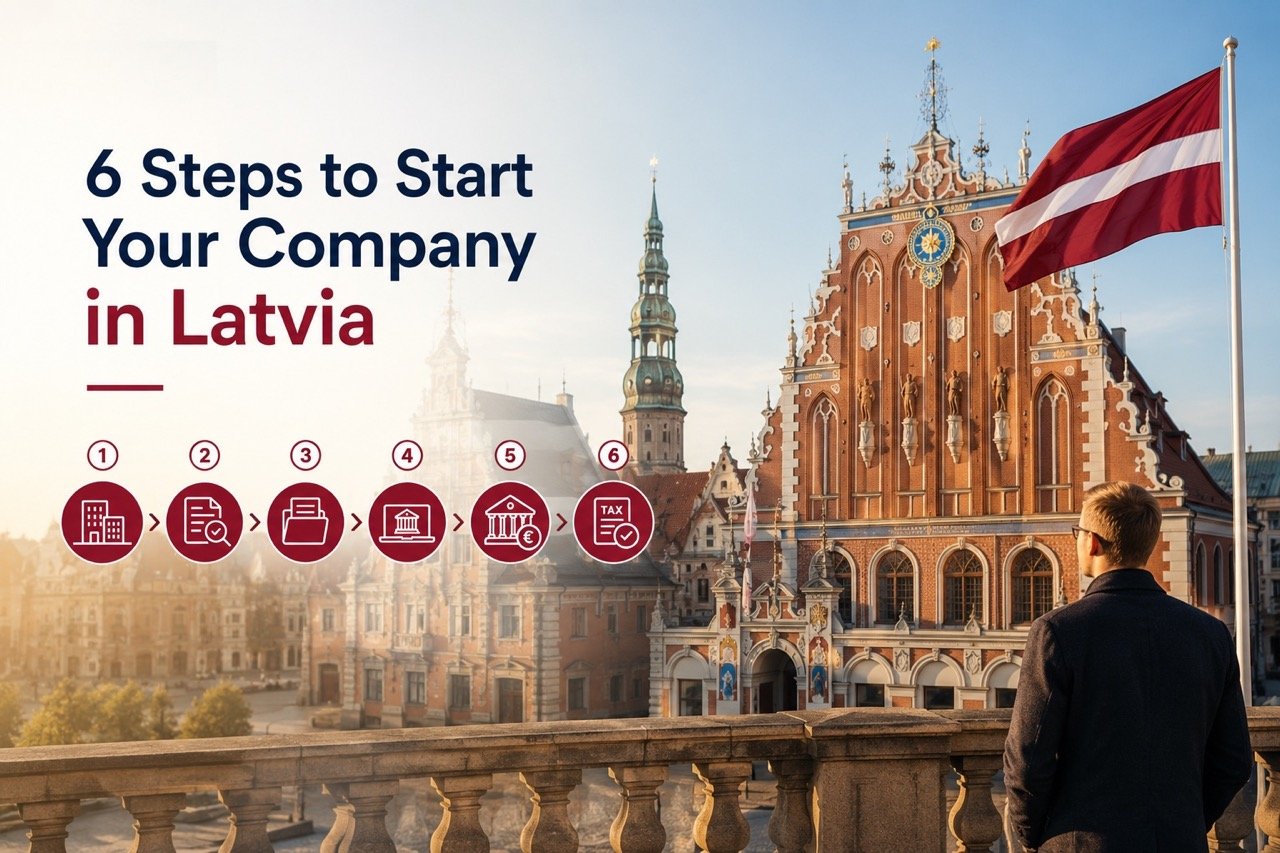
Step 1: Choose a Business Structure
Most foreign entrepreneurs choose an SIA because of its flexibility and liability protection.
Step 2: Reserve a Company Name
The proposed company name must be checked and approved before registration.
Step 3: Prepare Incorporation Documents
Typical registration documents include:
- Articles of Association
- Shareholder details
- Director information
- Registered office address
- Share capital confirmation
Foreign founders may also need identification documents and additional compliance verification depending on the company structure.
Step 4: Register the Company
The application is submitted to the Latvian Register of Enterprises.
Depending on the structure and documentation, registration can usually be completed within several business days.
Step 5: Open a Business Bank Account
After incorporation, entrepreneurs may open a corporate bank account or use licensed fintech payment institutions for international transactions and multi-currency operations.
Step 6: Register for Taxes
VAT registration may be required depending on business activity and annual turnover.
Companies hiring employees in Latvia must also comply with payroll tax and social contribution regulations.
Can Foreigners Open a Company in Latvia?
Yes. Foreign entrepreneurs and international companies can fully own and manage a Latvian company.
Latvia remains attractive for non-resident founders because:
- Company ownership is open to foreigners
- Remote registration may be possible
- EU market access is available
- Business regulations are transparent
- International banking and fintech solutions are accessible
Many entrepreneurs work with professional company formation providers to simplify registration, compliance, and accounting procedures.
Corporate Taxes in Latvia
Latvia is known for having one of the more business-friendly corporate tax systems in Europe. The country operates a taxation model similar to Estonia, where corporate income tax is generally paid only when profits are distributed.
This structure is particularly attractive for startups, e-commerce businesses, consulting firms, and growing international companies that prefer to reinvest earnings instead of distributing dividends.
Corporate Income Tax (CIT)
Under the standard Latvian corporate tax regime:
- 0% corporate tax applies to retained and reinvested profits
- 20% corporate income tax applies to distributed profits
This means that as long as profits remain inside the company and are used for business development, expansion, marketing, hiring, or operational growth, corporate income tax is generally deferred.
In practice, Latvian companies pay corporate tax mainly when:
- Dividends are distributed to shareholders
- Profits are treated as deemed distributions
- Certain non-business expenses are incurred
How Undistributed Profits Work
One of the key advantages of the Latvian tax system is the treatment of undistributed profits.
For example:
- A company earns EUR 100,000 profit
- The company reinvests the entire amount into operations
- No corporate income tax is generally payable at that stage
However, if the company later distributes profits as dividends, corporate tax becomes payable.
Under the standard regime, Latvia applies the so-called 20/80 formula:
- If shareholders receive EUR 80,000 in dividends
- The company pays EUR 20,000 corporate tax
- The total gross distributed amount becomes EUR 100,000
This model is one of the main reasons why Latvia is often compared to Estonia for tax-efficient business structuring.
Value Added Tax (VAT)
The standard VAT rate in Latvia is:
- 21% standard VAT rate
- Reduced VAT rates may apply to certain goods and services
Businesses are generally required to register for VAT once their annual taxable turnover exceeds the local VAT threshold.
VAT registration may also become mandatory earlier for:
- Cross-border EU transactions
- E-commerce businesses
- Digital services
- Import/export activities
Companies trading internationally often register for VAT from the beginning of operations to simplify cooperation with EU clients and suppliers.
Payroll Taxes and Minimum Salary
Companies employing staff in Latvia must comply with payroll tax and social contribution regulations.
Employers are generally responsible for:
- Personal income tax withholding
- Social security contributions
- Salary reporting obligations
- Employee registration requirements
Latvia also applies statutory minimum salary requirements, which employers must respect when hiring local employees.
For foreign-owned companies, it is important to maintain proper payroll accounting and employment compliance, especially when directors or founders receive salaries from the company.
Professional accounting support is strongly recommended to ensure compliance with Latvian tax and labour regulations.
Business Banking in Latvia
Opening a business bank account is one of the most important steps after company registration.
Latvia offers access to both traditional corporate banking institutions and modern European fintech solutions.
Latvian Corporate Banks
Entrepreneurs commonly use traditional Latvian banks such as:
- Swedbank
- SEB Bank
- Citadele Bank
- Luminor
Traditional banks may request:
- Detailed business activity descriptions
- Source of funds documentation
- Customer contracts
- Information about business partners
- Proof of operational activities
- Information regarding beneficial owners
International companies may undergo enhanced compliance and KYC verification procedures.
European Fintech Solutions
Many entrepreneurs also use licensed European fintech platforms for international transactions and multi-currency operations, including:
- Revolut
- Wise
- Paysera
- Payoneer
- SwissFx
Fintech solutions are particularly popular among:
- E-commerce businesses
- Consulting companies
- Freelancers
- Digital service providers
- International trading businesses
Compared to traditional banks, fintech onboarding procedures are often faster and more flexible for international entrepreneurs.
However, approval rates usually depend on:
- Transparent company structure
- Clear business model
- Proper documentation
- Low-risk business activity
- Compliance readiness
Businesses operating in regulated or high-risk industries may face additional banking verification procedures.
Accounting and Compliance Requirements
All Latvian companies are required to maintain proper accounting records and comply with local reporting obligations.
Key compliance requirements include:
- Annual financial statements
- Corporate tax reporting
- VAT declarations
- Payroll reporting
- Bookkeeping and accounting records
Working with local accountants can help businesses avoid penalties and maintain smooth operations.
Cost of Company Formation in Latvia
The total cost of company registration in Latvia depends on several factors, including:
- Government registration fees
- Legal and consulting support
- Share capital structure
- Accounting setup
- Virtual office or legal address services
- Banking assistance
Additional costs may include:
- Notary fees
- Translation services
- Compliance documentation
- Ongoing accounting services
Entrepreneurs should also consider ongoing annual compliance and accounting costs after incorporation.
How Long Does Company Registration Take?
In many cases, company registration in Latvia can be completed within a few business days.
The timeline depends on:
- Document preparation
- Shareholder structure
- Registration method
- Banking compliance procedures
- Remote verification requirements
International founders may require additional verification checks depending on the jurisdiction involved.
Industries Growing in Latvia
Several industries continue to attract foreign entrepreneurs and investors in Latvia.
Popular sectors include:
- IT and software development
- E-commerce
- Logistics and transportation
- Financial and fintech services
- Marketing and digital agencies
- Consulting businesses
- Import and export operations
Latvia’s geographic location makes it particularly attractive for businesses operating between Western Europe, Scandinavia, and Eastern Europe.
Common Mistakes During Company Formation
Entrepreneurs can avoid delays and compliance problems by preparing documentation properly from the beginning.
Common mistakes include:
- Choosing a company name that is already registered
- Submitting incomplete documentation
- Ignoring VAT obligations
- Using unclear business activity descriptions
- Delaying accounting setup
- Failing banking compliance checks
Professional guidance can significantly reduce registration risks and administrative delays.
Is Latvia Good Location for International Business?
Latvia continues to attract international entrepreneurs due to its combination of EU market access, competitive costs, and business-friendly taxation.
Key advantages include:
- EU legal framework
- Euro currency
- Strategic location
- Modern infrastructure
- Competitive operating costs
- Skilled multilingual workforce
- Flexible corporate taxation
- Growing startup ecosystem
Many international founders view Latvia as a practical alternative to Estonia and other European jurisdictions for launching or expanding their businesses.
Latvia…Latvia and once again Latvia….
Latvia remains one of the more attractive European jurisdictions for entrepreneurs seeking efficient company formation, transparent regulation, and access to the European market.
The country combines relatively low operating costs with a modern business environment, EU legal protection, and a corporate tax system designed to support reinvestment and growth.
Whether you are launching a startup, opening a consulting company, expanding an e-commerce business, or establishing an international trading structure, Latvia offers a practical and internationally respected business environment.
With proper planning, professional accounting support, and expert guidance, entrepreneurs can establish and operate a Latvian company efficiently while maintaining long-term compliance and scalability within the European market.
Need help with your next business step?
Book a focused 3-hour consultation with Eesti Consulting for €100.
Book a 3-hour consultation — €100