
Trademark Risk Assessment: What to Do Before Submission
Before filing, a Trademark Risk Assessment helps you check whether a proposed name may conflict with an earlier brand, product or business name. It gives you a clearer basis for deciding what to investigate before an application is submitted.
Not sure whether your proposed name is safe to file?
Order a Trademark Risk Assessment for €199. We review the proposed mark, relevant earlier rights and the planned goods and services, then outline practical next steps.
Filing it as a trademark is a separate decision: an application can be distinctive in principle and still create a serious conflict with an earlier brand, product or business name. A careful pre-filing review helps you decide whether to apply, narrow the goods and services, pause for more research or choose a different name.
This guide sets out a practical checklist for businesses preparing an EU or national trademark application. It is general information, not a legal opinion or a guarantee that a mark will be registered.
What does a Trademark Risk Assessment cover?
A Trademark Risk Assessment reviews the proposed mark alongside relevant earlier rights. Depending on the search scope, it can compare identical and similar names, spelling, sound and meaning; check the record owner and status; and consider the territory and goods and services involved.
A useful trademark risk assessment also explains how close results may affect the planned business. It can help identify whether to proceed to a more detailed professional review, investigate a result, narrow the goods and services or consider a more distinctive name. The assessment supports a filing decision; it does not guarantee registration or confirm that a name is free to use.
Keep the search date, databases and variations checked, important results and unresolved questions with the report. This gives your team a practical record of the pre-filing review.
1. Decide what the mark should protect
Start by identifying the sign you actually use or plan to use: a word, logo, slogan, or a combination. If the name is the core brand, assess the word itself before relying on a logo. A distinctive visual design does not automatically remove the risk created by an identical or similar brand name.
Also decide where protection matters. An EU trade mark is intended to cover the European Union as a whole; a national filing is narrower. The right territory depends on your customers, planned launch markets, distributors and realistic expansion plans. EUIPO’s guide to preparing an EU trade mark application explains the main decisions to make before filing.
2. Check that the applicant and ownership are correct
Confirm the exact legal name and address of the applicant, the entity that will own the brand, and the relationship between that entity and any founders or group companies. A mismatch can complicate later assignments, licensing, renewals or enforcement. Verify company details against current records before submitting the application.
3. Search beyond exact spelling
Search the exact word, but do not stop there. Look for close spellings, likely typos, similar sounds, abbreviations, translations and visually similar logos. Compare the overall impression of each result rather than checking only whether the letters match exactly.
For EU-level screening, use EUIPO’s availability guidance and TMview search route. The Estonian Patent Office explains how earlier rights can create conflicts and points applicants to the relevant national and EU databases. For broader screening, the WIPO Global Brand Database searches multiple national, regional and international collections.
A database search is a starting point, not a clearance certificate. Records can be incomplete, delayed or difficult to interpret; a mark may also be used in the market without appearing in the database you checked. Review company names, domains, app stores, product listings and relevant online use as well.
4. Compare the businesses behind similar marks
Trademark risk is not decided by the class number alone. Consider the actual goods and services, their purpose, customers, sales channels and how closely the products compete or complement one another. Two businesses can be relevant to each other even if their descriptions use different wording or sit in different classes.
For example, a short name for a downloadable app may raise a different level of concern when an earlier identical name is already used for a closely related digital service. That can create practical risks for launch, search visibility, app-store discovery and customer recognition even while the register position still needs to be confirmed.
5. Define a focused goods-and-services list
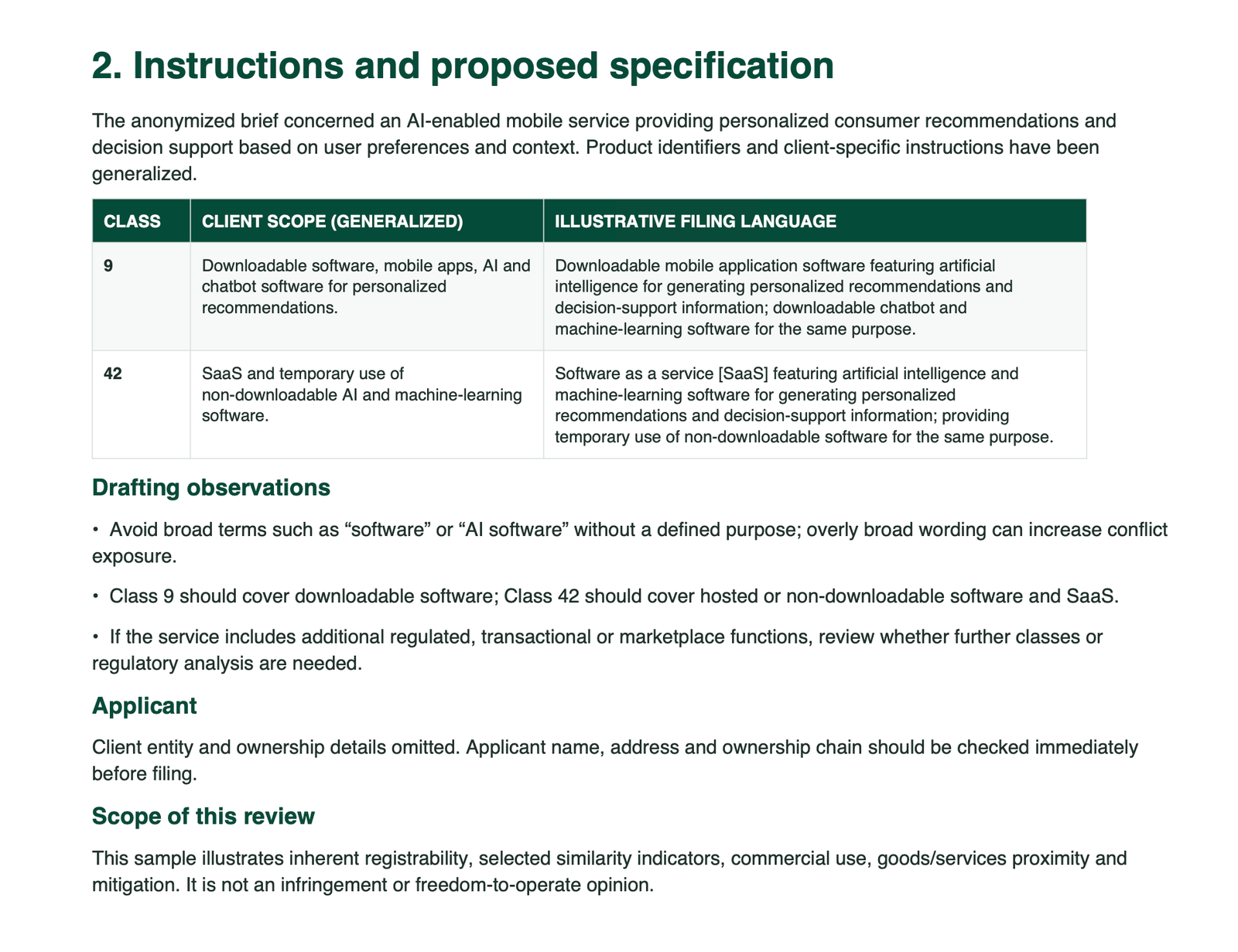
Write down what you sell now and what you genuinely expect to offer under the mark. Separate downloadable products from hosted services where relevant. For example, downloadable software is commonly considered under Class 9, while software-as-a-service may fall under Class 42; the precise wording depends on the product.
Use EUIPO’s Nice Classification guidance and its TMclass search tool to identify accepted terms. Avoid a vague list such as “software” if you can describe the product’s real function more precisely. EUIPO notes that the list of goods and services cannot be expanded after submission, so plan the scope carefully before filing.
Do not add classes simply to make the application look broader. Every extra class should match a real business need, and an overly broad description can increase overlap with earlier marks without providing useful protection.
6. Use the search results to choose a path
Organise the findings by sign similarity, goods-and-services proximity, territory, owner and current status. Then make a deliberate decision:
- Proceed to professional review: no close results appear in the relevant territory, or the identified marks are clearly remote in purpose and market.
- Pause and investigate: a similar mark appears in an adjacent field, the owner or status is unclear, or the specification needs closer comparison.
- Reconsider the name: an identical or highly similar mark is already associated with a closely overlapping product, users or sales channel.
Where the name itself is the main source of conflict, changing capitalization or adding a generic descriptor may do little to distinguish it. A more distinctive replacement name is often a cleaner route than investing further in a brand whose availability remains uncertain.
A search result raised a red flag?
Before you invest further in a name, get an independent pre-filing review of the proposed mark, relevant earlier rights and goods-and-services scope. Trademark Risk Assessment: €199.
7. Verify the live record before filing
For every important search result, confirm the official record: filing and priority dates, owner, current status, territory, goods-and-services wording, and any relevant proceedings. Check both registered marks and pending applications. If the result could affect your launch, have the comparison reviewed by a qualified trade mark professional before committing to the name.
8. Keep a short decision record
Save the search date, databases used, terms and variants searched, important results, the specification you selected and the reason for proceeding or changing course. This gives your team a clear record of what was checked and makes later brand decisions easier to explain.
Pre-filing checklist
- We have identified the exact sign and the owner that should apply.
- We have selected the territory that matches our market plans.
- We searched exact, similar-sounding and visually similar marks.
- We reviewed relevant products, services, customers and channels—not class numbers alone.
- Our goods-and-services wording describes a real, focused business scope.
- We checked official records and relevant market use, and recorded unresolved questions.
- We have a clear proceed, investigate or rename decision before public launch.
If you need help preparing an application after the availability review, see our EU trademark registration service. The right time to file is after the name, owner, territory and specification have been checked together.
Make your filing decision with more confidence
Order a focused Trademark Risk Assessment before submission. €199 for a structured review of the proposed mark and its pre-filing risks.
View a Trademark Risk Assessment sample
See an anonymised example of the format and topics covered in a pre-filing Trademark Risk Assessment. This sample is illustrative only; it is not an assessment of your mark and does not guarantee registration or freedom to use a name.
Important: This article is for general information only. Trademark registrability, earlier rights and opposition risk depend on the facts and the relevant territory. Database searches do not guarantee acceptance or freedom to use a brand. Obtain case-specific professional advice before filing where a material conflict may exist.