How to Set Up an MTÜ (NGO) in Estonia: A Simple Guide for Foreigners
Estonia is one of the most digital countries in the world and a popular destination for entrepreneurs, startups, and international organisations.
The country is home to more than 120,000 e-Residents from over 180 countries and has created globally known companies such as Skype, Wise, Bolt, Pipedrive, and Veriff. Estonia is known for its simple administration, digital services, and transparent legal system.
While many people know Estonia as a great place to start a company, fewer know that foreigners can also establish an MTÜ (Mittetulundusühing), which is the Estonian version of a non-profit organisation or NGO.
Whether you want to launch a charity, sports club, educational project, cultural organisation, professional association, or community initiative, an Estonian MTÜ can be an excellent solution.
In this guide, you’ll learn how to register an MTÜ in Estonia, what documents are required, how much it costs, how long it takes, and what options are available if you do not have Estonian e-Residency.
What Is an MTÜ?
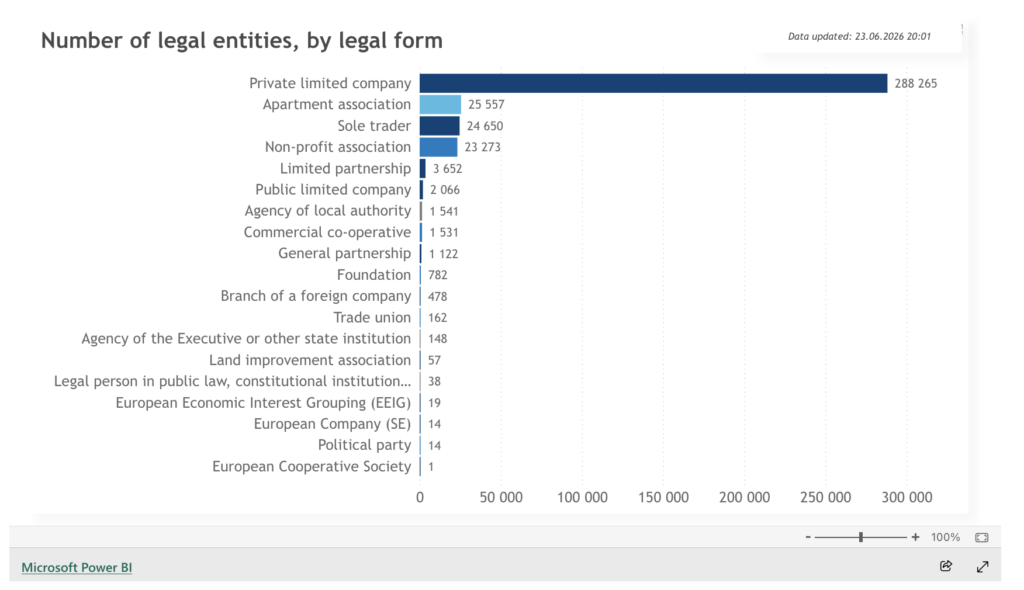
An MTÜ is a non-profit organisation. There are approximately 23,000 non-profit organisations registered in Estonia, compared to 288,265 private limited companies (OÜs).
Unlike a company, it is not created to generate profits for owners or shareholders. Any income earned by the organisation must be used to support its activities and goals.
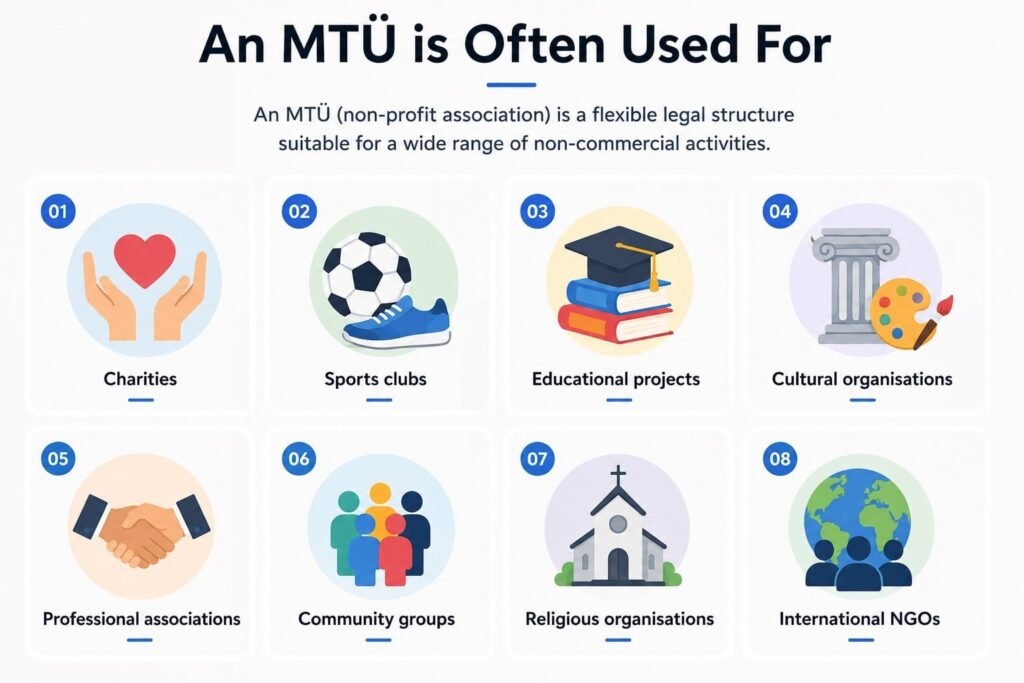
An MTÜ – non profit organization – is often used for:
✔ Charities, Sports clubs, Educational projects, Cultural organisations, Professional associations, Community groups, Religious organisations, International NGOs
Imagine three friends who want to make a positive impact across Europe. 🇩🇪 Anna is a teacher from Germany, 🇵🇱 Marek is an IT specialist from Poland, and 🇪🇸 Sofia is a social worker from Spain. Together, they decide to create a non-profit organisation that provides free digital skills training to disadvantaged young people.
Their project includes organising workshops, partnering with schools and local communities, applying for European grants, and accepting donations from private sponsors. They also plan to hire trainers and cooperate with volunteers in several countries.
Instead of setting up a commercial company, they choose to establish an Estonian MTÜ. The legal structure perfectly matches their non-profit goals and provides a recognised European legal entity for their activities.
None of the founders live in Estonia, and they do not have Estonian e-Residency. Fortunately, this is not a problem. They authorise a representative through a Power of Attorney, who completes the registration process on their behalf.
Within a short period, their MTÜ is officially registered in Estonia. The organisation can now sign contracts, receive grants and donations, employ staff, cooperate with international partners, and manage projects across Europe.
An MTÜ can receive donations, apply for grants, hire employees, sign contracts, and own assets.
MTÜ vs OÜ: What’s the Difference?
| Feature | OÜ (Private Limited Company) | MTÜ (Non-Profit Association) |
|---|---|---|
| Purpose | Conducting business and generating profit | Non-profit activities and pursuing a common interest |
| Profit Distribution | Allowed (dividends can be paid to shareholders) | Not allowed; profits must be reinvested into the organisation’s objectives |
| Owners / Members | Shareholders | Members |
| Minimum Founders | 1 | 2 |
| Management Body | Management Board | Management Board |
| Main Goal | Commercial activities | Social, cultural, educational, charitable, sports, or other non-commercial activities |
| Taxation | Subject to corporate taxation rules | Tax benefits may apply depending on activities and status |
| Popularity in Estonia | Approximately 288,265 registered entities | Approximately 23,000 registered entities |
| Suitable For | Businesses, startups, consulting, e-commerce, investments | Clubs, associations, charities, community projects, NGOs |
Who Can Register an MTÜ?
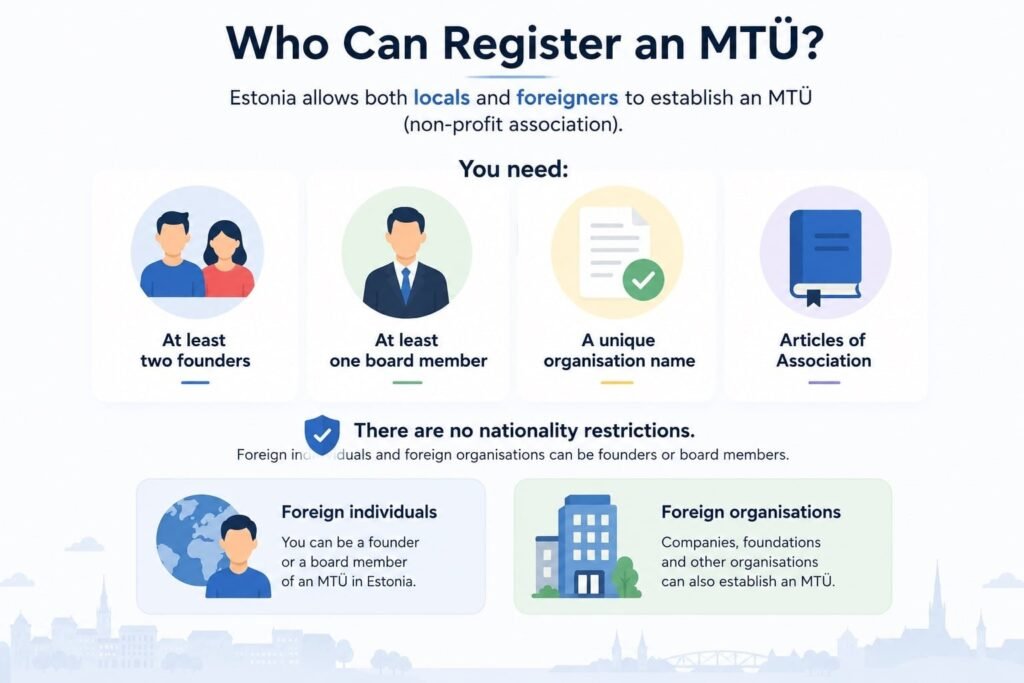
Estonia allows both locals and foreigners to establish an MTÜ.
You need:
✔ At least two founders
✔ At least one board member
✔ A unique organisation name
✔ Articles of Association
There are no nationality restrictions.
Foreign individuals and foreign organisations can be founders or board members.
How Much Does It Cost?
The official Estonian state fee for MTÜ registration is currently EUR 30.
Additional costs may apply if you need:
✔ Notarial services
✔ Apostille or legalisation
✔ Certified translations
✔ Professional registration assistance

How Long Does Registration Take?
Estonia is known for fast registration procedures.
In most cases, an MTÜ is registered within approximately five business days after the application has been submitted.
The process may take longer if documents need to be notarised or sent internationally.
How to Register an MTÜ in Estonia
The registration process is relatively simple.
✔ Choose a Name
Your organisation must have a unique name that is not already registered in Estonia.
✔ Prepare the Articles of Association
This document explains the purpose of the organisation, membership rules, management structure, and decision-making procedures.
✔ Appoint the Board
Every MTÜ needs at least one board member who will represent the organisation.
✔ Submit the Application
The registration documents are submitted to the Estonian Business Register.
✔ Pay the State Fee
The registration fee must be paid before the application can be processed.
✔ Receive Registration Confirmation
Once approved, your MTÜ receives its registration number and becomes an official legal entity.
What If I Don’t Have e-Residency?
Many people think they need Estonian e-Residency to establish an MTÜ.
This is not true.
You can register an MTÜ even if you:
✔ Do not have e-Residency
✔ Do not have an Estonian ID card
✔ Have never visited Estonia
✔ Live outside the European Union
While e-Residency can make some procedures easier, it is not required.
Can I Register an MTÜ Remotely?
Yes.
If you cannot travel to Estonia, you can usually establish an MTÜ through a Power of Attorney (PoA).
This means you authorise a representative to complete the registration process on your behalf.
The process usually includes:
✔ Preparing the incorporation documents
✔ Signing a Power of Attorney before a local notary
✔ Obtaining an apostille if required
✔ Sending the documents to Estonia
✔ Registration by an authorised representative
This option is very popular among international founders.
Advantages of an Estonian MTÜ
There are many reasons why foreign founders choose Estonia.
✔ European Union Legal Entity
Your organisation operates within an EU member state.
✔ Remote Registration
You can often register an MTÜ without travelling to Estonia.
✔ Open to Foreigners
There are no nationality restrictions for founders.
✔ Low Registration Costs
The state fee is only EUR 30.
✔ Fast Registration
Most registrations are completed within a few business days.
✔ Modern Digital Environment
Estonia is one of the world’s most advanced digital societies.
✔ Good International Reputation
Estonian legal entities are respected throughout Europe and internationally.
✔ Flexible Structure
An MTÜ can receive donations, hire staff, own property, and apply for grants.
Does an MTÜ Pay Taxes?
An MTÜ is not automatically exempt from taxes.
Depending on its activities, it may need to pay:
✔ Employment taxes
✔ VAT
✔ Taxes on certain benefits
✔ Taxes related to commercial activities
Many organisations use professional accounting services to ensure compliance with Estonian regulations.
Is an Estonian MTÜ Right for You?
An MTÜ may be the right choice if you want to establish:
✔ A charity
✔ An NGO
✔ A sports club
✔ A cultural association
✔ An educational organisation
✔ A community project
✔ A professional network
✔ An international non-profit initiative
If your goal is to run a commercial business and earn profits, an OÜ is usually a better option.
Final Thoughts
Estonia offers one of the simplest and most efficient systems in Europe for establishing a non-profit organisation.
With a state registration fee of only EUR 30, a registration time of around five business days, and the possibility of remote incorporation through a Power of Attorney, foreign founders can establish an Estonian MTÜ quickly and efficiently.
Most importantly, you do not need Estonian e-Residency to get started. Even if you have never visited Estonia, it is possible to create and manage an Estonian NGO while benefiting from the country’s modern digital infrastructure and strong international reputation.